

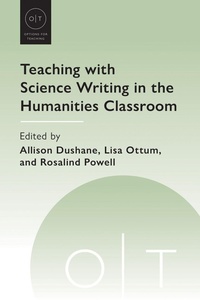
Teaching with Science Writing in the Humanities Classroom
Published on 20. February 2026
Book
Hardback
294 pages
978-1-60329-715-8 (ISBN)
Description
Options for teaching science writing in humanities courses
Science writing is an expansive genre that invites collaborations between the humanities and science-not as separate endeavors but as mutually constitutive practices. Engaging with long-standing scholarly conversations in science and technology studies, literature and science, rhetoric, and science communication, the essays in this volume showcase the value of science writing as a mode of cultural analysis, as an object of close reading, and as a foundation for justice-oriented pedagogies. Readers will find practical strategies for teaching science writing in literature, writing, and interdisciplinary classrooms, from general education courses to electives to graduate courses.
This volume also contains discussion of the following authors and works: Adelard of Bath, Quaestiones naturales (Natural Questions); Albertus Magnus, On Animals; Amy Matilda Cassey; Geoffrey Chaucer, Parliament of Fowls; Samuel Taylor Coleridge, The Rime of the Ancient Mariner; Charles Darwin; Lorraine Daston and Peter Galison, Objectivity; Emily Dickinson; Amitav Ghosh, The Hungry Tide; Ibn al-Nafis, Theologus Autodidactus (Self-Taught Theologian); Robin Wall Kimmerer, Braiding Sweetgrass; Jamaica Kincaid, My Garden (Book); Thomas S. Kuhn, The Structure of Scientific Revolutions; Bruno Latour; Marie de France, "Bisclavret" ("The Werewolf"); Aimee Nezhukumatathil, World of Wonders; Philosophical Transactions of the Royal Society; Britt Rusert, Fugitive Science; C. P. Snow, The Two Cultures; Bram Stoker, Dracula; Emile Zola, L'Assommoir.
Science writing is an expansive genre that invites collaborations between the humanities and science-not as separate endeavors but as mutually constitutive practices. Engaging with long-standing scholarly conversations in science and technology studies, literature and science, rhetoric, and science communication, the essays in this volume showcase the value of science writing as a mode of cultural analysis, as an object of close reading, and as a foundation for justice-oriented pedagogies. Readers will find practical strategies for teaching science writing in literature, writing, and interdisciplinary classrooms, from general education courses to electives to graduate courses.
This volume also contains discussion of the following authors and works: Adelard of Bath, Quaestiones naturales (Natural Questions); Albertus Magnus, On Animals; Amy Matilda Cassey; Geoffrey Chaucer, Parliament of Fowls; Samuel Taylor Coleridge, The Rime of the Ancient Mariner; Charles Darwin; Lorraine Daston and Peter Galison, Objectivity; Emily Dickinson; Amitav Ghosh, The Hungry Tide; Ibn al-Nafis, Theologus Autodidactus (Self-Taught Theologian); Robin Wall Kimmerer, Braiding Sweetgrass; Jamaica Kincaid, My Garden (Book); Thomas S. Kuhn, The Structure of Scientific Revolutions; Bruno Latour; Marie de France, "Bisclavret" ("The Werewolf"); Aimee Nezhukumatathil, World of Wonders; Philosophical Transactions of the Royal Society; Britt Rusert, Fugitive Science; C. P. Snow, The Two Cultures; Bram Stoker, Dracula; Emile Zola, L'Assommoir.
More details
Series
Language
English
Place of publication
New York
United States
Target group
Professional and scholarly
Product notice
sewn/stitched
Cloth over boards
Dimensions
Height: 232 mm
Width: 152 mm
Thickness: 28 mm
Weight
544 gr
ISBN-13
978-1-60329-715-8 (9781603297158)
Copyright in bibliographic data and cover images is held by Nielsen Book Services Limited or by the publishers or by their respective licensors: all rights reserved.
Schweitzer Classification
Content
Introduction: Science Literacy and Science Writing: A Call to Humanists, by Allison Dushane, Lisa Ottum, and Rosalind Powell
Part I: Historical Science Writing
Before Objectivity: Pluralizing Science with Premodern Knowledge, by Aylin Malcolm
Epistolary Science: The Early Philosophical Transactions, by Rosalind Powell
Less Than Nothing in The Rime of the Ancient Mariner: Literature, Mathematics, Realism, and Anti-Realism, by Aaron Ottinger
The Vampire We Need: Bram Stoker's Dracula and the Victorian Science of the Mind, by Melissa Dickson
Botany in the American Literature Classroom: Emily Dickinson and Amy Matilda Cassey, by Julia Dauer
Experiments with the Science of Alcoholism, by Susanna Lee
Part II: General Education and Writing Courses
Digital Science Communication in Rhetoric and Writing Courses, by Laura McGrath
Science, Stories, and Academic Ecology, by Marissa Kopp
Environmental Science Communication as Storytelling, by Luke Rodewald
Embracing Subjectivity: Humanizing and Historicizing Science Writing in the Post-Pandemic Classroom, by Scott C. Thompson
Science Writing as a General Education Linchpin, by Matthew Newcomb
Part III: Science Writing for Change
Anti-Racist Science Writing: Environmental Justice and Energy Futures in the Interdisciplinary Humanities Classroom, by Davy Knittle, Annesha Manocha, and Arielle Rivera
Women's Historical Ecomedia and Environmental Advocacy, by Bridgitte Barclay
Jamaica Kincaid's Anti-Colonial, Black, Cross-Species, Embodied, Feminist Onto-Epistemologies, by Nicole M. Merola
Multispecies Relationships: Nonhumans and Knowledge Production in Science Writing, by Nathaniel Otjen
Part IV: Courses and Assignments
The Critic Afield: Field Guides as Tools for Interdisciplinary Close Reading, by John MacNeill Miller
Teaching the Invisible: Science, Labor, and Pedagogy, by Xan Sarah Chacko
Teaching with the Hive: Beekeeping as a Scientific and Creative Practice, by James Barilla
Sex, Gender, and the Short Story, by Nancy Easterlin
Science Writing and the Art of Interpretation, by Joshua DiCaglio
Taming a Two-Headed Beast: Integrating Science, Literature, and the Living World, by Bryan Shawn Wang and Sandy Feinstein
Part V: Resources
Notes on Contributors
Part I: Historical Science Writing
Before Objectivity: Pluralizing Science with Premodern Knowledge, by Aylin Malcolm
Epistolary Science: The Early Philosophical Transactions, by Rosalind Powell
Less Than Nothing in The Rime of the Ancient Mariner: Literature, Mathematics, Realism, and Anti-Realism, by Aaron Ottinger
The Vampire We Need: Bram Stoker's Dracula and the Victorian Science of the Mind, by Melissa Dickson
Botany in the American Literature Classroom: Emily Dickinson and Amy Matilda Cassey, by Julia Dauer
Experiments with the Science of Alcoholism, by Susanna Lee
Part II: General Education and Writing Courses
Digital Science Communication in Rhetoric and Writing Courses, by Laura McGrath
Science, Stories, and Academic Ecology, by Marissa Kopp
Environmental Science Communication as Storytelling, by Luke Rodewald
Embracing Subjectivity: Humanizing and Historicizing Science Writing in the Post-Pandemic Classroom, by Scott C. Thompson
Science Writing as a General Education Linchpin, by Matthew Newcomb
Part III: Science Writing for Change
Anti-Racist Science Writing: Environmental Justice and Energy Futures in the Interdisciplinary Humanities Classroom, by Davy Knittle, Annesha Manocha, and Arielle Rivera
Women's Historical Ecomedia and Environmental Advocacy, by Bridgitte Barclay
Jamaica Kincaid's Anti-Colonial, Black, Cross-Species, Embodied, Feminist Onto-Epistemologies, by Nicole M. Merola
Multispecies Relationships: Nonhumans and Knowledge Production in Science Writing, by Nathaniel Otjen
Part IV: Courses and Assignments
The Critic Afield: Field Guides as Tools for Interdisciplinary Close Reading, by John MacNeill Miller
Teaching the Invisible: Science, Labor, and Pedagogy, by Xan Sarah Chacko
Teaching with the Hive: Beekeeping as a Scientific and Creative Practice, by James Barilla
Sex, Gender, and the Short Story, by Nancy Easterlin
Science Writing and the Art of Interpretation, by Joshua DiCaglio
Taming a Two-Headed Beast: Integrating Science, Literature, and the Living World, by Bryan Shawn Wang and Sandy Feinstein
Part V: Resources
Notes on Contributors