

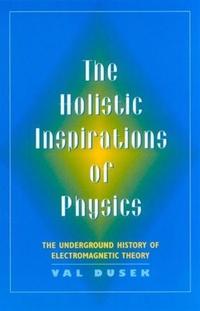
The Holistic Inspiration of Physics
The Underground History of Electromagnetic Theory
Published on 1. August 1999
Book
Paperback/Softback
298 pages
978-0-8135-2635-5 (ISBN)
Description
While many books have claimed parallels between modern physics and Eastern philosophy, none have dealt with the historical influences of both Chinese traditional thought and non-mechanistic, holistic western thought on the philosophies of the scientists who developed electromagnetic field theory. In The Holistic Inspirations of Physics, R. Valentine Dusek asks: to what extent is classical field theory a product of organic and holistic philosophies and frameworks?
Electromagnetic theory has been greatly influenced by holistic worldviews, Dusek posits, and he highlights three alternative scientific systems that made the development of electromagnetic theory possible: medieval Chinese science, Western Renaissance occultism, and the German romantic traditions. He situates these "alternative" approaches in their social context and background, and traces their connection with components of "accepted" physical science in relation to a number of social movements and philosophical theories.
Readers will learn of specific contributions made by these alternative traditions, such as the Chinese inventing the compass and discovering the earth's magnetic field and magnetic declination. Western alchemical ideas of active forces and "occult" influences contributed to Newton's theory of gravitation force as action at a distance, rather as a result of purely mechanical collisions and contact action.
Dusek also describes the extent to which women's culture supplied (often without credit) the philosophical background ideas that were absorbed into mainstream field theory.
Electromagnetic theory has been greatly influenced by holistic worldviews, Dusek posits, and he highlights three alternative scientific systems that made the development of electromagnetic theory possible: medieval Chinese science, Western Renaissance occultism, and the German romantic traditions. He situates these "alternative" approaches in their social context and background, and traces their connection with components of "accepted" physical science in relation to a number of social movements and philosophical theories.
Readers will learn of specific contributions made by these alternative traditions, such as the Chinese inventing the compass and discovering the earth's magnetic field and magnetic declination. Western alchemical ideas of active forces and "occult" influences contributed to Newton's theory of gravitation force as action at a distance, rather as a result of purely mechanical collisions and contact action.
Dusek also describes the extent to which women's culture supplied (often without credit) the philosophical background ideas that were absorbed into mainstream field theory.
Reviews / Votes
DusekAEs book is an intellectual feast where we find magic, witches, mysterious correlations, trigrams of the I Ching, forces and fields, peasants and Platonists, wild nature, primitives and sophisticates, and how they hang together. - Robert S. Cohen (Professor of Physics and Philosophy Emeritus, Boston University)More details
Language
English
Place of publication
New Brunswick NJ
United States
Target group
College/higher education
Professional and scholarly
Product notice
Paperback (trade)
Unsewn / adhesive bound
Dimensions
Height: 236 mm
Width: 158 mm
Thickness: 23 mm
Weight
562 gr
ISBN-13
978-0-8135-2635-5 (9780813526355)
Copyright in bibliographic data and cover images is held by Nielsen Book Services Limited or by the publishers or by their respective licensors: all rights reserved.
Schweitzer Classification
Person
Val Dusek teaches philosophy at the University of New Hampshire. He has written many articles on philosophy and science.
Content
Preface and Acknowledgments1 Introduction: Historical Undergrounds, Holistic Theories, and Classical Physics
PART I The Contributions of Chinese Science and Technology
2 Discovery of the Compass and Magnetic Declination
3 Major Movements of Chinese Thought
4 Social Background of Organismic Thought: "China" in Three Classic Sociologies
5 Interlude: Peter the Wayfarer and the Western Reception of the Compass
PART II Renaissance Occultism
6 Occultism and the Rise of Early Modern Science
7 Occultism and the Social Background of Science: Peasants, Artisans, and Women
8 Gilbert and Early Modern Theories of the Magnet
9 Kepler and the Magnetic Force Model of the Solar System
10 Newton: Alchemy and Active Principles
11 Interlude: Leibniz and China
PART III Romantic Philosophy of Nature and Electromagnetism
12 Philosophical Background of Romantic Science
13 Social Background to Romanticism: Revolution and Women
14 Schelling's Romantic Philosophy of Nature
15 Coleridge: Poet of Nature
16 Orsted: Romanticism, Nature Philosophy, and the Discovery of Electromagnetism
17 Davy, Faraday, and Field Theory
18 Maxwell, Field Theory, and Mechanical Models
19 Conclusion: Metaphysics of Science--Creation and Justification
Notes
Selected Bibliography
Index
PART I The Contributions of Chinese Science and Technology
2 Discovery of the Compass and Magnetic Declination
3 Major Movements of Chinese Thought
4 Social Background of Organismic Thought: "China" in Three Classic Sociologies
5 Interlude: Peter the Wayfarer and the Western Reception of the Compass
PART II Renaissance Occultism
6 Occultism and the Rise of Early Modern Science
7 Occultism and the Social Background of Science: Peasants, Artisans, and Women
8 Gilbert and Early Modern Theories of the Magnet
9 Kepler and the Magnetic Force Model of the Solar System
10 Newton: Alchemy and Active Principles
11 Interlude: Leibniz and China
PART III Romantic Philosophy of Nature and Electromagnetism
12 Philosophical Background of Romantic Science
13 Social Background to Romanticism: Revolution and Women
14 Schelling's Romantic Philosophy of Nature
15 Coleridge: Poet of Nature
16 Orsted: Romanticism, Nature Philosophy, and the Discovery of Electromagnetism
17 Davy, Faraday, and Field Theory
18 Maxwell, Field Theory, and Mechanical Models
19 Conclusion: Metaphysics of Science--Creation and Justification
Notes
Selected Bibliography
Index