

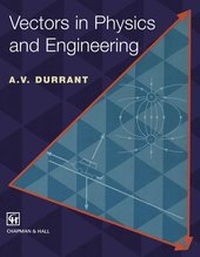
Vectors in Physics and Engineering
Published on 17. September 2011
Book
Paperback/Softback
300 pages
978-1-4613-8068-9 (ISBN)
Description
This book is intended as a self-study text for students following courses in science and engineering where vectors are used. The material covered and the level of treatment should be sufficient to provide the vector algebra and vector calculus skills required for most honours courses in mechanics, electromagnetism, fluid mechanics, aerodynamics, applied mathematics and mathematical modelling. It is assumed that the student begins with minimal (school-level) skills in algebra, geometry and calculus and has no previous knowledge of vectors. There are brief reviews at appropriate points in the text on elementary mathematical topics: the definition of a function, the derivative of a function, the definite integral and partial differentiation. The text is characterised by short two or three page sections where new concepts, terminologies and skills are introduced, followed by detailed summaries and consolidation in the form of Examples and Problems that test the objectives listed at the beginning of each chapter. Each Example is followed by a fully worked out solution, but the student is well advised to have a go at each Ex. ample before looking at the solution.
Many of the Examples and Problems are set in the context of mechanics and electromagnetism but no significant previous knowledge of these subjects is assumed. Bare answers to selected Problems are given at the back of the book. Full solutions to all Problems can be found on www at http://physics. open. ukl-avdurranlvectors. htrnl.
Many of the Examples and Problems are set in the context of mechanics and electromagnetism but no significant previous knowledge of these subjects is assumed. Bare answers to selected Problems are given at the back of the book. Full solutions to all Problems can be found on www at http://physics. open. ukl-avdurranlvectors. htrnl.
More details
Edition
Softcover reprint of the original 1st ed. 1996
Language
English
Place of publication
New York, NY
United States
Target group
College/higher education
Research
Product notice
Paperback (trade)
Illustrations
black & white illustrations
Dimensions
Height: 244 mm
Width: 189 mm
Thickness: 15 mm
Weight
579 gr
ISBN-13
978-1-4613-8068-9 (9781461380689)
DOI
10.1007/978-1-4613-0439-5
Copyright in bibliographic data and cover images is held by Nielsen Book Services Limited or by the publishers or by their respective licensors: all rights reserved.
Schweitzer Classification
Other editions
Additional editions
Alan Durrant
Vectors in Physics and Engineering
Book
09/1996
1st Edition
CRC Press
€111.59
Shipment within 10-20 days
Content
1 Vector algebra I: Scaling and adding vectors.- 1.1 Introduction to Scalars,Numbers and Vectors.- 1.1.1 Scalars and numbers.- 1.1.2 Introducing vectors.- 1.1.3 Displacements and arrows.- 1.1.4 Vector notation.- 1.2 Scaling Vectors and Unit Vectors.- 1.2.1 Scaling a vector or multiplication of a vector by a number.- 1.2.2 Unit vectors.- 1.3 Vector Addition - The Triangle Addition Rule.- 1.4 Linear Combinations of Vectors.- 1.5 Cartesian Vectors.- 1.5.1 Cartesian coordinates of a point - a review.- 1.5.2 Cartesian unit vectors and cartesian components of a vector.- 1.6 Magnitudes and Directions of Cartesian Vectors.- 1.7 Scaling and Adding Cartesian Vectors.- 1.8 Vectors in Science and Engineering.- 1.8.1 Definition of a vector and evidence for vector behaviour.- 1.8.2 Vector problems in science and engineering.- 2 Vector algebra II: Scalar products and vector products.- 2.1 The Scalar Product.- 2.1.1 Definition of the scalar product and projections.- 2.1.2 The scalar product in vector algebra.- 2.2 Cartesian form of the Scalar Product.- 2.3 The Angle Between Two Vectors.- 2.4 The Vector Product.- 2.4.1 Definition of the vector product.- 2.4.2 The vector product in vector algebra.- 2.5 Cartesian form of the Vector Product.- 2.6 Triple Products of Vectors.- 2.6.1 The scalar triple product.- 2.6.2 The vector triple product.- 2.7 Scalar and Vector Products in Science and Engineering.- 2.7.1 Background summary: Forces, torque and equilibrium.- 2.7.2 Background summary: Work and energy.- 2.7.3 Background summary: Energy and torque on dipoles in electric and magnetic fields.- 3 Time-dependent vectors.- 3.1 Introducing Vector Functions.- 3.1.1 Scalar functions - a review.- 3.1.2 Vector functions of time.- 3.2 Differentiating Vector Functions - Definitions of Velocity and Acceleration.- 3.2.1 Differentiation of a scalar function - a review.- 3.2.2 Differentiation of a vector function.- 3.2.3 Definitions of velocity and acceleration.- 3.3 Rules of Differentiation of Vector Functions.- 3.4 Rotational Motion - The Angular Velocity Vector.- 3.5 Rotating Vectors of Constant Magnitude.- 3.6 Application to Relative Motion and Inertial Forces.- 3.6.1 Relative translational motion and inertial forces.- 3.6.2 Relative rotational motion and inertial forces.- 4 Scalar and vector fields.- 4.1 Pictorial Representations of Fields.- 4.1.1 Scalar field contours.- 4.1.2 Vector field lines.- 4.2 Scalar Field Functions.- 4.2.1 Specifying scalar field functions.- 4.2.2 Cartesian scalar fields.- 4.2.3 Graphs and contours.- 4.3 Vector Field Functions.- 4.3.1 Specifying vector field functions.- 4.3.2 Cartesian vector fields.- 4.3.3 Equation of a field line.- 4.4 Polar Coordinate Systems.- 4.4.1 Symmetries and coordinate systems.- 4.4.2 Cylindrical polar coordinate systems.- 4.4.3 Spherical polar coordinate systems.- 4.5 Introducing Flux and Circulation.- 4.5.1 Flux of a vector field.- 4.5.2 Circulation of a vector field.- 5 Differentiating fields.- 5.1 Directional Derivatives and Partial Derivatives.- 5.2 Gradient of a Scalar Field.- 5.2.1 Introducing gradient.- 5.2.2 Calculating gradients.- 5.2.3 Gradient and physical law.- 5.3 Divergence of a Vector Field.- 5.3.1 Introducing divergence.- 5.3.2 Calculating divergence.- 5.3.3 Divergence and physical law.- 5.4 Curl of a Vector Field.- 5.4.1 Introducing curl.- 5.4.2 Calculating curl.- 5.4.3 Curl and physical law.- 5.5 The Vector Differential Operator "Del".- 5.5.1 Introducing differential operators.- 5.5.2 The "del" operator.- 5.5.3 The Laplacian operator.- 5.5.4 Vector-field identities.- 6 Integrating fields.- 6.1 Definite Integrals - A Review.- 6.2 Line Integrals.- 6.2.1 Defining the scalar line integral.- 6.2.2 Evaluating simple line integrals.- 6.3 Line Integrals Along Parameterised Curves.- 6.3.1 Parameterisation of a curve.- 6.3.2 A systematic technique for evaluating line integrals.- 6.4 Conservative Fields.- 6.5 Surface Integrals.- 6.5.1 Introducing surface integrals.- 6.5.2 Expressing surface integrals as double integrals and evaluating them.- 6.6 Stokes's Theorem.- 6.6.1 An integral form of curl.- 6.6.2 Deriving Stokes's theorem.- 6.6.3 Using Stokes's theorem.- 6.7 Volume Integrals.- 6.8 Gauss's Theorem (The Divergence Theorem).- Appendix A SI units and physical constants.- Appendix B Mathematical conventions and useful results.- Answers to selected Problems.