

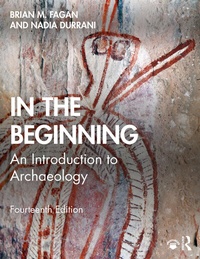
In the Beginning
An Introduction to Archaeology
14th Edition
Published on 14. April 2020
Book
Paperback/Softback
460 pages
978-1-138-72293-4 (ISBN)
Description
In the Beginning describes the basic methods and theoretical approaches of archaeology. This is a book about fundamental principles written in a clear, flowing style, with minimal use of technical jargon, which approaches archaeology from a global perspective.
Starting with a broad-based introduction to the field, this book surveys the highlights of archaeology's colorful history, then covers the basics of preservation, dating the past, and the context of archaeological finds. Descriptions of field surveys, including the latest remote-sensing methods, excavation, and artifact analysis lead into the study of ancient environments, landscapes and settlement patterns, and the people of the past. Two chapters cover cultural resource management, public archaeology, and the important role of archaeology in contemporary society. There is also a chapter on archaeology as a potential career. In the Beginning takes the reader on an evenly balanced journey through today's archaeology. This well-illustrated account, with its numerous boxes and sidebars, is laced with interesting, and sometimes entertaining, examples of archaeological research from all parts of the world.
This classic textbook of archaeological method and theory has been in print for nearly 50 years and is used in many countries around the world. It is aimed at introductory students in archaeology and anthropology taking survey courses on archaeology, as well as more advanced readers.
Starting with a broad-based introduction to the field, this book surveys the highlights of archaeology's colorful history, then covers the basics of preservation, dating the past, and the context of archaeological finds. Descriptions of field surveys, including the latest remote-sensing methods, excavation, and artifact analysis lead into the study of ancient environments, landscapes and settlement patterns, and the people of the past. Two chapters cover cultural resource management, public archaeology, and the important role of archaeology in contemporary society. There is also a chapter on archaeology as a potential career. In the Beginning takes the reader on an evenly balanced journey through today's archaeology. This well-illustrated account, with its numerous boxes and sidebars, is laced with interesting, and sometimes entertaining, examples of archaeological research from all parts of the world.
This classic textbook of archaeological method and theory has been in print for nearly 50 years and is used in many countries around the world. It is aimed at introductory students in archaeology and anthropology taking survey courses on archaeology, as well as more advanced readers.
Reviews / Votes
"In the Beginning offers an expansive yet accessible explanation of what archaeologists do. The experience of finding and excavating sites is revealed, and we learn the strategies and skills archaeologists employ to recover and interpret evidence. The book places archaeological thinking and practices in contemporary social contexts, and provides compelling guidance to readers intrigued by the subject."Peter Hiscock, University of Sydney, Australia
More details
Edition
14th edition
Language
English
Place of publication
London
United Kingdom
Publishing group
Taylor & Francis Ltd
Target group
College/higher education
Illustrations
283 farbige Abbildungen, 256 Farbfotos bzw. farbige Rasterbilder, 27 farbige Zeichnungen, 25 s/w Tabellen
25 Tables, black and white; 27 Line drawings, color; 256 Halftones, color; 283 Illustrations, color
Dimensions
Height: 217 mm
Width: 279 mm
Thickness: 25 mm
Weight
1546 gr
ISBN-13
978-1-138-72293-4 (9781138722934)
Copyright in bibliographic data and cover images is held by Nielsen Book Services Limited or by the publishers or by their respective licensors: all rights reserved.
Schweitzer Classification
Other editions
New editions
Book
02/2025
15th Edition
Routledge
€234.50
Shipment within 10-20 days
Additional editions
Book
05/2020
14th Edition
Routledge
€326.83
Article exhausted; check for reprint
Previous edition
Book
09/2013
13th Edition
Pearson
€245.12
Article exhausted; check for reprint
Persons
Brian M. Fagan is one of the world's leading writers about archaeology and an internationally recognized authority on world prehistory. He studied archaeology and anthropology at Pembroke College, Cambridge University, and then spent seven years in sub-Saharan Africa. Now a distinguished professor emeritus, from 1967 to 2013 he was a professor of anthropology at the University of California, Santa Barbara. Brian has written seven bestselling textbooks and numerous general books on archaeology, ancient climate change, and other topics.
Nadia Durrani has contributed to a wide range of archaeological publications and is the former editor of Britain's two bestselling archaeological magazines, Current Archaeology and Current World Archaeology. Over the years, she has authored and edited countless articles and books, including co-authoring a portfolio of books with Brian. Her background is in Arabian archaeology, and following a degree in archaeology and anthropology from Cambridge University, she took a PhD in southwest Arabian archaeology from University College, London. Nadia remains actively involved in Arabian studies and is on the board of the International Association for the Study of Arabia. She is also a founding member of the Great War Archaeology Group and a Fellow of the Society of Antiquaries.
Nadia Durrani has contributed to a wide range of archaeological publications and is the former editor of Britain's two bestselling archaeological magazines, Current Archaeology and Current World Archaeology. Over the years, she has authored and edited countless articles and books, including co-authoring a portfolio of books with Brian. Her background is in Arabian archaeology, and following a degree in archaeology and anthropology from Cambridge University, she took a PhD in southwest Arabian archaeology from University College, London. Nadia remains actively involved in Arabian studies and is on the board of the International Association for the Study of Arabia. She is also a founding member of the Great War Archaeology Group and a Fellow of the Society of Antiquaries.
Content
PART I BACKGROUND TO ARCHAEOLOGY; 1 Introducing Archaeology; 2 The Beginnings of Scientific Archaeology: Sixth Century B.C. to the 1950s; 3 The Many-Voiced Past: Archaeological Thought from the 1950s to Now; PART II THE BASICS; 4 Matrix and Preservation; 5 Doing Archaeological Research; 6 Culture, Data, and Context; 7 Dating the Past; PART III RECOVERING THE DATA; 8 They Sought It Here, They Sought It There: Finding the Past; 9 Excavation; PART IV ANALYZING THE PAST: ARTIFACTS AND TECHNOLOGY; 10 Classifying Artifacts; 11 Technologies of the Ancients; PART V STUDYING ENVIRONMENTS AND PEOPLE; 12 Ancient Environments; 13 Studying Subsistence; 14 The Living Past; 15 Landscape and Settlement; 16 Interactions: People of the Past; 17 Archaeology and the Intangible; PART VI MANAGING THE PAST; 18 Cultural Resource Management (CRM) and Public Archaeology; 19 Archaeology and Contemporary Society; PART VII CAREERS AND RESOURCES; 20 So You Want to Become an Archaeologist?; Useful Addresses; Glossary; Bibliography; Index