

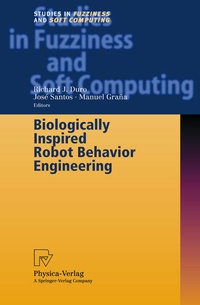
Biologically Inspired Robot Behavior Engineering
Published on 22. October 2002
Book
Hardback
XX, 439 pages
978-3-7908-1513-9 (ISBN)
Description
The book presents an overview of current research on biologically inspired autonomous robotics from the perspective of some of the most relevant researchers in this area. The book crosses several boundaries in the field of robotics and the closely related field of artificial life. The key aim throughout the book is to obtain autonomy at different levels. From the basic motor behavior in some exotic robot architectures right through to the planning of complex behaviors or the evolution of robot control structures, the book explores different degrees and definitions of autonomous behavior. These behaviors are supported by a wide variety of modeling techniques: structural grammars, neural networks, and fuzzy logic and evolution underlies many of the development processes. Thus this text can be used by scientists and students interested in these areas and provides a general view of the field for a more general audience.
More details
Series
Edition
2003 ed.
Language
English
Place of publication
Heidelberg
Germany
Target group
College/higher education
Professional and scholarly
Research
Illustrations
XX, 439 p.
Dimensions
Height: 241 mm
Width: 160 mm
Thickness: 30 mm
Weight
852 gr
ISBN-13
978-3-7908-1513-9 (9783790815139)
DOI
10.1007/978-3-7908-1775-1
Schweitzer Classification
Other editions
Additional editions
Richard J. Duro | Jose Santos | Manuel Grana
Biologically Inspired Robot Behavior Engineering
Book
10/2010
Physica
€160.49
Shipment within 10-15 days
Content
1. Evolutionary approaches to neural control of rolling, walking, swimming and flying animats or robots.- 2. Behavior coordination and its modification on monkey-type mobile robot.- 3. Visuomotor control in flies and behavior-based agents.- 4. Using evolutionary methods to parameterize neural models: a study of the lamprey central pattern generator.- 5. Biologically inspired neural network approaches to real-time collision-free robot motion planning.- 6. Self-adapting neural networks for mobile robots.- 7. Evolving robots able to integrate sensory-motor information over time.- 8. A non-computationally-intensive neurocontroller for autonomous mobile robot navigation.- 9. Some approaches for reusing behaviour based robot cognitive architectures obtained through evolution.- 10. Modular neural architectures for robotics.- 11. Designing neural control architectures for an autonomous robot using vision to solve complex learning tasks.- 12. Robust estimation of the optical flow based on VQ-BF.- 13. Steps towards one-shot vision-based self-localization.- 14. Computing the optimal trajectory of arm movement: the TOPS (Task Optimization in the Presence of Signal-dependent noise) model.- 15. A general learning approach to visually guided 3D-positioning and pose control of robot arms.