

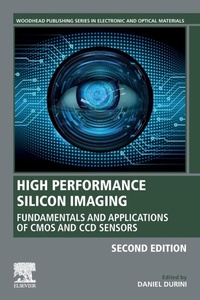
High Performance Silicon Imaging
Fundamentals and Applications of CMOS and CCD Sensors
2nd Edition
Published on 18. October 2019
Book
Paperback/Softback
522 pages
978-0-08-102434-8 (ISBN)
Description
High Performance Silicon Imaging: Fundamentals and Applications of CMOS and CCD Sensors, Second Edition, covers the fundamentals of silicon image sensors, addressing existing performance issues and current and emerging solutions. Silicon imaging is a fast growing area of the semiconductor industry. Its use in cell phone cameras is already well established, with emerging applications including web, security, automotive and digital cinema cameras. The book has been revised to reflect the latest state-of-the art developments in the field, including 3D imaging, advances in achieving lower signal noise, and new applications for consumer markets.
The fundamentals section has also been expanded to include a chapter on the characterization and testing of CMOS and CCD sensors that is crucial to the success of new applications. This book is an excellent resource for both academics and engineers working in the optics, photonics, semiconductor and electronics industries.
The fundamentals section has also been expanded to include a chapter on the characterization and testing of CMOS and CCD sensors that is crucial to the success of new applications. This book is an excellent resource for both academics and engineers working in the optics, photonics, semiconductor and electronics industries.
More details
Series
Edition
2nd edition
Language
English
Place of publication
Cambridge
United Kingdom
Publishing group
Elsevier Science & Technology
Target group
Professional and scholarly
Materials Scientists, and Engineers, professionals working in sensor R&D
Product notice
Paperback (trade)
Dimensions
Height: 228 mm
Width: 151 mm
Thickness: 32 mm
Weight
885 gr
ISBN-13
978-0-08-102434-8 (9780081024348)
Copyright in bibliographic data and cover images is held by Nielsen Book Services Limited or by the publishers or by their respective licensors: all rights reserved.
Schweitzer Classification
Other editions
Additional editions
E-Book
10/2019
2nd Edition
Woodhead Publishing
€220.00
Available for download
Previous edition
Book
10/2018
Woodhead Publishing Ltd
€185.70
The article will not be published
Person
Daniel Durini is currently Director of Research and a full Research Professor in areas of microelectronics and radiation detection at the National Institute of Astrophysics, Optics and Electronics (INAOE) in Puebla, Mexico. He obtained the B.Sc. degree in Electrical-Electronic Engineering from the National Autonomous University of Mexico (UNAM) in 2002, the M.Sc. degree in area of Microelectronics from the National Institute of Astrophysics, Optics and Electronics in Mexico in 2003, and the Ph.D. degree in area of Microelectronics from the University of Duisburg-Essen in Germany in 2009. He was with the Fraunhofer Institute for Microelectronic Circuits and Systems (IMS) in Duisburg, Germany, between 2004 and end of 2013, where he led during the last four years a group dedicated to developing special CMOS process modules for high-performance photodetection devices, pixel structures and imagers. Prior to his current position, he was with the Central Institute of Engineering, Electronics and Analytics, ZEA-2 - Electronic Systems of the research centre Forschungszentrum Juelich in Juelich, Germany, where he headed between 2015 and beginning of 2018 the development of Detector Systems dedicated to scientific applications. He received the Duisburger Sparkasse Award for outstanding Ph.D. thesis in 2009 and two best paper awards. He has authored and co-authored more than 60 technical papers and three book chapters, and holds six patents in the area of CMOS image sensors. He is Member of the IEEE since 2009, and forms part of the National System for Researchers (SNI) in Mexico since 2014.
Content
Part I Fundamentals1. Fundamental principles of photosensing 2. Operational principles of silicon image sensors3. Charge coupled device (CCD) image sensors4. Backside illuminated (BSI) complementary metal-oxide-semiconductor (CMOS) image sensors5. CMOS circuits for high-performance imaging
6. Smart cameras on a chip: using complementary metal-oxide-semiconductor (CMOS) image sensors to create smart vision chips
Part II Applications7. CMOS image sensor technology advances for mobile devices8. Complementary metal-oxide-semiconductor (CMOS) image sensors for automotive applications9. CMOS and CCD image sensors for space applications10. Complementary metal-oxide-semiconductor (CMOS) sensors for high-performance scientific imaging11. CMOS-based optical time-of-flight 3D imaging and ranging12. CMOS sensors for fluorescence lifetime imaging13. Complementary metal-oxide-semiconductor (CMOS) X-ray sensors14. Complementary metal-oxide-semiconductor (CMOS) and charge coupled device (CCD) image sensors in high-definition TV imaging15. High-performance silicon imagers, back illumination using delta and superlattice doping, and their applications in astrophysics, medicine, and other fields
6. Smart cameras on a chip: using complementary metal-oxide-semiconductor (CMOS) image sensors to create smart vision chips
Part II Applications7. CMOS image sensor technology advances for mobile devices8. Complementary metal-oxide-semiconductor (CMOS) image sensors for automotive applications9. CMOS and CCD image sensors for space applications10. Complementary metal-oxide-semiconductor (CMOS) sensors for high-performance scientific imaging11. CMOS-based optical time-of-flight 3D imaging and ranging12. CMOS sensors for fluorescence lifetime imaging13. Complementary metal-oxide-semiconductor (CMOS) X-ray sensors14. Complementary metal-oxide-semiconductor (CMOS) and charge coupled device (CCD) image sensors in high-definition TV imaging15. High-performance silicon imagers, back illumination using delta and superlattice doping, and their applications in astrophysics, medicine, and other fields