

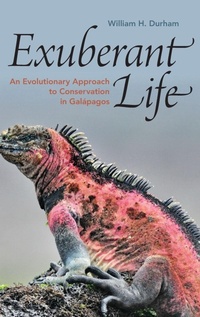
Exuberant Life
An Evolutionary Approach to Conservation in Galapagos
Published on 30. September 2021
Book
Hardback
406 pages
978-0-19-753151-8 (ISBN)
Description
The terrestrial organisms of the Galapagos Islands live under conditions unlike those anywhere else. At the edge of a uniquely rich mid-ocean upwelling, their world is also free of mammalian predators and competitors, allowing them to live unbothered, exuberant lives. With its giant tortoises, marine iguanas, flightless cormorants, and forests of giant daisies, there's no question that this is a magnificent place.
Long before people traversed the Earth, evolution endowed native species with adaptations to these special conditions and to perturbations like El Nino events and periodic droughts. As the islands have grown ever-more connected with humanity, those same adaptations now make its species vulnerable. Today, the islands are best viewed as one big social-ecological system where the ability of each native organism to survive and reproduce is a product of human activity in addition to ecological circumstances.
In this book, William H. Durham takes readers on a tour of Galapagos and the organisms that inhabit these isolated volcanic islands. Exuberant Life offers a contemporary synthesis of what we know about the evolution of its curiously wonderful organisms, how they are faring in the tumultuous changing world around them, and how evolution can guide our efforts today for their conservation.
The book highlights the ancestry of a dozen specific organisms in these islands, when and how they made it to the Galapagos, as well as how they have changed in the meantime. Durham traces the strengths and weaknesses of each species, arguing that the mismatch between natural challenges of their habitats and the challenges humans have recently added is the main task facing conservation efforts today. Such analysis often provides surprises and suggestions not yet considered, like the potential benefits to joint conservation efforts between tree finches and tree daisies, or ways in which the peculiar evolved behaviors of Nazca and blue-footed boobies can be used to benefit both species today. In each chapter, a social-ecological systems framework is used to highlight links between human impact, including climate change, and species status today,
Historically, the Galapagos have played a central role in our understanding of evolution; what these islands now offer to teach us about conservation may well prove indispensable for the future of the planet.
Long before people traversed the Earth, evolution endowed native species with adaptations to these special conditions and to perturbations like El Nino events and periodic droughts. As the islands have grown ever-more connected with humanity, those same adaptations now make its species vulnerable. Today, the islands are best viewed as one big social-ecological system where the ability of each native organism to survive and reproduce is a product of human activity in addition to ecological circumstances.
In this book, William H. Durham takes readers on a tour of Galapagos and the organisms that inhabit these isolated volcanic islands. Exuberant Life offers a contemporary synthesis of what we know about the evolution of its curiously wonderful organisms, how they are faring in the tumultuous changing world around them, and how evolution can guide our efforts today for their conservation.
The book highlights the ancestry of a dozen specific organisms in these islands, when and how they made it to the Galapagos, as well as how they have changed in the meantime. Durham traces the strengths and weaknesses of each species, arguing that the mismatch between natural challenges of their habitats and the challenges humans have recently added is the main task facing conservation efforts today. Such analysis often provides surprises and suggestions not yet considered, like the potential benefits to joint conservation efforts between tree finches and tree daisies, or ways in which the peculiar evolved behaviors of Nazca and blue-footed boobies can be used to benefit both species today. In each chapter, a social-ecological systems framework is used to highlight links between human impact, including climate change, and species status today,
Historically, the Galapagos have played a central role in our understanding of evolution; what these islands now offer to teach us about conservation may well prove indispensable for the future of the planet.
Reviews / Votes
The author has written a gem of a book that illustrates the utility of this approach. The volume not only serves as anamazing companion for Galapagos-bound tourists to enrich their understanding of what they are seeing, but it serves as a model for sustainable biodiversity management globally. * Daniel T. Blumstein, Quarterly Review of Biology, Vol.97, no.1 * If you can't visit the Galapagos Islands just yet, this reading tour is a wonderful alternative. Durham's joyous account of the islands is full of accessible, accurate information that introduces us to the evolutionary basis of many of the curious adaptations acquired by the resident species well as the challenges that they face in a world permeated by human activity. The lively case studies weave together biology, human history, modern conservation policy, Ecuadorian economic development, and personal observations on animals' lives in order to illuminate the dynamic ecosystems that bind the environment with the living world. Durham gives readers exceptional insight into the biodiversity of this 'little world,' as Charles Darwin called it, and calls attention to its continuing fragility in the Anthropocene. * Janet Browne, author of Charles Darwin: A Biography * In Exuberant Life, William Durham brings us on a journey of discovery to the enchanted and endangered isles of the Galapagos. As someone renowned for his interdisciplinary scholarship and teaching about evolution, conservation, and human-environmental relationships, a book of this magnitude and vision could only have been written by Durham. Simultaneously a work of natural history, a cautionary tale, and an impassioned call to action, Exuberant Life engages us with a conversational tone and masterful storytelling, robust scientific documentation, and striking photographs and figures. It is clearly a labor of love, and Durham instills a sense of both wonder and urgency--the fate of the Galapagos portends the future for us all. * Flora Lu, Professor and Pepper-Giberson Endowed Chair of Environmental Studies and Provost of Colleges Nine and Ten, University of California, Santa Cruz * If you have not had the chance to explore the value of evolution, here is an explanation written in the most unique, fascinating, and practical way. Exuberant Life takes readers through evolution and its applications to the conservation and sustainability of the Galapagos Islands. This book confirms Durham's extraordinary ability to communicate how evolution is vital to the conservation of nature. * Arturo Izurieta Valery, Oceans, Coasts, and Islands Group Coordinator for Ecuadorian Coordinator of Organizations for the Defense of Nature and the Environment (CEDENMA), Former Executive Director, Charles Darwin Foundation for the Galapagos Islands, and twice former Director of the Galapagos National Park and Marine Reserve *More details
Language
English
Place of publication
New York
United States
Target group
Professional and scholarly
Dimensions
Height: 240 mm
Width: 161 mm
Thickness: 26 mm
Weight
772 gr
ISBN-13
978-0-19-753151-8 (9780197531518)
Copyright in bibliographic data and cover images is held by Nielsen Book Services Limited or by the publishers or by their respective licensors: all rights reserved.
Schweitzer Classification
Other editions
Additional editions
E-Book
03/2021
OUP eBook
€37.99
Available for download
E-Book
03/2021
OUP eBook
€37.99
Available for download
Person
William H. Durham is Bing Professor in Human Biology, Emeritus, and Yang and Yamazaki University Fellow, Emeritus, at Stanford University. He's focused his career on two things. The first is putting the principles of evolution to work in understanding and sustaining biological and cultural diversity. The second is identifying the social dimensions of environmental problems and how to solve them. Durham is a recipient of the MacArthur Prize Fellowship, and he previously served 16 years as Editor of the Annual Review of Anthropology. At Stanford University, he has served as both Chair and Co-Chair of Anthropology as well as Director of Human Biology. Durham is currently Co-Director of "The Osa and Golfito Initiative," Stanford's sustainability project in Costa Rica.
Content
Preface
Chapter 1: Out of the Ordinary
Chapter 2: Tough Times for the Loneliest Albatross
Chapter 3: The "Secret Recipe" of Galapagos
Chapter 4: Galapagos Derailed
Chapter 5: Beautiful on the Inside
Chapter 6: "An Inexplicable Confusion"
Chapter 7: Caught in a Booby Trap
Chapter 8: Not Earthbound Misfits After All
Chapter 9: Fishing in a Common Pool
Chapter 10: One Big Social-Ecological System
Appendix 1: An Evolution Primer
Appendix 2: Treasured Islands-How to Help
References
Index
Chapter 1: Out of the Ordinary
Chapter 2: Tough Times for the Loneliest Albatross
Chapter 3: The "Secret Recipe" of Galapagos
Chapter 4: Galapagos Derailed
Chapter 5: Beautiful on the Inside
Chapter 6: "An Inexplicable Confusion"
Chapter 7: Caught in a Booby Trap
Chapter 8: Not Earthbound Misfits After All
Chapter 9: Fishing in a Common Pool
Chapter 10: One Big Social-Ecological System
Appendix 1: An Evolution Primer
Appendix 2: Treasured Islands-How to Help
References
Index