

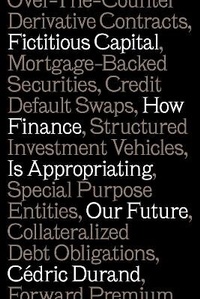
Fictitious Capital
How Finance Is Appropriating Our Future
Published on 2. May 2017
Book
Hardback
176 pages
978-1-78663-284-5 (ISBN)
Description
How finance is a mechanism of social and political domination
The 2007-08 credit crisis and the long recession that followed brutally exposed the economic and social costs of financialization. Understanding what lay behind these events, the rise of "fictitious capital" and its opaque logic, is crucial to grasping the social and political conditions under which we live. Yet, for most people, the operations of the financial system remain shrouded in mystery.
In this lucid and compelling book, economist Cedric Durand offers a concise and critical introduction to the world of finance, unveiling the truth behind the credit crunch. Fictitious Capital moves beyond moralizing tales about greedy bankers, short-sighted experts and compromised regulators to look at the big picture. Using comparative data covering the last four decades, Durand examines the relationship between trends such as the rise in private and public debt and the proliferation of financial products; norms such as our habitual assumptions about the production of value and financial stability; and the relationship of all this to political power.
Fictitious Capital offers a stark warning about the direction that the international economy is taking. Durand argues that the accelerated expansion of financial operations is a sign of the declining power of the economies of the Global North. The City, Wall Street and other centres of the power of money, he suggests, may already be caked with the frosts of winter.
The 2007-08 credit crisis and the long recession that followed brutally exposed the economic and social costs of financialization. Understanding what lay behind these events, the rise of "fictitious capital" and its opaque logic, is crucial to grasping the social and political conditions under which we live. Yet, for most people, the operations of the financial system remain shrouded in mystery.
In this lucid and compelling book, economist Cedric Durand offers a concise and critical introduction to the world of finance, unveiling the truth behind the credit crunch. Fictitious Capital moves beyond moralizing tales about greedy bankers, short-sighted experts and compromised regulators to look at the big picture. Using comparative data covering the last four decades, Durand examines the relationship between trends such as the rise in private and public debt and the proliferation of financial products; norms such as our habitual assumptions about the production of value and financial stability; and the relationship of all this to political power.
Fictitious Capital offers a stark warning about the direction that the international economy is taking. Durand argues that the accelerated expansion of financial operations is a sign of the declining power of the economies of the Global North. The City, Wall Street and other centres of the power of money, he suggests, may already be caked with the frosts of winter.
Reviews / Votes
"Cedric Durand is amongst the most promising of young French university economists today. This is indeed why we awaited the publication of his new book with bated breath. Let us just say immediately that it was worth the wait. His latest work, Fictitious Capital is an important intervention which tries to make sense of the excesses of capitalism over the last forty years and of the development of finance." Jacques SapirMore details
Language
English
Place of publication
London
United Kingdom
Dimensions
Height: 210 mm
Width: 140 mm
ISBN-13
978-1-78663-284-5 (9781786632845)
Copyright in bibliographic data and cover images is held by Nielsen Book Services Limited or by the publishers or by their respective licensors: all rights reserved.
Schweitzer Classification
Other editions
New editions
Book
05/2017
Verso Books
€24.00
Shipment within 3-4 weeks
Persons
Cedric Durand teaches economics and development theories at the University of Paris 13 and the EHESS. Working within the tradition of Marxist and French Regulationist political economy, he is the author of several articles on the Euro-crisis, the financialization-globalization nexus and the post-Soviet transformation. He is a member of the editorial board of the radical online journal ContreTemps.