

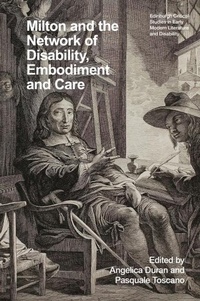
Milton and the Network of Disability, Embodiment and Care
Will be published approx. on 31. December 2025
Book
Hardback
296 pages
978-1-3995-4145-9 (ISBN)
Description
The governing questions of Milton and the Network of Disability, Embodiment and Care are threefold: What does reading Milton's texts - and literature generally - through the theoretical lens of disability, embodiment and care studies (DEC) reveal that was illegible before? How have Milton's visual and mobility impairments, as well as his artistic representations of human biodiversity, factored into his status as a canonical author? And what insights does bringing a DEC lens to Milton's body of work and its reception give us into literature and longstanding stereotypes about humans and their cultural and physical environments? The thirteen chapters, Foreword and Afterword of this collection, composed by established and emerging scholars, provide cogent answers by drawing on the contributors' expertise in various fields. The volume advances what Milton's texts - from sonnet to epic and political tract to tragedy - can tell us about not only literary representations of human variation, physical and mental, but also cultural responses to disability, embodiment and care that affect all readers - and all people - today.
Reviews / Votes
This timely collection breaks important new ground by addressing the divide between Milton scholarship and Critical Disability Studies. Contributors offer fresh and innovative insights on Milton's self-representations and literary imaginings of blindness, as well as on his lived experience of embodied disability and access to the world of care. -- Laura L. Knoppers, University of Notre DameMore details
Series
Language
English
Place of publication
Edinburgh
United Kingdom
Target group
College/higher education
Product notice
sewn/stitched
Cloth over boards
Illustrations
7 black & white illustrations
Dimensions
Height: 234 mm
Width: 156 mm
Thickness: 18 mm
Weight
590 gr
ISBN-13
978-1-3995-4145-9 (9781399541459)
Copyright in bibliographic data and cover images is held by Nielsen Book Services Limited or by the publishers or by their respective licensors: all rights reserved.
Schweitzer Classification
Persons
Angelica Duran is Professor of English, Comparative Literature and Religious Studies at Purdue University, where she has also served as Purdue's Director of Religious Studies (2009-2013), Interim Director of Creative Writing (2022-24) and affiliate faculty of Critical Disability Studies. She is the author, editor and co-editor of ten books, including Milton among Spaniards (2020), Global Milton and Visual Art (2021) and Milton Across Borders and Media (2023). She has served on the Executive Committee (2012-21) of the Milton Society of America, on the editorial board of Milton Quarterly (2005-) and as Conference Chair of the Renaissance Society of America (2022-27). Pasquale Toscano is Assistant Professor of English at Vassar College, after earning a master's degree in Classics from the University of Oxford as a Rhodes Scholar and a PhD in English from Princeton University. He is a co-winner of the Sixteenth Century Society's Harold J. Grimm Prize for scholarship on the Reformation and was named a 2023-24 Peter Ogden Jacobus Fellow, Princeton's highest honour for graduate students. His scholarship appears in Studies in English Literature, 1550-1900 (SEL), Classical Receptions Journal, Disability Studies Quarterly, The Oxford Handbook of George Herbert and Shakespeare and Early Modern Madness. His public-facing and creative writing focus primarily on disability-related issues and appear in The New York Times, The Atlantic and other venues.
Content
List of figures
Notes on contributors
Acknowledgements
Foreword by Rosemarie Garland-Thomson
Part I. 'A Darksome House of Mortal Clay'
1. 'With wand'ring steps and slow'
Angelica Duran and Pasquale Toscano
2. Milton and disability
Thomas N. Corns
Appendix 1: Milton's Letter to Philaras about his blindness (Epistolae familiares 15), Latin transcription and English translation
Sarah Knight
Part II. 'Spirited with Various Forms'
3. Milton's stammer
Joe Moshenska
4. Incapacity and human life in Paradise Lost, Artis logicae, and De doctrina Christiana
Timothy M. Harrison
5. Milton and the human condition
Elizabeth Sauer
6. The matter of blindness in the Second Defence and Samson Agonistes
Susannah B. Mintz
7. Disability and the drama of Folly in Samson Agonistes
Maura Brady
Part III. 'Gathering Up Limb by Limb'
8. Blind self-governance in Milton's 'Cyriack, This Three Years' Days These Eyes'
Teri Fickling
9. Paradise Regained, prophetic practice, and the Quaker communities of care
Joan Curbet Soler
10. Access, ableism, and accommodation in Samson Agonistes and its Restoration successors
Pasquale Toscano
Part IV. 'Written to Aftertimes'
11. The blind Milton as caretaker, Englishman, and husband on the Spanish stage
Angelica Duran
12. When Tyehimba Jess (re)considers Milton's Sonnet 'When I Consider How My Light Is Spent'
Reginald A. Wilburn
13. Picturing Satan's body in Paradise Lost
John Leonard
Afterword
Georgina Kleege
Index
Notes on contributors
Acknowledgements
Foreword by Rosemarie Garland-Thomson
Part I. 'A Darksome House of Mortal Clay'
1. 'With wand'ring steps and slow'
Angelica Duran and Pasquale Toscano
2. Milton and disability
Thomas N. Corns
Appendix 1: Milton's Letter to Philaras about his blindness (Epistolae familiares 15), Latin transcription and English translation
Sarah Knight
Part II. 'Spirited with Various Forms'
3. Milton's stammer
Joe Moshenska
4. Incapacity and human life in Paradise Lost, Artis logicae, and De doctrina Christiana
Timothy M. Harrison
5. Milton and the human condition
Elizabeth Sauer
6. The matter of blindness in the Second Defence and Samson Agonistes
Susannah B. Mintz
7. Disability and the drama of Folly in Samson Agonistes
Maura Brady
Part III. 'Gathering Up Limb by Limb'
8. Blind self-governance in Milton's 'Cyriack, This Three Years' Days These Eyes'
Teri Fickling
9. Paradise Regained, prophetic practice, and the Quaker communities of care
Joan Curbet Soler
10. Access, ableism, and accommodation in Samson Agonistes and its Restoration successors
Pasquale Toscano
Part IV. 'Written to Aftertimes'
11. The blind Milton as caretaker, Englishman, and husband on the Spanish stage
Angelica Duran
12. When Tyehimba Jess (re)considers Milton's Sonnet 'When I Consider How My Light Is Spent'
Reginald A. Wilburn
13. Picturing Satan's body in Paradise Lost
John Leonard
Afterword
Georgina Kleege
Index