

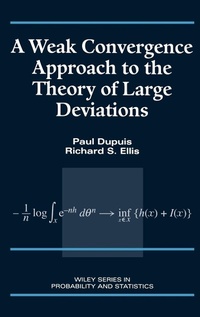
A Weak Convergence Approach to the Theory of Large Deviations
1st Edition
Published on 10. March 1997
Book
Hardback
504 pages
978-0-471-07672-8 (ISBN)
Description
Applies the well-developed tools of the theory of weak convergenceof probability measures to large deviation analysis--a consistentnew approach
The theory of large deviations, one of the most dynamic topics inprobability today, studies rare events in stochastic systems. Thenonlinear nature of the theory contributes both to its richness anddifficulty. This innovative text demonstrates how to employ thewell-established linear techniques of weak convergence theory toprove large deviation results. Beginning with a step-by-stepdevelopment of the approach, the book skillfully guides readersthrough models of increasing complexity covering a wide variety ofrandom variable-level and process-level problems. Representationformulas for large deviation-type expectations are a key tool andare developed systematically for discrete-time problems.
Accessible to anyone who has a knowledge of measure theory andmeasure-theoretic probability, A Weak Convergence Approach to theTheory of Large Deviations is important reading for both studentsand researchers.
The theory of large deviations, one of the most dynamic topics inprobability today, studies rare events in stochastic systems. Thenonlinear nature of the theory contributes both to its richness anddifficulty. This innovative text demonstrates how to employ thewell-established linear techniques of weak convergence theory toprove large deviation results. Beginning with a step-by-stepdevelopment of the approach, the book skillfully guides readersthrough models of increasing complexity covering a wide variety ofrandom variable-level and process-level problems. Representationformulas for large deviation-type expectations are a key tool andare developed systematically for discrete-time problems.
Accessible to anyone who has a knowledge of measure theory andmeasure-theoretic probability, A Weak Convergence Approach to theTheory of Large Deviations is important reading for both studentsand researchers.
More details
Series
Language
English
Place of publication
United States
Publishing group
John Wiley & Sons Inc
Target group
College/higher education
Professional and scholarly
Product notice
sewn/stitched
Cloth over boards
Dimensions
Height: 240 mm
Width: 161 mm
Thickness: 32 mm
Weight
924 gr
ISBN-13
978-0-471-07672-8 (9780471076728)
Copyright in bibliographic data and cover images is held by Nielsen Book Services Limited or by the publishers or by their respective licensors: all rights reserved.
Schweitzer Classification
Other editions
Additional editions
Paul Dupuis | Richard S. Ellis
A Weak Convergence Approach to the Theory of Large Deviations
E-Book
09/2011
Wiley
€201.99
Available for download
Persons
PAUL DUPUIS is a professor in the Division of Applied Mathematics at Brown University in Providence, Rhode Island.
RICHARD S. ELLIS is a professor in the Department of Mathematics and Statistics at the University of Massachusetts at Amherst.
RICHARD S. ELLIS is a professor in the Department of Mathematics and Statistics at the University of Massachusetts at Amherst.
Content
Formulation of Large Deviation Theory in Terms of the LaplacePrinciple.
First Example: Sanov's Theorem.
Second Example: Mogulskii's Theorem.
Representation Formulas for Other Stochastic Processes.
Compactness and Limit Properties for the Random Walk Model.
Laplace Principle for the Random Walk Model with ContinuousStatistics.
Laplace Principle for the Random Walk Model with DiscontinuousStatistics.
Laplace Principle for the Empirical Measures of a MarkovChain.
Extensions of the Laplace Principle for the Empirical Measures of aMarkov Chain.
Laplace Principle for Continuous-Time Markov Processes withContinuous Statistics.
Appendices.
Bibliography.
Indexes.
First Example: Sanov's Theorem.
Second Example: Mogulskii's Theorem.
Representation Formulas for Other Stochastic Processes.
Compactness and Limit Properties for the Random Walk Model.
Laplace Principle for the Random Walk Model with ContinuousStatistics.
Laplace Principle for the Random Walk Model with DiscontinuousStatistics.
Laplace Principle for the Empirical Measures of a MarkovChain.
Extensions of the Laplace Principle for the Empirical Measures of aMarkov Chain.
Laplace Principle for Continuous-Time Markov Processes withContinuous Statistics.
Appendices.
Bibliography.
Indexes.