

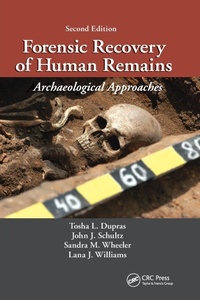
Forensic Recovery of Human Remains
Archaeological Approaches, Second Edition
2nd Edition
Published on 31. March 2021
Book
Paperback/Softback
398 pages
978-0-367-77871-2 (ISBN)
Description
This reference, now in its second edition, is a comprehensive guide that focuses on the practical aspects of excavating and recovering human remains, as well as any associated evidence, from crime scenes. It highlights the protocols and techniques that are used to successfully survey, map, recover, document, collect, and transport evidence. New additions to the reference include discussion questions and suggested readings, updated mapping and measuring techniques, including a section on GIS and backpack differential GPS systems, expanded information on botany, DNA, and soil, and non-forensic burial contexts. Almost 200 illustrations are included to help clarify concepts.
More details
Edition
2nd edition
Language
English
Place of publication
London
United Kingdom
Publishing group
Taylor & Francis Ltd
Target group
Professional and scholarly
Academic and Professional Practice & Development
Dimensions
Height: 234 mm
Width: 156 mm
Thickness: 21 mm
Weight
605 gr
ISBN-13
978-0-367-77871-2 (9780367778712)
Copyright in bibliographic data and cover images is held by Nielsen Book Services Limited or by the publishers or by their respective licensors: all rights reserved.
Schweitzer Classification
Other editions
Additional editions
Tosha L. Dupras | John J. Schultz | Sandra M. Wheeler
Forensic Recovery of Human Remains
Archaeological Approaches, Second Edition
E-Book
10/2011
2nd Edition
CRC Press
€81.99
Available for download
Tosha L. Dupras | John J. Schultz | Sandra M. Wheeler
Forensic Recovery of Human Remains
Archaeological Approaches, Second Edition
Book
10/2011
2nd Edition
CRC Press
€177.10
Shipment within 15-20 days
Tosha L. Dupras | John J. Schultz | Sandra M. Wheeler
Forensic Recovery of Human Remains
Archaeological Approaches, Second Edition
E-Book
10/2011
2nd Edition
CRC Press
€81.99
Available for download
Persons
Tosha L. Dupras, Ph.D. specializes in bioarchaeology, particularly diet reconstruction through chemical analysis, and has been associated with the Dakhleh Oasis and Dayr al Barsha projects in Egypt where she has excavated in several cemeteries and analyzed many skeletal remains. Dupras also assists local law enforcement agencies with the search for and excavation of human remains.
John J. Schultz, Ph.D.'s
primary research focuses on forensic and archaeological applications of ground-penetrating radar (GPR) for grave detection, and detection of buried metallic weapons using various geophysical technologies. Schultz is also a consulting forensic anthropologist in the central Florida area for various law enforcement agencies and the local Medical Examiner's Office.
Sandra M. Wheeler, Ph.D.
specializes in bioarchaeology, paleopathology, juvenile osteology, and mortuary archaeology. Wheeler has conducted fieldwork in Belize and Mexico and continues to actively work with the Dakhleh Oasis Project, Egypt. She has assisted law enforcement in Florida and Canada with the search for and recovery of human remains.
Lana J. Williams, Ph.D.
specializes in biochemical analysis of human remains, mortuary archaeology, and human osteology. Williams has conducted fieldwork in Greece and Belize and is currently working with the Dakhleh Oasis and Dayr al Barsha projects in Egypt. In addition, she has assisted law enforcement in Florida and Canada in the search, recovery, and analysis of human remains.
John J. Schultz, Ph.D.'s
primary research focuses on forensic and archaeological applications of ground-penetrating radar (GPR) for grave detection, and detection of buried metallic weapons using various geophysical technologies. Schultz is also a consulting forensic anthropologist in the central Florida area for various law enforcement agencies and the local Medical Examiner's Office.
Sandra M. Wheeler, Ph.D.
specializes in bioarchaeology, paleopathology, juvenile osteology, and mortuary archaeology. Wheeler has conducted fieldwork in Belize and Mexico and continues to actively work with the Dakhleh Oasis Project, Egypt. She has assisted law enforcement in Florida and Canada with the search for and recovery of human remains.
Lana J. Williams, Ph.D.
specializes in biochemical analysis of human remains, mortuary archaeology, and human osteology. Williams has conducted fieldwork in Greece and Belize and is currently working with the Dakhleh Oasis and Dayr al Barsha projects in Egypt. In addition, she has assisted law enforcement in Florida and Canada in the search, recovery, and analysis of human remains.
Content
Introduction to Forensic Archaeology. Tools and Equipment. Human Skeletal Terminology. Understanding the Forensic Context. Search Techniques for Locating Human Remains. Methods of Geophysical Survey. Surveying and Mapping Methods. Applying Archaeological Methods in a Forensic Context. Collecting Botanical and Entomological Evidence. Collecting Skeletal Remains. Writing the Final Report. Appendix A: Adult Skeletal Inventory Form (Field Collection). Appendix B: Infant Skeletal Inventory Form (Field Collection). Appendix C: Child Skeletal Inventory Form (Field Collection). Appendix D: Personnel and Scene Summary Form. Appendix E: Recovery Scene Context Form. Appendix F: Surface Deposit Recovery Form. Appendix G: Feature Excavation Form. Appendix H: Remains Summary Form. Appendix I: Forensic Entomology Data Collection Form. Appendix J: Photography/Video Record Form. Appendix K: Evidentiary Inventory Form. Appendix L: Evidentiary Chain of Custody Form. Glossary. Index.