

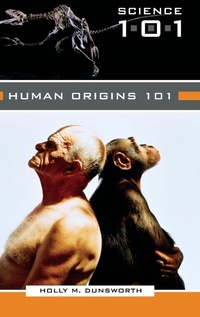
Human Origins 101
Published on 30. August 2007
Book
Hardback
224 pages
978-0-313-33673-7 (ISBN)
Description
What should the average person know about science? Because science is so central to life in the 21st century, science educators and other leaders of the scientific community believe that it is essential that everyone understand the basic concepts of the most vital and far-reaching disciplines. Human Origins 101 does exactly that. This accessible volume provides readers - whether students new to the field or just interested members of the lay public - with the essential ideas of the origins of humans using a minimum of jargon and mathematics. Concepts are introduced in a progressive order so that more complicated ideas build on simpler ones, and each is discussed in small, bite-sized segments so that they can be more easily understood.
Human Origins 101 enables students and the general public to understand the basic concepts underlying our knowledge of our evolution as a species. This small volume covers:
; A brief history of paleoanthropology, and the discovery of human's place in nature
; Evolution and the Origin of Life
; Clues to human origins from genetics
; The fossil and archaeological records
; The distinctive traits that makes us human
; The diversity of modern humans
With a bibliography, glossary, and discussion of hoaxes, fringe theories, and hot-button issues, Human Origins 101 provides the perfect starting point for anyone wishing to understand how scientists know how humans evolved.
Human Origins 101 enables students and the general public to understand the basic concepts underlying our knowledge of our evolution as a species. This small volume covers:
; A brief history of paleoanthropology, and the discovery of human's place in nature
; Evolution and the Origin of Life
; Clues to human origins from genetics
; The fossil and archaeological records
; The distinctive traits that makes us human
; The diversity of modern humans
With a bibliography, glossary, and discussion of hoaxes, fringe theories, and hot-button issues, Human Origins 101 provides the perfect starting point for anyone wishing to understand how scientists know how humans evolved.
Reviews / Votes
Dunsworth offers students and general readers an introductory exploration of human origins and evolution. Coverage includes a brief history of the search for human origins and human evolutionary studies; evolutionary theory and Darwin's formulation of the theory of evolution by natural selection and by sexual selection; fossil and archaeological records; recent advances that the field of genetics has made in understanding human origins and evolution; and ways of interpreting the evidence from living animal models, fossils, artifacts, and genetics. * Reference & Research Book News * Human Origins 101 provides a comprehensive look at our understandings of human origins and the evidence we use to support them. It is well researched and comprehensive, filling an important gap in most science programs....This book represents a compact and complete reference to human paleontology and would be an excellent addition to a library. Many of the books currently available do not do such a thorough job.... * National Science Teachers Association *More details
Series
Language
English
Place of publication
United States
Publishing group
Bloomsbury Publishing Plc
Target group
Adult education
Interest Age: From 7 to 17 years
Dimensions
Height: 240 mm
Width: 161 mm
Thickness: 17 mm
Weight
505 gr
ISBN-13
978-0-313-33673-7 (9780313336737)
Copyright in bibliographic data and cover images is held by Nielsen Book Services Limited or by the publishers or by their respective licensors: all rights reserved.
Schweitzer Classification
Other editions
Additional editions

Holly M. Dunsworth
Human Origins 101
E-Book
08/2007
1st Edition
Greenwood Press
€63.69
Available for download
Person
Holly M. Dunsworth is a Postdoctoral Fellow in the Department of Anthropology at the Pennsylvania State University. When not collecting fossils in Kenya or the Republic of Georgia, she uses sophisticated imaging technology to look at their inner structures. By interpreting clues from the outer and inner anatomy of bones, she reconstructs the biology and behavior of fossil monkeys, apes, and hominins to better understand how humans arrived at their present state.