

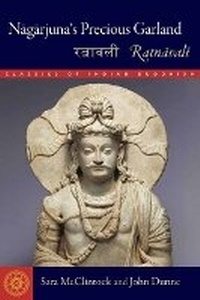
N?g?rjuna's Precious Garland
Ratnavali
Published on 5. April 2024
Book
Hardback
360 pages
978-1-61429-846-5 (ISBN)
Description
"In this profound work of five hundred verses, we encounter a presentation of Buddhism that integrates both the worldly and the transcendent. The clear and sagacious advice laid out on every page serves as a road map to one's highest goal-whether that goal is a better life, here called the Dharma of ascendance, or the ultimate one of spiritual freedom, the Dharma of the highest good. The verses, written for an unnamed ruler, touch on questions of statecraft, but their broader themes speak to us today because they tackle the difficulty of integrating one's spiritual journey with the social and political demands of daily life. Nåagåarjuna was an Indian Buddhist teacher, probably of the second century CE, who was renowned for his astute articulation of the philosophy of the Middle Way (Madhyamaka). His thoroughgoing critique of all forms of essentialism became a touchstone for Mahåayåana Buddhism in India, Tibet, and throughout East Asia, and his importance for the development of the Mahåayåana tradition can scarcely be exaggerated. The translators here first rendered Nåagåarjuna's letter for the Dalai Lama's teachings on the work in Los Angeles in 1997. While that commemorative edition was translated from the Tibetan, the present volume prioritizes the surviving Sanskrit verses along with the only known Indian commentary, by the eleventh-century scholar Ajitamitra. This is the first complete translation in English of the Precious Garland that takes the Indian text and commentary as its primary authorities. In addition, they provide rigorous working editions of the Sanskrit and Tibetan verses they translate. This elegant and precise rendering of Nåagåarjuna's work is certain to become the touchstone translation of this celebrated Buddhist text"--
More details
Series
Language
English
Place of publication
Somerville
United States
Dimensions
Height: 227 mm
Width: 151 mm
Thickness: 24 mm
Weight
544 gr
ISBN-13
978-1-61429-846-5 (9781614298465)
Copyright in bibliographic data and cover images is held by Nielsen Book Services Limited or by the publishers or by their respective licensors: all rights reserved.
Schweitzer Classification
Other editions
Additional editions
E-Book
03/2024
Simon + Schuster LLC
€25.70
Available for download
Persons
Sara McClintock (PhD 2002, Harvard University) is a Buddhist philosopher and scholar of religion whose interests converge at the intersections of ethics, metaphysics, truth, and story. Sara is an associate professor in the Department of Religion at Emory University.
John D. Dunne serves on the faculty of the University of Wisconsin-Madison, where he holds the Distinguished Chair in Contemplative Humanities at the Center for Healthy Minds. He is also chair of the Department of Asian Languages & Cultures. His work focuses on Buddhist philosophy and contemplative practice, especially in dialog with Cognitive Science and Psychology. His more than fifty publications appear in venues ranging across both the Humanities and the Sciences, including Foundations of Dharmakirti’s Philosophy (2004) and Science and Philosophy in the Indian Buddhist Classics: The Mind (2020). John Dunne speaks in both academic and public contexts, and he occasionally teaches for Buddhist communities. His broader engagements include being a Fellow of the Mind and Life Institute, where he was previously a member of the board of directors, and serving as an academic advisor to the Rangjung Yeshe Institute in Kathmandu, Nepal.
John D. Dunne serves on the faculty of the University of Wisconsin-Madison, where he holds the Distinguished Chair in Contemplative Humanities at the Center for Healthy Minds. He is also chair of the Department of Asian Languages & Cultures. His work focuses on Buddhist philosophy and contemplative practice, especially in dialog with Cognitive Science and Psychology. His more than fifty publications appear in venues ranging across both the Humanities and the Sciences, including Foundations of Dharmakirti’s Philosophy (2004) and Science and Philosophy in the Indian Buddhist Classics: The Mind (2020). John Dunne speaks in both academic and public contexts, and he occasionally teaches for Buddhist communities. His broader engagements include being a Fellow of the Mind and Life Institute, where he was previously a member of the board of directors, and serving as an academic advisor to the Rangjung Yeshe Institute in Kathmandu, Nepal.