

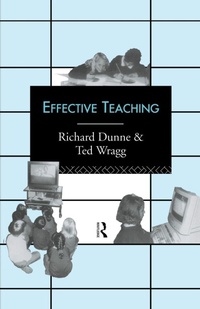
Effective Teaching
1st Edition
Published on 19. May 1994
Book
Paperback/Softback
56 pages
978-0-415-10916-1 (ISBN)
Description
First Published in 2004. In the nineteenth century, teacher training institutions were called 'normal schools', because it was assumed that there was only one way to teach - the 'norm'. Today there is no single style of teaching endorsed by everyone. How teachers teach depends on factors like the age and ability of the children, their background and needs, the nature of the subject or topic being studied and the resources available. The authors draw on their considerable experience of teacher training and research into classrooms, to explore several dimen-sions of teaching. These include planning and preparation, direct instruction, the management of materials and of behaviour, conversation with children, monitoring, and evaluating learning. They show how teachers can improve their competence and meet their aspirations, both individually and with their colleagues. The book will be very useful to trainee and experienced teachers, heads, teacher trainers and inspectors.
More details
Language
English
Place of publication
London
United Kingdom
Publishing group
Taylor & Francis Ltd
Target group
College/higher education
Professional and scholarly
Dimensions
Height: 216 mm
Width: 138 mm
Weight
249 gr
ISBN-13
978-0-415-10916-1 (9780415109161)
Copyright in bibliographic data and cover images is held by Nielsen Book Services Limited or by the publishers or by their respective licensors: all rights reserved.
Schweitzer Classification
Other editions
Additional editions
Richard Dunne | E.C. Wragg | Prof E. C. Wragg
Effective Teaching
E-Book
09/2003
Routledge
€52.49
Available for download
Richard Dunne | E.C. Wragg | Prof E. C. Wragg
Effective Teaching
E-Book
09/2003
Routledge
€52.49
Available for download
Persons
Richard Dunne is a Lecturer in the School of Education at the University of Exeter. Ted Wragg is Professor of Education at Exeter University and the author of many books including Class Management and, with George Brown, Explaining and Questioning in this series. He writes a regular column for the Times Educational Supplement and is a fre-quent commentator for radio and television on education matters.
Content
Introduction Unit 1 WHAT IS EFFECTIVE TEACHING? Written Activity followed by Discussion (1); Unit 2 IMPROVING PERSONAL COMPETENCE Focusing on classroom performance; The nine dimensions of teaching; Practical Activity (2); Practical Activity (3); Annotating an agenda during classroom observation; Written Activity followed by Discussion and Practical Activity (4); Practical Activity followed by Discussion (5); Unit 3 UNDERSTANDING HOW CHILDREN LEARN Discussion Activity (6); A category system for understanding children's learning; Practical Activity followed by Discussion (7); Practical Activity followed by Discussion (8); Unit 4 CLASSROOM ORGANISATION AND MANAGEMENT The framework for discussion; Discussion Activity (9); Discussion Activity (10); Discussion Activity (11); Teaching style; Discussion Activity (12); Unit 5 INSTRUCTIONAL DESIGN The idea of instructional design; Practical Activity (13); Unit 6 WHOLE-SCHOOL ISSUES The focus on individualisation; A theory of learning; Organising the curriculum; Discussion Activity (14); School organisation and curriculum detail