

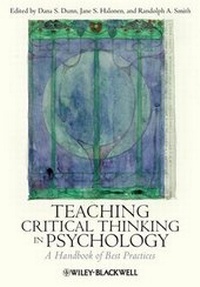
Teaching Critical Thinking in Psychology
A Handbook of Best Practices
Will be published approx. on 5. September 2008
Book
Paperback/Softback
320 pages
978-1-4051-7402-2 (ISBN)
Description
Teaching Critical Thinking in Psychology features current scholarship on effectively teaching critical thinking skills in the discipline of psychology. These skills include the ability to recognize patterns; to solve problems in practical, creative, or scientific ways; to engage in psychological reasoning; and to adopt different perspectives when evaluating ideas or issues. Through these skills students improve their abilities to observe, infer, question, decide, develop new ideas, and analyze arguments.
Using original materials and perspectives, this edited volume provides novel and nontraditional approaches to teaching critical thinking, including strategies, tactics, diversity issues, service learning, and the use of case studies. Written by experts in the field, this accessible collection provides instructors with a showcase for best practices for teaching critical thinking issues at all levels of psychology.
Reviews / Votes
"Although there are other books that address enhancing critical thinking, none of them includes the variety of data-based approaches included in this one. Further, it uniquely has a focus on teaching psychology, making it an invaluable resource for teachers of psychology at all educational levels." Bill Hill, Kennesaw State University "Dunn, Halonen, and Smith provide a comprehensive resource that includes empirical support and practical applications for teaching in ways that will help students to think critically. This book is destined to become the seminal resource for teaching critical thinking in psychology and related disciplines." - Maureen McCarthy, Kennesaw State University and President of Society for the Teaching of Psychology (2008)More details
Edition
1. Auflage
Language
English
Place of publication
Hoboken
United Kingdom
Publishing group
John Wiley and Sons Ltd
Target group
Professional and scholarly
Product notice
Paperback (trade)
sewn/stitched
Dimensions
Height: 244 mm
Width: 168 mm
Thickness: 18 mm
Weight
544 gr
ISBN-13
978-1-4051-7402-2 (9781405174022)
Schweitzer Classification
Other editions
Additional editions
Dana S. Dunn | Jane S. Halonen | Randolph A. Smith
Teaching Critical Thinking in Psychology
A Handbook of Best Practices
E-Book
01/2009
Wiley-Blackwell
€38.99
Available for download
Dana S. Dunn | Jane S. Halonen | Randolph A. Smith
Teaching Critical Thinking in Psychology
A Handbook of Best Practices
Book
09/2008
Wiley
€109.00
Shipment within 3-4 weeks
Persons
Dana S. Dunn is Professor of Psychology and Director of the Learning in Common Curriculum at Moravian College. A Fellow of the American Psychological Association, Dunn is active in the Society for the Teaching of Psychology and frequently presents at national and regional disciplinary conferences. The author or editor of 7 previous books, Dunn has also written numerous articles, chapters, and book reviews.
Jane S. Halonen is Dean of the College of Arts and Sciences at the University of West Florida. She publishes in the areas of assessment, critical thinking, faculty development, and student success. A Fellow of Division 2 of the American Psychological Association, Jane is a past President of the Society for the Teaching of Psychology and serves as Associate Editor of its journal, Teaching of Psychology.
Randolph A. Smith is Professor of Psychology and Department Chair at Lamar University. His professional work focuses on the scholarship of teaching and learning. Smith is a Fellow of Divisions 1 and 2 of the American Psychological Association and has served as Editor of Teaching of Psychology from 1997-2008. He has authored or edited 4 previous books, as well as many articles, chapters, and presentations.
Content
Foreword.
Preface.
Section 1: Introduction.
01. Engaging Minds: Introducing Best Practices in Teaching Critical Thinking in Psychology.
Section 2: The Case for Teaching Critical Thinking in Psychology.
02. Critical Thinking: Needed Now More Than Ever.
03. Have We Demystified Critical Thinking?.
04. Are They Ready Yet? Developmental Issues in Teaching Thinking.
05. Simple Strategies for Teaching Your Students to Think Critically.
Section 3: Assessing Critical Thinking.
06. Measure for Measure: The Challenge of Assessing Critical Thinking.
07. Programmatic Assessment of Critical Thinking.
08. A Process Approach to Critical Thinking About Complex Concepts.
Section 4: Critical Thinking in Critical Psychology Courses.
09. Integrating Critical Thinking With Course Content.
10. Critical Thinking on Contemporary Issues.
11. The Repertory Grid as a Heuristic Tool in Teaching Undergraduate Psychology.
12. Critical Thinking in Critical Courses: Principles and Applications.
13. Teaching Critical Thinking in Statistics and Research Methods.
Section 5: Integrating Critical Thinking Across the Psychology Curriculum.
14. Teaching Critical Thinking Through Writing.
15. Using Service Learning to Promote Critical Thinking in the Psychology Curriculum.
16. Beyond Standard Lectures: Supporting the Development of Critical Thinking in Cognitive Psychology Courses.
17. Why We Believe: Fostering Critical Thought and Scientific Literacy in Research Methods.
18. Special Targets of Critical Thinking: Immovable Objects and Irresistible Forces.
Section 6: Thinking Critical Beyond the Classroom.
19. Thinking Critically About Careers in Psychology.
Section 7: Critical Briefings: Short Reports on Critical Thinking.
Short Report 1: Best and Worst: Learning to Think Like a Psychologist.
Short Report 2: Personal Mission Statements as Tools for Developing Writing and Reflection Skills.
Short Report 3: A Module-Based Research Project: Modeling Critical Thinking in Psychology.
Short Report 4: Effectively Using Literature Circles in the Psychology Classroom.
Short Report 5: Introducing Controversial Issues in Psychology Through Debate and Reflection.
Short Report 6: The Critical Thinking Lab: Developing Student Skills Through Practical Application.
Short Report 7: Encouraging Students to Think Critically About Psychotherapy: Overcoming Naïve Realism.
Short Report 8: Effectiveness of a Web-Based Critical Thinking Module.
Short Report 9: An Introductory Exercise for Promoting Critical Thinking about Psychological Measurement.
About the Editors.
Author Index.
Subject Index