

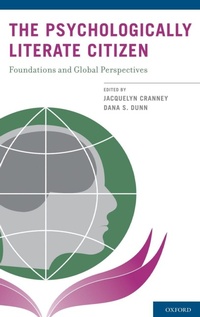
The Psychologically Literate Citizen
Foundations and Global Perspectives
1st Edition
Published on 29. September 2011
Book
Hardback
384 pages
978-0-19-979494-2 (ISBN)
Description
The concepts of psychological literacy and the psychologically literate citizen promise to invigorate a new global approach to psychology education. They pose a basic question: What attributes and capabilities should undergraduate psychology majors acquire? Many psychological organizations have defined psychological literacy by guidelines and lists of student learning outcomes, but although psychology educators across the globe have been working towards helping students to acquire these attributes over the past 50 years, educators have only recently explicitly delineated attributes and learning outcomes, and sought to develop appropriate learning, teaching, and assessment strategies, including whole program approaches.
The contributors to this volume argue that psychological literacy is the most important outcome of an undergraduate psychology education and that psychologically literate citizens use their knowledge of psychology to problem-solve in ethical and socially responsible ways that directly benefit their communities. In this book, a rich variety of international perspectives contribute to the development of the two key concepts of psychological literacy and the psychologically literate citizen. Authors provide practical guidance for classroom psychology educators, as well as curriculum developers and reviewers. Ultimately, they make the case for a paradigm shift in psychology education.
The contributors to this volume argue that psychological literacy is the most important outcome of an undergraduate psychology education and that psychologically literate citizens use their knowledge of psychology to problem-solve in ethical and socially responsible ways that directly benefit their communities. In this book, a rich variety of international perspectives contribute to the development of the two key concepts of psychological literacy and the psychologically literate citizen. Authors provide practical guidance for classroom psychology educators, as well as curriculum developers and reviewers. Ultimately, they make the case for a paradigm shift in psychology education.
Reviews / Votes
I found the perspective offered by this book really stimulated my thinking around the concept and would suggest anyone with an interest in how psychology might develop will find it useful. * Psychology Learning and Teaching, August 2013 *More details
Language
English
Place of publication
New York
United States
Target group
Professional and scholarly
Educators of psychology undergraduates, directors of psychology programs, psychology department chairs, high school teachers of psychology courses (particularly Advanced Placement courses), educators of graduate psychology students, multidisciplinary faculty and curriculum developers
Dimensions
Height: 240 mm
Width: 161 mm
Thickness: 25 mm
Weight
740 gr
ISBN-13
978-0-19-979494-2 (9780199794942)
Copyright in bibliographic data and cover images is held by Nielsen Book Services Limited or by the publishers or by their respective licensors: all rights reserved.
Schweitzer Classification
Other editions
Additional editions
Dana Dunn | Jacquelyn Cranney
The Psychologically Literate Citizen
Foundations and Global Perspectives
E-Book
01/2013
1st Edition
OUP eBook
€60.99
Available for download
Persons
Jacquelyn Cranney is currently Associate Professor of Psychology at the University of New South Wales. She is also an Australian Learning and Teaching Council National Teaching Fellow. She obtained her BA and MA at the University of Queensland, and her PhD at Bryn Mawr College. She has received many awards for teaching, including the Australian Psychological Society Distinguished Contribution to Education Award and a Carrick Citation Award.
Dana S. Dunn is currently Professor of Psychology and Director of the Learning in Common Curriculum at Moravian College in Bethlehem, Pennsylvania. He earned his BA in psychology from Carnegie Mellon University and his PhD in experimental social psychology from the University of Virginia.
Dana S. Dunn is currently Professor of Psychology and Director of the Learning in Common Curriculum at Moravian College in Bethlehem, Pennsylvania. He earned his BA in psychology from Carnegie Mellon University and his PhD in experimental social psychology from the University of Virginia.
Content
Part I: Introduction ; Chapter 1 ; Psychological literacy and the psychologically literate citizen: New frontiers for a global discipline ; Jacquelyn Cranney and Dana S. Dunn ; Part II: Curriculum Perspectives ; Chapter 2 ; Curriculum matters: Structure, content, and psychological literacy ; Dana S. Dunn, Robin L. Cautin, and Regan A. R. Gurung ; Chapter 3 ; Critical thinking and the education of psychologically literate citizens ; Diane Halpern and Heather Butler ; Chapter 4 ; Enhancing ethical literacy of psychologically literate citizens ; Graham Davidson and Shirley Morrissey ; Chapter 5 ; The social psychology of intergroup harmony and the education of psychologically literate citizens ; Fiona White ; Chapter 6 ; Changing the lens: Indigenous perspectives on psychological literacy ; Pat Dudgeon, Dawn Darlaston-Jones, and Yvonne Clark ; Chapter 7 ; Introductory Psychology and Psychological Literacy ; Lorelle J. Burton and Kathie J. McDonald ; Chapter 8 ; Educational psychology and psychological literacy in higher education: Developmental and cultural aspects of racial diversity ; Nida Denson and Marsha Ing ; Chapter 9 ; The role of positive psychology in creating the psychologically literate citizen ; Suzy Green, Paula L. Robinson, and Lindsay G. Oades ; Chapter 10 ; Departmental program approaches for educating psychologically literate citizens ; Jane Halonen, Dana Dunn, Suzanne Baker, and Maureen McCarthy ; Chapter 11 ; Psychological Literacy and applied psychology in undergraduate education ; Jacquelyn Cranney, Sue Morris, Frances Martin, Steve Provost, Lucy Zinkiewicz, John Reece, Josephine Milne-Home, Lorelle Burton, Fiona White, Judi Homewood, Joanne Earl, and Sherri McCarthy ; Part III: Global Perspectives ; Chapter 12 ; Psychological Literacy: An Italian perspective ; Remo Job, Lorella Lotto, and Claudio Tonzar ; Chapter 13 ; An Indonesian perspective on psychological literacy ; Sarlito Sarwono ; Chapter 14 ; A UK perspective on Psychological Literacy and Citizenship ; Annie Trapp and Jacqui Akhurst ; Chapter 15 ; Psychological Literacy Goals in Psychology Teaching in Russian Education ; Victor Karandashev ; Chapter 16 ; Sustainability and the Psychologically Literate Citizen: A New Zealand Perspective ; Niki Harre, Taciano Milfont, William Helton, and Andrea Mead ; Chapter 17 ; Fostering psychologically literate citizens: A Canadian perspective ; Steve Charlton and Jocelyn Lymburner ; Section IV: Integrative Perspectives ; Chapter 18: Adaptive cognition and psychological literacy ; Jacquelyn Cranney and Sue Morris ; Chapter 19: Psychological literacy: Bridging citizenship and character. ; Bryan W. Sokol and Janet E. Kuebli ; Chapter 20 ; A scientist-educator perspective on psychological literacy ; Daniel Bernstein ; Chapter 21 ; Virtues and Character Strengths of Psychologically Literate Faculty ; Thomas V. McGovern ; Chapter 22 ; Psychological literacy: An alumni perspective ; Harold Takooshian and Giulia Landi ; Chapter 23 ; What the world needs now is psychological literacy ; Jacquelyn Cranney and Dana S. Dunn