

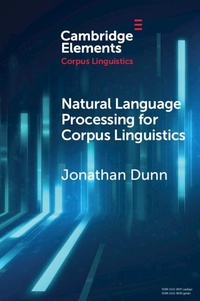
Natural Language Processing for Corpus Linguistics
Published on 31. March 2022
Book
Paperback/Softback
96 pages
978-1-009-07443-8 (ISBN)
Description
Corpus analysis can be expanded and scaled up by incorporating computational methods from natural language processing. This Element shows how text classification and text similarity models can extend our ability to undertake corpus linguistics across very large corpora. These computational methods are becoming increasingly important as corpora grow too large for more traditional types of linguistic analysis. We draw on five case studies to show how and why to use computational methods, ranging from usage-based grammar to authorship analysis to using social media for corpus-based sociolinguistics. Each section is accompanied by an interactive code notebook that shows how to implement the analysis in Python. A stand-alone Python package is also available to help readers use these methods with their own data. Because large-scale analysis introduces new ethical problems, this Element pairs each new methodology with a discussion of potential ethical implications.
More details
Series
Language
English
Place of publication
Cambridge
United Kingdom
Product notice
Paperback (trade)
Illustrations
Worked examples or Exercises
Dimensions
Height: 229 mm
Width: 152 mm
Thickness: 6 mm
Weight
153 gr
ISBN-13
978-1-009-07443-8 (9781009074438)
Copyright in bibliographic data and cover images is held by Nielsen Book Services Limited or by the publishers or by their respective licensors: all rights reserved.
Schweitzer Classification
Other editions
Additional editions
Jonathan Dunn
Natural Language Processing for Corpus Linguistics
E-Book
03/2022
Cambridge University Press
€15.49
Available for download
Jonathan Dunn
Natural Language Processing for Corpus Linguistics
E-Book
03/2022
Cambridge University Press
€15.49
Available for download
Person
Content
Accessing the Code Notebooks; 1. Computational Linguistic Analysis; 2. Text Classification; 3. Text Similarity; 4. Validation and Visualization; 5. Conclusions.