

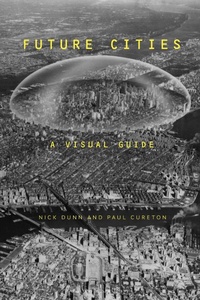
Future Cities
A Visual Guide
Published on 10. December 2020
Book
Paperback/Softback
224 pages
978-1-350-01165-6 (ISBN)
Description
What might our cities look like in ten, twenty or fifty years? How may future cities face global challenges? Imagining the city of the future has long been an inspiration for many architects, artists and designers. This book examines how cities of the future have been visualised, what these projects sought to communicate and what the implications may be for us now. It provides a visual history of the future and explores the relationships between different visualisation techniques and ideologies for cities.
Thinking about what futures are, who they are for, why they are desirable, and how and when they are to be brought into being is central to this book. Through visualisation we are able to experiment in ways that would be impractical and potentially hazardous in the real world, and this book, therefore, aims to contribute toward a better understanding of the power and agency of visualisations for future cities.
In this lavishly illustrated text, the authors apply several critical lenses to consider the subject in different ways: technological futures, social futures, and global futures, providing a comprehensive survey and analysis of visions for future cities, and engaging creatively with how we perceive tomorrow's world and future studies more widely.
Thinking about what futures are, who they are for, why they are desirable, and how and when they are to be brought into being is central to this book. Through visualisation we are able to experiment in ways that would be impractical and potentially hazardous in the real world, and this book, therefore, aims to contribute toward a better understanding of the power and agency of visualisations for future cities.
In this lavishly illustrated text, the authors apply several critical lenses to consider the subject in different ways: technological futures, social futures, and global futures, providing a comprehensive survey and analysis of visions for future cities, and engaging creatively with how we perceive tomorrow's world and future studies more widely.
Reviews / Votes
Images of future cities are one of the most revealing ways in which hopes, fears and plans about the future are imagined. This wonderful book brings together images of urban futures from a wide range of places, disciplines, histories, media and genres, to dizzying effect. Whether you make images of urban futures, you're interested in studying them, or you're a fascinated spectator, this book is an essential, imaginative, provocative and above all generous resource for thinking about how and why to picture future cities. * Gillian Rose, Professor of Human Geography, University of Oxford, UK * We conceive of the future via the images we make of it. This lavishly illustrated visual history of the city is a powerful reminder of the influence of images on our thinking about the future. It is an asset in times when we need to scan the probable, the possible and the preferable futures that lie ahead. A wonderful and valuable resource. * Maarten Hajer, Professor of Urban Futures, Utrecht University, the Netherlands *More details
Language
English
Place of publication
London
United Kingdom
Publishing group
Bloomsbury Publishing PLC
Target group
College/higher education
Illustrations
166 colour illus
Dimensions
Height: 243 mm
Width: 188 mm
Thickness: 14 mm
Weight
628 gr
ISBN-13
978-1-350-01165-6 (9781350011656)
Copyright in bibliographic data and cover images is held by Nielsen Book Services Limited or by the publishers or by their respective licensors: all rights reserved.
Schweitzer Classification
Other editions
Additional editions
E-Book
12/2020
1st Edition
Bloomsbury Visual Arts
€30.99
Available for download
E-Book
12/2020
1st Edition
Bloomsbury Visual Arts
€30.99
Available for download
Persons
Nick Dunn is Professor of Urban Design and Executive Director of Imagination, the design research lab at Lancaster University, UK. He is Senior Fellow at the Institute for Social Futures, examining the insights that the arts and humanities can bring to the ways we think, envision, and analyse the futures of people, places, and planet.
Paul Cureton is a Senior Lecturer in Design at ImaginationLancaster, and member of the Data Science Institute, Lancaster University, UK. His previous publications include Strategies for Landscape Representation: Digital and Analogue Techniques (2016) and Drone Futures: UAS in Landscape & Urban Design (2020).
Paul Cureton is a Senior Lecturer in Design at ImaginationLancaster, and member of the Data Science Institute, Lancaster University, UK. His previous publications include Strategies for Landscape Representation: Digital and Analogue Techniques (2016) and Drone Futures: UAS in Landscape & Urban Design (2020).
Content
List of Figures
List of Tables
Preface
Acknowledgements
1. Introduction: futures, imagination, and visions for cities
2. Cities of Vision: a visual history of the future
3. Rendering Tomorrow: the impact of visualisation techniques
4. Technological Futures: optimism, science fiction, and infrastructural systems
5. Social Futures: experiments, ephemerality, and experiences
6. Global Futures: challenges and opportunities for collective life
7. Tomorrow's Cities Today: conclusions and alternative futures
References
List of Tables
Preface
Acknowledgements
1. Introduction: futures, imagination, and visions for cities
2. Cities of Vision: a visual history of the future
3. Rendering Tomorrow: the impact of visualisation techniques
4. Technological Futures: optimism, science fiction, and infrastructural systems
5. Social Futures: experiments, ephemerality, and experiences
6. Global Futures: challenges and opportunities for collective life
7. Tomorrow's Cities Today: conclusions and alternative futures
References