

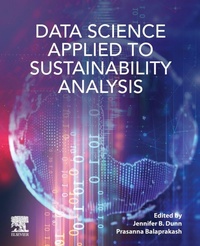
Data Science Applied to Sustainability Analysis
Published on 17. May 2021
Book
Paperback/Softback
310 pages
978-0-12-817976-5 (ISBN)
Description
Data Science Applied to Sustainability Analysis focuses on the methodological considerations associated with applying this tool in analysis techniques such as lifecycle assessment and materials flow analysis. As sustainability analysts need examples of applications of big data techniques that are defensible and practical in sustainability analyses and that yield actionable results that can inform policy development, corporate supply chain management strategy, or non-governmental organization positions, this book helps answer underlying questions. In addition, it addresses the need of data science experts looking for routes to apply their skills and knowledge to domain areas.
More details
Language
English
Place of publication
United States
Target group
Professional and scholarly
sustainability analysts, life cycle assessment practitioners, and industrial ecologists, data scientists seeking applications for techniques such as machine learning, computer vision, and other data science tools, policy makers, and graduate students
Product notice
Paperback (trade)
Unsewn / adhesive bound
Illustrations
Approx. 120 illustrations (60 in full color)
Dimensions
Height: 232 mm
Width: 187 mm
Thickness: 18 mm
Weight
628 gr
ISBN-13
978-0-12-817976-5 (9780128179765)
Copyright in bibliographic data and cover images is held by Nielsen Book Services Limited or by the publishers or by their respective licensors: all rights reserved.
Schweitzer Classification
Other editions
Additional editions
Jennifer Dunn | Prasanna Balaprakash
Data Science Applied to Sustainability Analysis
E-Book
05/2021
Elsevier
€131.00
Available for download
Persons
Jennifer B. Dunn is the Director of Research of the Northwestern-Argonne Institute of Science and a Research Associate Professor at Northwestern University in Chemical and Biological Engineering. She holds a joint appointment in the Energy Systems Division of Argonne National Laboratory, where she led the Biofuels Analysis Team before taking on her current role. In her research, Jennifer investigates life cycle energy consumption and environmental impacts of advanced transportation and fuel technologies, including biofuels and battery-powered electric drive vehicles. She is also interested in carbon capture and utilization (CCU), automotive lithium-ion battery impacts and recycling, and fit-for-purpose water treatment. She holds a PhD in Chemical Engineering from the University of Michigan. Prasanna Balaprakash is a computer scientist in the Mathematics and Computer Science Division with the joint appointment in the Leadership Computing Facility at Argonne National Laboratory. He is also a Fellow in the Northwestern-Argonne Institute of Science and Engineering of the Northwestern University. His research interests span the areas of artificial intelligence, machine learning, optimization, and high-performance computing. Currently, his research focus is on the automated design and development of scalable algorithms for solving large-scale problems that arise in scientific data analysis and in automating application performance modeling and tuning. He holds a Ph.D. in engineering sciences from CoDE-IRIDIA (AI Lab), Universite libre de Bruxelles, Brussels, Belgium, where he was a Marie Curie fellow and later an FNRS Aspirant.
Editor
Director of Research of the Northwestern-Argonne Institute of Science; Research Associate Professor, Northwestern University, USA
Computer Scientist, Mathematics and Computer Science Division, Joint Appointment in the Leadership Computing Facility, Argonne National Laboratory; Fellow, Northwestern University, USA
Content
I. Introduction
1. Overview of Data Science and Sustainability Analysis and State of their Co-Application
II. Enironmental Health and Sustainability
2. Applying AI for Conservation
3. Water balance characterization
4. Machine Learning in the Australian Critical Zone
III. Energy and Water
5. A Clustering Analysis of Energy and Water Consumption in U.S. States from 1985 to 2015
6. Energy footprint of big data evaluated with data science
7. Solar PV rooftop disaprities by race and ethnicity in US
8. Screening materials for solar pv
IV. Sustainable Systems Analysis
9. Machine Learning in life cycle analysis
10. Industry sustainable supply chain management with data science
V. Society and Policy
11. Machine Learning to Inform Enhance Environmental Enforcement
12. Sociologically informed use of remote sensing data to predict rural household poverty
13. Trade-offs Between Environmental and Social Indicators of Sustainability
VI. Conclusion
14. Research and Development for Increased Application of Data Science in Sustainability analysis
1. Overview of Data Science and Sustainability Analysis and State of their Co-Application
II. Enironmental Health and Sustainability
2. Applying AI for Conservation
3. Water balance characterization
4. Machine Learning in the Australian Critical Zone
III. Energy and Water
5. A Clustering Analysis of Energy and Water Consumption in U.S. States from 1985 to 2015
6. Energy footprint of big data evaluated with data science
7. Solar PV rooftop disaprities by race and ethnicity in US
8. Screening materials for solar pv
IV. Sustainable Systems Analysis
9. Machine Learning in life cycle analysis
10. Industry sustainable supply chain management with data science
V. Society and Policy
11. Machine Learning to Inform Enhance Environmental Enforcement
12. Sociologically informed use of remote sensing data to predict rural household poverty
13. Trade-offs Between Environmental and Social Indicators of Sustainability
VI. Conclusion
14. Research and Development for Increased Application of Data Science in Sustainability analysis