

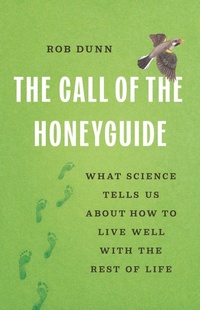
The Call of the Honeyguide
What Science Tells Us about How to Live Well with the Rest of Life
Published on 18. September 2025
Book
Hardback
384 pages
978-1-5416-0573-2 (ISBN)
Description
How rethinking our relationships with other species can help us reimagine the future of humankind
In the woodlands of sub-Saharan Africa, sometime deep in our species' past, something strange happened: a bird called out, not to warn others of human presence, but to call attention to herself. Having found a beehive, that bird-a honeyguide-sought human aid to break in. The behavior can seem almost miraculous: How would a bird come to think that people could help her? Isn't life simply bloodier than that?
As Rob Dunn argues in The Call of the Honeyguide, it isn't. Nature is red in tooth and claw, but in equal measure, life works together. Cells host even smaller life, wrapped in a web of mutual interdependence. Ants might go to war, but they also tend fungi, aphids, and even trees. And we humans work not just with honeyguides but with yeast, crops, and pets. Ecologists call these beneficial relationships mutualisms. And they might be the most important forces in the evolution of life.
We humans often act as though we are all alone, independent from the rest of life. As The Call of the Honeyguide shows, we are not. It is a call to action for a more beneficent, less lonely future.
In the woodlands of sub-Saharan Africa, sometime deep in our species' past, something strange happened: a bird called out, not to warn others of human presence, but to call attention to herself. Having found a beehive, that bird-a honeyguide-sought human aid to break in. The behavior can seem almost miraculous: How would a bird come to think that people could help her? Isn't life simply bloodier than that?
As Rob Dunn argues in The Call of the Honeyguide, it isn't. Nature is red in tooth and claw, but in equal measure, life works together. Cells host even smaller life, wrapped in a web of mutual interdependence. Ants might go to war, but they also tend fungi, aphids, and even trees. And we humans work not just with honeyguides but with yeast, crops, and pets. Ecologists call these beneficial relationships mutualisms. And they might be the most important forces in the evolution of life.
We humans often act as though we are all alone, independent from the rest of life. As The Call of the Honeyguide shows, we are not. It is a call to action for a more beneficent, less lonely future.
More details
Language
English
Place of publication
United States
Target group
College/higher education
Professional and scholarly
Product notice
Trade binding
Illustrations
23 BW images on text
Dimensions
Height: 242 mm
Width: 158 mm
Thickness: 30 mm
Weight
590 gr
ISBN-13
978-1-5416-0573-2 (9781541605732)
Copyright in bibliographic data and cover images is held by Nielsen Book Services Limited or by the publishers or by their respective licensors: all rights reserved.
Schweitzer Classification
Other editions
Additional editions
Rob Dunn
The Call of the Honeyguide
What Science Tells Us about How to Live Well with the Rest of Life
E-Book
08/2025
Basic Books
€13.99
Available for download
Person
Rob Dunn is professor in the Department of Applied Ecology and senior vice provost at North Carolina State University. He is the author of seven previous books, including A Natural History of the Future and Never Home Alone. He lives in Raleigh, North Carolina.