

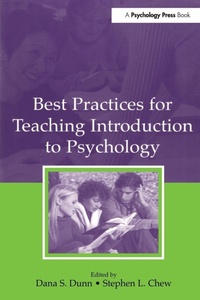
Best Practices for Teaching Introduction to Psychology
Published on 17. June 2005
Book
Paperback/Softback
304 pages
978-0-8058-5218-9 (ISBN)
Description
This new book provides a scholarly, yet practical approach to the challenges found in teaching introductory psychology. Best Practices for Teaching Introduction to Psychology addresses:
* developing the course and assessing student performance
* selecting which topics to cover and in how much depth
* the effective use of teaching assistants (TAs) and efficient and fair ways to construct and grade exams
* choosing the best textbook
* assessment advice on how to demonstrate students are learning;
* using on-line instruction, writing exercises, and class demonstrations
* teaching majors and non-majors in the same classroom.
This book will appeal to veteran and novice educators who teach introductory psychology as well as graduate students teaching the course for the first time. It will also serve as an excellent resource in faculty workshops on teaching introductory psychology.
* developing the course and assessing student performance
* selecting which topics to cover and in how much depth
* the effective use of teaching assistants (TAs) and efficient and fair ways to construct and grade exams
* choosing the best textbook
* assessment advice on how to demonstrate students are learning;
* using on-line instruction, writing exercises, and class demonstrations
* teaching majors and non-majors in the same classroom.
This book will appeal to veteran and novice educators who teach introductory psychology as well as graduate students teaching the course for the first time. It will also serve as an excellent resource in faculty workshops on teaching introductory psychology.
Reviews / Votes
"This edited volume will be a useful tool for the first-year graduate student who has to teach the course as well as for faculty who have taught the course for almost 20 years. Many of the issues discussed in Best Practices are similiar to issues that psychology faculty discuss for undergraduate and graduate psychology curricula." - PsycCRITIQUES"...many teaching books appear to be designed for beginning instructors...this book is unique in that it will also appeal to instructors who have taught the course for years." - Kevin J. Apple, James Madison University, USA
"I suspect that most faculty will use it as a reference to which they will return again and again as they confront various problems in teaching the Intro course..." - Douglas A. Bernstein, University of South Florida, USA "This edited volume will be a useful tool for the first-year graduate student who has to teach the course as well as for faculty who have taught the course for almost 20 years. Many of the issues discussed in Best Practices are similiar to issues that psychology faculty discuss for undergraduate and graduate psychology curricula." - PsycCRITIQUES
"I suspect that most faculty will use it as a reference to which they will return again and again as they confront various problems in teaching the Intro course..." - Douglas A. Bernstein, University of South Florida, USA
"...many teaching books appear to be designed for beginning instructors...this book is unique in that it will also appeal to instructors who have taught the course for years." - Kevin J. Apple, James Madison University, USA
More details
Language
English
Place of publication
Philadelphia
United States
Publishing group
Taylor & Francis Inc
Target group
College/higher education
Professional and scholarly
Dimensions
Height: 229 mm
Width: 152 mm
Thickness: 17 mm
Weight
446 gr
ISBN-13
978-0-8058-5218-9 (9780805852189)
Copyright in bibliographic data and cover images is held by Nielsen Book Services Limited or by the publishers or by their respective licensors: all rights reserved.
Schweitzer Classification
Other editions
Additional editions
Dana S. Dunn | Stephen L. Chew
Best Practices for Teaching Introduction to Psychology
E-Book
04/2006
Psychology Press Ltd
€64.49
Available for download
Dana S. Dunn | Stephen L. Chew
Best Practices for Teaching Introduction to Psychology
E-Book
04/2006
Psychology Press Ltd
€64.49
Available for download
Dana S. Dunn | Stephen L. Chew
Best Practices for Teaching Introduction to Psychology
E-Book
04/2006
1st Edition
Psychology Press
€57.99
Available for download
Dana S. Dunn | Stephen L. Chew
Best Practices for Teaching Introduction to Psychology
Book
06/2005
Psychology Press
€206.80
Shipment within 10-20 days
Persons
Dana S. Dunn, Stephen L. Chew
Content
G.W. Hill, IV, Foreword. D.S. Dunn, S.L. Chew, Preface. D.S. Dunn, S.L. Chew, Grounding the Teaching of Introductory Psychology: Rationale for and Overview of Best Practices. Part 1. Basic Issues.R.A. Griggs, Selecting an Introductory Textbook: They Are Not "All the Same." D.S. Dunn, M.E. Schmidt, S.B. Zaremba, On Becoming a Fox: Covering Unfamiliar Topics in Introductory Psychology. R.A.R. Gurung, D. Daniel, Evidence-Based Pedagogy: Do Text-Based Pedagogical Features Enhance Student Learning? D.C. Appleby, Defining, Teaching, and Assessing Critical Thinking in Introductory Psychology. A. Hackney, J.H. Korn, W. Buskist, Learning to Teach Introductory Psychology: Philosophy and Practice. Part 2. Alternative Approaches to Teaching Introductory Psychology.E. Johnson, J. Carton, Introductory Psychology Without the Big Book. J.E. Trimble, Enriching Introductory Psychology With Race and Ethnicity: Considerations for History of Psychology, Biopsychology, and Intelligence Measurement. R.M. Stoddart, M.J. McKinley, Using Narratives, Literature, and Primary Sources to Teach Introductory Psychology: An Interdisciplinary Approach. D.L. Finley, Teaching Introductory Psychology Online: Active Learning is Not an Oxymoron. T.E. Ludwig, C.W. Perdue, Multimedia and Computer-Based Learning in Introductory Psychology. M.M. Handelsman, Teaching Ethics in Introductory Psychology. Part 3. Assessment Issues. R.A. Smith, A.C. Fineburg, Standards and Outcomes: Encouraging Best Practices in Teaching Introductory Psychology. J.S. Halonen, C.M. Harris, D.A. Pastor, C.E. Abrahamsom, C.J. Huffman, Assessing General Education Outcomes in Introductory Psychology. Part 4. Focus on Student Learning.S.L. Chew, Seldom in Doubt but Often Wrong: Addressing Tenacious Student Misconceptions. V.A. Benassi, G.S. Goldstein, Students' Beliefs About Paranormal Claims: Implications for Teaching Introductory Psychology. C.E. Abrahamson, Motivating Students Through Personal Connections: Storytelling as Pedagogy in Introductory Psychology. Part 5. Last Words.D.G. Myers, Teaching Tips From Experienced Teachers: Advice for Introductory Psychology.