

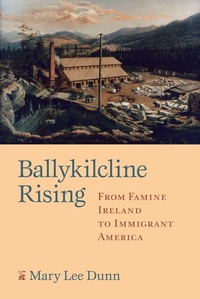
Ballykilcline Rising
From Famine Ireland to Immigrant America
Will be published approx. on 30. July 2008
Book
Paperback/Softback
256 pages
978-1-55849-659-0 (ISBN)
Description
This book shows how tenant farmers evicted from Ireland made a new life in the United States. In 1847, in the third year of Ireland's Great Famine and the thirteenth year of their rent strike against the Crown, hundreds of tenant farmers in Ballykilcline, County Roscommon, were evicted by the Queen's agents and shipped to New York. Mary Lee Dunn tells their story in this meticulously researched book. Using numerous Irish and U.S. sources and with descendants' help, she traces dozens of the evictees to Rutland, Vermont, as railroads and marble quarries transformed the local economy. She follows the immigrants up to 1870 and learns not only what happened to them but also what light American experience and records cast on their Irish ""rebellion.""Dunn begins with Ireland's pre-Famine social and political landscape as context for the Ballykilcline strike. The tenants had rented earlier from the Mahons of Strokestown, whose former property now houses Ireland's Famine Museum. In 1847, landlord Denis Mahon evicted and sent nearly a thousand tenants to Quebec, where half died before or just after reaching the Grosse Ile quarantine station. Mahon was gunned down months later. His murder provoked an international controversy involving the Vatican. An early suspect in the case was a man from Ballykilcline.In the United States, many of the immigrants resettled in clusters in several locations, including Vermont, Illinois, Iowa, Maryland, and New York. In Vermont they found jobs in the marble quarries, but some of them lost their homes again in quarry labor actions after 1859. Others prospered in their new lives. A number of Ballykilcline families who stopped in Rutland later moved west; one had a son kidnapped by Indians in Minnesota.Readers who have Irish Famine roots will gain a sense of their own ""back story"" from this account of Ireland and the native Irish, and scholars in the field of immigration studies will find it particularly useful.
Reviews / Votes
A well-researched, compelling narrative.... Dunn has scrupulously examined the events leading up to and following the forced evictions... she has extended the knowledge of the evictees by investigating their lives in detail on both sides of the Atlantic... and she has added significantly to our knowledge, not only of these few hundred, but also of the million emigrants who fled Ireland during the Great Famine. - Marie E. Daly, New England Historic Genealogical SocietyMore details
Language
English
Place of publication
Massachusetts
United States
Product notice
Paperback (trade)
Illustrations
14 illustrations
Dimensions
Height: 232 mm
Width: 154 mm
Thickness: 20 mm
Weight
432 gr
ISBN-13
978-1-55849-659-0 (9781558496590)
Copyright in bibliographic data and cover images is held by Nielsen Book Services Limited or by the publishers or by their respective licensors: all rights reserved.
Schweitzer Classification
Person
MARY LEE DUNN is a writer and editor affiliated with the graduate Department of Work Environment at the University of Massachusetts Lowell.