

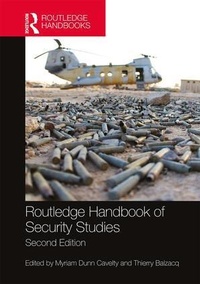
Routledge Handbook of Security Studies
2nd Edition
Published on 13. July 2016
Book
Hardback
480 pages
978-1-138-80393-0 (ISBN)
Description
This revised and updated second edition features over twenty new chapters and offers a wide-ranging collection of cutting-edge essays from leading scholars in the field of Security Studies.
The field of Security Studies has undergone significant change during the past 20 years, and is now one of the most dynamic sub-disciplines within International Relations. This second edition has been significantly updated to address contemporary and emerging security threats with chapters on organised crime, migration and security, cyber-security, energy security, the Syrian conflict and resilience, amongst many others. Comprising articles by both established and up-and-coming scholars, The Routledge Handbook of Security Studies provides a comprehensive overview of the key contemporary topics of research and debate in the field of Security Studies. The volume is divided into four main parts:
* Part I: Theoretical Approaches to Security
* Part II: Security Challenges
* Part III: Regional (In)Security
* Part IV: Security Governance
This new edition of the Handbook is a benchmark publication with major importance for both current research and the future of the field. It will be essential reading for all scholars and students of Security Studies, War and Conflict Studies, and International Relations.
The field of Security Studies has undergone significant change during the past 20 years, and is now one of the most dynamic sub-disciplines within International Relations. This second edition has been significantly updated to address contemporary and emerging security threats with chapters on organised crime, migration and security, cyber-security, energy security, the Syrian conflict and resilience, amongst many others. Comprising articles by both established and up-and-coming scholars, The Routledge Handbook of Security Studies provides a comprehensive overview of the key contemporary topics of research and debate in the field of Security Studies. The volume is divided into four main parts:
* Part I: Theoretical Approaches to Security
* Part II: Security Challenges
* Part III: Regional (In)Security
* Part IV: Security Governance
This new edition of the Handbook is a benchmark publication with major importance for both current research and the future of the field. It will be essential reading for all scholars and students of Security Studies, War and Conflict Studies, and International Relations.
Reviews / Votes
'Overall, this is the best available introduction to the field for graduate students, academics, and practitioners. Highly Recommended.' -- CHOICE review of the first editionMore details
Edition
2nd edition
Language
English
Place of publication
London
United Kingdom
Publishing group
Taylor & Francis Ltd
Target group
College/higher education
Professional and scholarly
Postgraduate, Professional, and Undergraduate
Edition type
New edition
Product notice
sewn/stitched
Cloth over boards
Illustrations
9 s/w Zeichnungen, 7 s/w Tabellen
7 Tables, black and white; 9 Line drawings, black and white
Dimensions
Height: 249 mm
Width: 175 mm
Thickness: 30 mm
Weight
1021 gr
ISBN-13
978-1-138-80393-0 (9781138803930)
Copyright in bibliographic data and cover images is held by Nielsen Book Services Limited or by the publishers or by their respective licensors: all rights reserved.
Schweitzer Classification
Other editions
Additional editions
Myriam Dunn Cavelty | Thierry Balzacq
Routledge Handbook of Security Studies
Book
07/2018
2nd Edition
Routledge
€81.30
Shipment within 10-20 days
Myriam Dunn Cavelty | Thierry Balzacq
Routledge Handbook of Security Studies
E-Book
07/2016
2nd Edition
Routledge
€67.49
Available for download
Myriam Dunn Cavelty | Thierry Balzacq
Routledge Handbook of Security Studies
E-Book
07/2016
2nd Edition
Routledge
€67.49
Available for download
Previous edition
Myriam Dunn Cavelty | Victor Mauer
The Routledge Handbook of Security Studies
Book
11/2009
Routledge
€223.21
Article exhausted; check for reprint
Persons
Myriam Dunn Cavelty is Senior Lecturer and Deputy Head of research and teaching at the Center for Security Studies (CSS), ETH Zurich, Switzerland. She is the author of Cyber-Security and Threat Politics: US Efforts to Secure the Information Age (Routledge, 2008).
Thierry Balzacq is Professor and Tocqueville Chair in International Relations at the University of Namur, Belgium, and Scientific Director at the Institute for Strategic Research at the French Ministry of Defense. His most recent books include Contesting Security (Routledge, 2014), and Traite de Relations Internationales (co-edited with F. Ramel, 2013).
Thierry Balzacq is Professor and Tocqueville Chair in International Relations at the University of Namur, Belgium, and Scientific Director at the Institute for Strategic Research at the French Ministry of Defense. His most recent books include Contesting Security (Routledge, 2014), and Traite de Relations Internationales (co-edited with F. Ramel, 2013).
Content
Introduction, Thierry Balzacq and Myriam Dunn Cavelty
Part I: Theoretical Approaches to Security
1. Realism and Security Studies, William C. Wohlforth
2. Liberalism: A Theoretical and Empirical Assessment, Thomas C. Walker and David L. Rousseau
3. International Political Economy and Security, Heikki Patomaeki
4. The English School and International Security, Barry Buzan
5. Critical Security Studies, David Mutimer
6. Constructivism and Securitization Studies, Juha Vuori
7. Poststructuralist Approaches to Security, Claudia Aradau and Rens van Munster
8. Feminist Security Studies, Annick T.R. Wibben
9. Postcolonialism: Interrogating National Security and Drone Warfare, Sheila Nair
10. Human Security: Lessons Learned from Afghanistan, Gunhild Hoogensen Gjorv
11. Risk and Security, Karen Lund Petersen
12. Security as Practice, Christian Bueger
Part II: Security Challenges
13. Terrorism and Counterterrorism, Oldrich Bures
14. Organised Crime , Adam Edwards
15. Migration and Security, Jef Huysmans and Vicki Squire
16. Cyber-Security, Ronald Deibert
17. War, Christopher Coker
18. Ethnic and Religious Violence, Delphine Alles
19. Energy Security, Robert W. Orttung
20. Resources, the Environment, and Conflict, Nils Petter Gleditsch and Ole Magnus Theisen
21. Pandemics and Global Health, Simon Rushton and Sonja Kittelsen
Part III: Regional (In)Security
22. China's Rise: Counterproductive Fearmongering, Jiun Bang and David C. Kang
23. Indian Security Policy, Sumit Ganguly
24. Afghanistan: A State in Limbo, Amin Saikal
25. Iran, Rouzbeh Parsi
26. Intervention in Iraq: From Regime Change to De Facto Partition, Gareth Stansfield
27. The Syrian Crisis and International Security, Raymond Hinnebusch
28. Israel-Palestine: An Archipelago of (In)Security, Nada Ghandour-Demiri
29. Analysing Drug Violence in Mexico, Kimberly Heinle, Octavio Rodriguez and David A. Shirk
30. Conflict in the Democratic Republic of Congo, Pierre Englebert
31. Russia's Revival, Jeffrey Mankoff
Part IV: Security Governance
32. Alliances, Carlo Masala and Alessandro Scheffler Corvaja
33. International Sanctions, Olivier Schmitt
34. Deterrence, Richard Ned Lebow
35. Nuclear Non-Proliferation, Wilfred Wan
36. Public Diplomacy in a National Security Context, Nancy Snow
37. Statebuilding, Tobias Debiel and Patricia Rinck
38. Humanitarian Intervention, Aidan Hehir
39. Global Security Governance, Thomas J. Biersteker
40. Resilience, David Chandler
41. The Study of Crisis Management, Arjen Boin, Magnus Ekengren and Mark Rhinard
42. 'Killer Robots' and Preventive Arms Control, Myriam Dunn Cavelty, Sophie-Charlotte Fischer and Thierry Balzacq
Part I: Theoretical Approaches to Security
1. Realism and Security Studies, William C. Wohlforth
2. Liberalism: A Theoretical and Empirical Assessment, Thomas C. Walker and David L. Rousseau
3. International Political Economy and Security, Heikki Patomaeki
4. The English School and International Security, Barry Buzan
5. Critical Security Studies, David Mutimer
6. Constructivism and Securitization Studies, Juha Vuori
7. Poststructuralist Approaches to Security, Claudia Aradau and Rens van Munster
8. Feminist Security Studies, Annick T.R. Wibben
9. Postcolonialism: Interrogating National Security and Drone Warfare, Sheila Nair
10. Human Security: Lessons Learned from Afghanistan, Gunhild Hoogensen Gjorv
11. Risk and Security, Karen Lund Petersen
12. Security as Practice, Christian Bueger
Part II: Security Challenges
13. Terrorism and Counterterrorism, Oldrich Bures
14. Organised Crime , Adam Edwards
15. Migration and Security, Jef Huysmans and Vicki Squire
16. Cyber-Security, Ronald Deibert
17. War, Christopher Coker
18. Ethnic and Religious Violence, Delphine Alles
19. Energy Security, Robert W. Orttung
20. Resources, the Environment, and Conflict, Nils Petter Gleditsch and Ole Magnus Theisen
21. Pandemics and Global Health, Simon Rushton and Sonja Kittelsen
Part III: Regional (In)Security
22. China's Rise: Counterproductive Fearmongering, Jiun Bang and David C. Kang
23. Indian Security Policy, Sumit Ganguly
24. Afghanistan: A State in Limbo, Amin Saikal
25. Iran, Rouzbeh Parsi
26. Intervention in Iraq: From Regime Change to De Facto Partition, Gareth Stansfield
27. The Syrian Crisis and International Security, Raymond Hinnebusch
28. Israel-Palestine: An Archipelago of (In)Security, Nada Ghandour-Demiri
29. Analysing Drug Violence in Mexico, Kimberly Heinle, Octavio Rodriguez and David A. Shirk
30. Conflict in the Democratic Republic of Congo, Pierre Englebert
31. Russia's Revival, Jeffrey Mankoff
Part IV: Security Governance
32. Alliances, Carlo Masala and Alessandro Scheffler Corvaja
33. International Sanctions, Olivier Schmitt
34. Deterrence, Richard Ned Lebow
35. Nuclear Non-Proliferation, Wilfred Wan
36. Public Diplomacy in a National Security Context, Nancy Snow
37. Statebuilding, Tobias Debiel and Patricia Rinck
38. Humanitarian Intervention, Aidan Hehir
39. Global Security Governance, Thomas J. Biersteker
40. Resilience, David Chandler
41. The Study of Crisis Management, Arjen Boin, Magnus Ekengren and Mark Rhinard
42. 'Killer Robots' and Preventive Arms Control, Myriam Dunn Cavelty, Sophie-Charlotte Fischer and Thierry Balzacq