

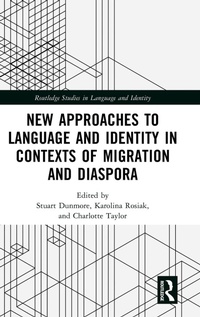
New Approaches to Language and Identity in Contexts of Migration and Diaspora
1st Edition
Published on 17. July 2024
Book
Hardback
188 pages
978-1-032-44738-4 (ISBN)
Description
New Approaches to Language and Identity in Contexts of Migration and Diaspora draws together expertise and contemporary research findings in respect of language and identity in migrant and diasporic contexts throughout the world.
Over thirteen chapters, contributors examine the intersection between migration, language, and identity through analyses of migration discourses, language practices, and legal policy, as well as the ideologies embedded and revealed within them. A wide range of subject areas and interdisciplinary approaches are represented, with fifteen authors drawn from the fields of education, intercultural communication, linguistics, geography, migration studies, psychology, and sociology.
This volume will primarily appeal to scholars and researchers in fields such as migration, intercultural communication, sociolinguistics, bilingualism, multilingualism, and heritage language learning.
Over thirteen chapters, contributors examine the intersection between migration, language, and identity through analyses of migration discourses, language practices, and legal policy, as well as the ideologies embedded and revealed within them. A wide range of subject areas and interdisciplinary approaches are represented, with fifteen authors drawn from the fields of education, intercultural communication, linguistics, geography, migration studies, psychology, and sociology.
This volume will primarily appeal to scholars and researchers in fields such as migration, intercultural communication, sociolinguistics, bilingualism, multilingualism, and heritage language learning.
More details
Series
Language
English
Place of publication
London
United Kingdom
Publishing group
Taylor & Francis Ltd
Target group
College/higher education
Professional and scholarly
Academic, Postgraduate, and Undergraduate Advanced
Illustrations
24 s/w Abbildungen, 5 s/w Photographien bzw. Rasterbilder, 19 s/w Zeichnungen, 21 s/w Tabellen
21 Tables, black and white; 19 Line drawings, black and white; 5 Halftones, black and white; 24 Illustrations, black and white
Dimensions
Height: 240 mm
Width: 161 mm
Thickness: 15 mm
Weight
467 gr
ISBN-13
978-1-032-44738-4 (9781032447384)
Copyright in bibliographic data and cover images is held by Nielsen Book Services Limited or by the publishers or by their respective licensors: all rights reserved.
Schweitzer Classification
Other editions
Additional editions
Stuart Dunmore | Karolina Rosiak | Charlotte Taylor
New Approaches to Language and Identity in Contexts of Migration and Diaspora
Book
approx. 11/2025
1st Edition
Routledge
€63.60
Not yet published
Stuart Dunmore | Karolina Rosiak | Charlotte Taylor
New Approaches to Language and Identity in Contexts of Migration and Diaspora
E-Book
07/2024
1st Edition
Routledge
€60.99
Available for download
Stuart Dunmore | Karolina Rosiak | Charlotte Taylor
New Approaches to Language and Identity in Contexts of Migration and Diaspora
E-Book
07/2024
1st Edition
Routledge
€60.99
Available for download
Persons
Stuart Dunmore is an associate tutor at the Institute for Language Education in the University of Edinburgh. His research examines language ideologies, minority language use, and cultural identities, with particular reference to Celtic language communities in the UK and North America. In 2022 he was a Fulbright scholar at Harvard University.
Karolina Rosiak is an assistant professor at the Celtic Studies Research Unit, Faculty of English at Adam Mickiewicz University in Poznan. Her research examines the sociolinguistics of the Welsh language, linguistic aspects of Polish migration to Wales, with a particular focus on language attitudes and ideologies, and cultural ties between Wales and Poland.
Charlotte Taylor is a professor of discourse and persuasion at the University of Sussex. Her research interests are centred on language use, discourse analysis, and pragmatics, particularly in relation to politeness, migration, nostalgia, and metaphor.
Karolina Rosiak is an assistant professor at the Celtic Studies Research Unit, Faculty of English at Adam Mickiewicz University in Poznan. Her research examines the sociolinguistics of the Welsh language, linguistic aspects of Polish migration to Wales, with a particular focus on language attitudes and ideologies, and cultural ties between Wales and Poland.
Charlotte Taylor is a professor of discourse and persuasion at the University of Sussex. Her research interests are centred on language use, discourse analysis, and pragmatics, particularly in relation to politeness, migration, nostalgia, and metaphor.
Content
Acknowledgements
List of contributors
1. Language and identity in Contexts of Migration and Diaspora - Introductory Remarks
2. "And suddenly the foreign, the Other, is no longer so foreign": Polish Cafe as a grassroots initiative of linguistic integration
3. "I think I speak European!": Tracing immigrant identities in Edinburgh, Scotland
4. Divergent language ideologies in a transatlantic minority: Gaelic in Scotland and Nova Scotia
5. Degrees of Belonging in Diasporic Contexts: Indexical scales of Vietnamese-ness in the UK
6. Formation and life course impact of language identity: A case study of Japanese returnees from China
7. Hybrid Language Identity of the Second-Generation Immigrants in Cyprus
8. Language Landscapes and Native Resilience: Land-Connectivity, Language, and Identity among Urban Native Americans
9. Language, accent and the experience of belonging for the second-generation Irish from England
10. Linguistic Identity of the second generation of Arabic speakers in Italy
11. Narratives of (un)belonging: Language management and identity negotiations in two immigrant families in New Zealand
12. The Performance of Agentic Identity by Refugees in Edinburgh: challenging the Victim Frame.
13. Epilogue and Future research directions in migration, language and identity
Index
List of contributors
1. Language and identity in Contexts of Migration and Diaspora - Introductory Remarks
2. "And suddenly the foreign, the Other, is no longer so foreign": Polish Cafe as a grassroots initiative of linguistic integration
3. "I think I speak European!": Tracing immigrant identities in Edinburgh, Scotland
4. Divergent language ideologies in a transatlantic minority: Gaelic in Scotland and Nova Scotia
5. Degrees of Belonging in Diasporic Contexts: Indexical scales of Vietnamese-ness in the UK
6. Formation and life course impact of language identity: A case study of Japanese returnees from China
7. Hybrid Language Identity of the Second-Generation Immigrants in Cyprus
8. Language Landscapes and Native Resilience: Land-Connectivity, Language, and Identity among Urban Native Americans
9. Language, accent and the experience of belonging for the second-generation Irish from England
10. Linguistic Identity of the second generation of Arabic speakers in Italy
11. Narratives of (un)belonging: Language management and identity negotiations in two immigrant families in New Zealand
12. The Performance of Agentic Identity by Refugees in Edinburgh: challenging the Victim Frame.
13. Epilogue and Future research directions in migration, language and identity
Index