

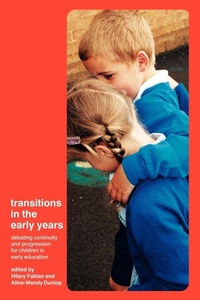
Transitions in the Early Years
Debating Continuity and Progression for Children in Early Education
Published on 12. September 2002
Book
Paperback/Softback
188 pages
978-0-415-27640-5 (ISBN)
Description
By the time young children enter statutory education, they may have already attended a number of different educational settings, from entry to group settings outside home, to joining playgroup or nursery school. Each of these experiences is likely to affect children's capacity to adjust and to learn.
This book focuses on children's experiences of personal and curricular transitions in early childhood. The authors are all academics with international reputations in the field of early childhood education. They draw on their research in Europe, Australasia and the USA to consider issues such as:
*the optimum environment and appropriate pedagogy for young children's learning
*how children, parents and educators cope with the transition from home to the first educational settings
*the ways in which professionals can better support and empower children in transition
The perspectives of children, parents and early years educators are all considered and case study examples are used throughout.
This book will be essential reading for anyone involved in working with young children and their families, including students on early years courses, early years practitioners and early years policy makers.
This book focuses on children's experiences of personal and curricular transitions in early childhood. The authors are all academics with international reputations in the field of early childhood education. They draw on their research in Europe, Australasia and the USA to consider issues such as:
*the optimum environment and appropriate pedagogy for young children's learning
*how children, parents and educators cope with the transition from home to the first educational settings
*the ways in which professionals can better support and empower children in transition
The perspectives of children, parents and early years educators are all considered and case study examples are used throughout.
This book will be essential reading for anyone involved in working with young children and their families, including students on early years courses, early years practitioners and early years policy makers.
More details
Language
English
Place of publication
London
United Kingdom
Publishing group
Taylor & Francis Ltd
Target group
College/higher education
Professional and scholarly
Dimensions
Height: 234 mm
Width: 156 mm
Thickness: 10 mm
Weight
295 gr
ISBN-13
978-0-415-27640-5 (9780415276405)
Copyright in bibliographic data and cover images is held by Nielsen Book Services Limited or by the publishers or by their respective licensors: all rights reserved.
Schweitzer Classification
Other editions
Additional editions
Aline-Wendy Dunlop | Hilary Fabian
Transitions in the Early Years
Debating Continuity and Progression for Children in Early Education
E-Book
11/2002
Routledge
€63.49
Available for download
Aline-Wendy Dunlop | Hilary Fabian
Transitions in the Early Years
Debating Continuity and Progression for Children in Early Education
E-Book
11/2002
Routledge
€63.49
Available for download
Aline-Wendy Dunlop | Hilary Fabian
Transitions in the Early Years
Debating Continuity and Progression for Children in Early Education
Book
09/2002
Routledge
€261.70
Shipment within 15-20 days
Persons
Content
1. The Wider Context: An International Overview of Transition Issues 2. The Importance of Social Adjustment for Future Success 3. From Home to Childcare: Challenges for Mothers, Teachers and Children 4. Communication and Continuity in the Transition from Kindergarten to School 5. Co-constructing Transition to School by Children, Parents and Teachers 6. Parents' Views of Transition to School and their Influence on its Content 7. Teachers' Perspectives on Children as Learners in the Transition to School 8. Perspectives on Children as Learners in the Transition to School 9. Planning Transition Programmes 10. Empowering Children for Transitions 11. Transitions Without School 12. Conclusion