

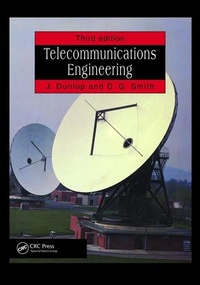
Telecommunications Engineering
3rd Edition
Published on 2. October 2017
Book
Hardback
593 pages
978-1-138-47241-9 (ISBN)
Description
Since the publication of the second edition of this highly acclaimed textbook, telecommunications has progressed at a rapid rate. Major advances continue to occur in mobile communications and broadband digital networks and services, sophisticated signal processing techniques are prevalent at increasingly higher bit rates, and digital systems are widespread. These developments need to be addressed in a textbook that bridges the gap in the current knowledge and teachings of telecommunications engineering.
Telecommunications Engineering, 3rd Edition offers an introduction to the major telecommunications topics by combining an analytical approach to important concepts with a descriptive account of systems design. Completely updated and expanded, this third edition includes substantial material on integrated services digital networks, mobile communications systems, metropolitan area networks, and more.
What's New in the 3rd Edition
* New chapter on mobile communications covering first generation analog and second generation digital systems
* Expanded chapter on non-linear coding of voice waveforms for PCM
* New section on NICAM
* Updated chapter on the transient performance of the phase locked loop
* Revised chapter on recent major developments in satellite television
* New introduction to coding techniques for burst errors
* Extended chapter on ISDN and broadband digital communications
Supplemented with worked problems, numerous illustrations, and extensive references to more advanced material, this textbook provides a solid foundation for undergraduate students of electrical, electronic, and telecommunications engineering.
Telecommunications Engineering, 3rd Edition offers an introduction to the major telecommunications topics by combining an analytical approach to important concepts with a descriptive account of systems design. Completely updated and expanded, this third edition includes substantial material on integrated services digital networks, mobile communications systems, metropolitan area networks, and more.
What's New in the 3rd Edition
* New chapter on mobile communications covering first generation analog and second generation digital systems
* Expanded chapter on non-linear coding of voice waveforms for PCM
* New section on NICAM
* Updated chapter on the transient performance of the phase locked loop
* Revised chapter on recent major developments in satellite television
* New introduction to coding techniques for burst errors
* Extended chapter on ISDN and broadband digital communications
Supplemented with worked problems, numerous illustrations, and extensive references to more advanced material, this textbook provides a solid foundation for undergraduate students of electrical, electronic, and telecommunications engineering.
More details
Edition
3rd edition
Language
English
Place of publication
London
United Kingdom
Publishing group
Taylor & Francis Ltd
Target group
College/higher education
Undergraduate
Dimensions
Height: 254 mm
Width: 178 mm
Weight
453 gr
ISBN-13
978-1-138-47241-9 (9781138472419)
Copyright in bibliographic data and cover images is held by Nielsen Book Services Limited or by the publishers or by their respective licensors: all rights reserved.
Schweitzer Classification
Other editions
Additional editions
John Dunlop
Telecommunications Engineering
E-Book
10/2017
3rd Edition
Routledge
€72.49
Available for download
John Dunlop
Telecommunications Engineering
E-Book
10/2017
3rd Edition
Routledge
€72.49
Available for download
John Dunlop
Telecommunications Engineering
Book
10/1994
3rd Edition
Nelson Thornes Ltd
€81.10
Shipment within 10-20 days
Person
John Dunlop
Content
Preface to the third edition, Preface to the second edition, Preface to the first edition, List of symbols and abbreviations, 1: Signals and channels, 2: Analogue modulation theory, 3: Discrete signals, 4: Noise in analogue communications systems, 5: Noise in digital communications systems, 6: High-frequency transmission lines, 7: Antennas, 8: Active microwave devices, 9: Passive microwave devices, 10: Telephony, 11: Television systems, 12: Optical fibre communications, 13: Packet switched networks, 14: Satellite communications, 15: Mobile communication systems, Appendix A: Four-figure Bessel functions, Appendix B: Useful trigonometric identities, Appendix C: Normal error function, Appendix D: Blocked-calls-cleared (Erlang B), Index