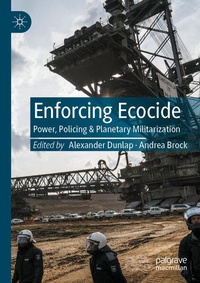
Policing and ecological crises - and all the inequalities, discrimination, and violence they entail - are pressing contemporary problems. Ecological degradation, biodiversity loss, and climate change threaten local communities and ecosystems, and, cumulatively, the planet as a whole. Police brutality, wars, paramilitarism, private security operations, and securitization more widely impact people - especially people of colour - and habitats. This edited collection explores their relationship, and investigates the numerous ways in which police, security, and military forces intersect with, reinforce, and facilitate ecological and climate catastrophe. Employing a case study-based approach, the book examines the relationships and entanglements between policing and ecosystems, revealing the intimate connection between political violence and ecological degradation.
Edition
Language
Place of publication
Publishing group
Springer International Publishing
Target group
Professional and scholarly
Illustrations
6 farbige Abbildungen, 13 s/w Abbildungen
XIX, 336 p. 19 illus., 6 illus. in color.
Dimensions
Height: 210 mm
Width: 148 mm
Thickness: 20 mm
Weight
ISBN-13
978-3-030-99648-2 (9783030996482)
DOI
10.1007/978-3-030-99646-8
Schweitzer Classification
Alexander Dunlap
is a postdoctoral research fellow at the Centre for Development and the Environment, University of Oslo. His work has critically examined police-military transformations, market-based conservation, wind energy development and extractive projects more generally in both Latin America and Europe. He is the author of two books:
Renewing Destruction: Wind Energy Development, Conflict and Resistance in a Latin American Context
(2019, Rowman & Littlefield) and
The Violent Technologies of Extraction
(2020, Palgrave).
Andrea Brock
is a lecturer at the Department of International Relations, Centre for Global Political Economy and STEPS Centre at the University of Sussex. Her work examines a wide range of techniques and technologies to manage anti-extractive projects, including criminalisation and co-option of dissent and greenwashing. She is interested in political ecologies of mining, corporate power, and statism.
Chapter 1. Introduction: Securing Ecological Destruction (
b
y Alexander Dunlap and Andrea Brock
).- Part 1: Hydrocarbon Militarization.- Chapter 2. A Postcolonial History of Accumulation by Contamination in the Gulf (
b
y Michael Hennessy Picard & Tina Beigi
).- Chapter 3. Beyond Rentier State and Climate Conflict: Clashing Environmental Imaginaries and Ecological Oppression in Iran (
by Maziar Samiee
).- Chapter 4. Policing Indigenous Land Defense and Climate Activism: Learnings from the Frontlines of Pipeline Resistance in Canada (
b
y Jen Gobby and Lucy Everett
).- Part 2: Enforcing Extraction.- Chapter 5. Global Britain and London's Mega-mining Corporations: Colonial Ecocide, Extractive Zones, and Frontiers of Martial Mining (
by Daniel Selwyn
).- Chapter 6. The Self-Reinforcing Cycle of Ecological Degradation & Repression: Uprooting the Ecological Coast of Policing & Militarization (
by Alexander Dunlap
).- Chapter 7. Oil, Arms and Emissions - The Role of the Military in a Changing Climate (
b
y Wendela de
Vries
).- Part 3: Policing Ecosystems.- Chapter 8. If the Army Cuts Trees, Why Can't We? Resource Extraction, Hunting and the Impacts of Militaries on Biodiversity Conservation (
b
y Anwesha Dutta and
Trishant
Simlai
).- Chapter 9. Policing the High Speed 2 (HS2) train line - repression and collusion along Europe's biggest infrastructure project (
by Andrea Brock and Jan Goodey
).- Chapter 10. Ecological Terror and Pacification: Counterinsurgency for the Climate Crisis (
by Peter Gelderloos
).- Part 4: Looking forward.- Chapter 11. Demilitarize for a Just Transition (
b
y Matthew Burke and Nina L. Smolyar
).