

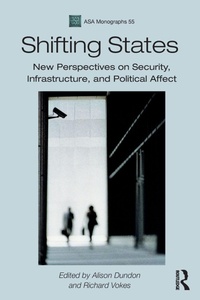
Shifting States
New Perspectives on Security, Infrastructure, and Political Affect
1st Edition
Published on 9. January 2023
Book
Paperback/Softback
222 pages
978-1-350-12556-8 (ISBN)
Description
Shifting States draws on a rich history of anthropological theorising on all kinds of states - from the pre- to the post- industrial - and explores topics as diverse as bureaucracy, infrastructure, surveillance, securitization, and public health.
As we enter the third decade of the twentieth century, there is a growing sense that 'the state' is in crisis everywhere. Although the nature of this perceived crisis varies from place to place, everywhere it is seen to have been caused by some combination of the inter-related forces of 'globalisation', of successive economic shocks, and of the rise of social media-fuelled populist movements. Yet, conversely, there is also a creeping perception that state power is becoming more pervasive in its reach, and in its effects, in ways which make it ever more imminent to the material worlds in which we live, more fundamental to the ways in which we conceive of the future, and more foundational to our very sense of self. How might we try to make sense of, and to mediate, these apparently contradictory impressions?
Based on ethnographic case studies from all over the world, this timely volume forges new ways of thinking about how state power manifests, and is imagined, and about the effects it has on ordinary people's lives. In so doing, the volume provides tools not only for understanding states' responses to the COVID-19 pandemic, but also for judging what effects these responses are likely to have.
As we enter the third decade of the twentieth century, there is a growing sense that 'the state' is in crisis everywhere. Although the nature of this perceived crisis varies from place to place, everywhere it is seen to have been caused by some combination of the inter-related forces of 'globalisation', of successive economic shocks, and of the rise of social media-fuelled populist movements. Yet, conversely, there is also a creeping perception that state power is becoming more pervasive in its reach, and in its effects, in ways which make it ever more imminent to the material worlds in which we live, more fundamental to the ways in which we conceive of the future, and more foundational to our very sense of self. How might we try to make sense of, and to mediate, these apparently contradictory impressions?
Based on ethnographic case studies from all over the world, this timely volume forges new ways of thinking about how state power manifests, and is imagined, and about the effects it has on ordinary people's lives. In so doing, the volume provides tools not only for understanding states' responses to the COVID-19 pandemic, but also for judging what effects these responses are likely to have.
More details
Series
Language
English
Place of publication
London
United Kingdom
Publishing group
Bloomsbury Publishing PLC
Illustrations
7 s/w Abbildungen, 7 s/w Photographien bzw. Rasterbilder
7 Halftones, black and white; 7 Illustrations, black and white
Dimensions
Height: 234 mm
Width: 156 mm
Thickness: 13 mm
Weight
365 gr
ISBN-13
978-1-350-12556-8 (9781350125568)
Copyright in bibliographic data and cover images is held by Nielsen Book Services Limited or by the publishers or by their respective licensors: all rights reserved.
Schweitzer Classification
Other editions
Additional editions
Alison Dundon | Richard Vokes
Shifting States
New Perspectives on Security, Infrastructure, and Political Affect
Book
12/2020
1st Edition
Routledge
€206.30
Shipment within 15-20 days
Alison Dundon | Richard Vokes
Shifting States
New Perspectives on Security, Infrastructure, and Political Affect
E-Book
12/2020
1st Edition
Routledge
€55.49
Available for download
Alison Dundon | Richard Vokes
Shifting States
New Perspectives on Security, Infrastructure, and Political Affect
E-Book
12/2020
1st Edition
Routledge
€55.49
Available for download
Persons
Alison Dundon is Senior Lecturer in the Department of Anthropology and Development Studies at the University of Adelaide, Australia.
Richard Vokes is Associate Professor of Anthropology at the University of Western Australia.
Richard Vokes is Associate Professor of Anthropology at the University of Western Australia.
Content
Introduction Part I: Ethnographies of Infrastructure: Assemblage, Experimentation, and Mobilization 1. Contingent statecraft: infrastructures, political creativity, and experimentation 2. Materialising the state: the meaning of water infrastructure 3. Driving into the nation-state: driving, roads, and selfhood in a post-socialist milieu 4. State of the grain: grain of the state: the political- and moral-economy of rice in Indonesia Part II: Dialectics of Security, Surveillance, and Struggle 5. Indigenous social policy, settler colonial dependencies, and toxic lingerings: living through mining and militarism in the Anthropocene 6. Awkward biculturalism: embodying ambiguity in New Zealand Army haka 7. Fear of a free lunch: markets, publics, and the would-be gift Part III: Sensory States, and their Contingent Citizenries 8. Intimate tonguing: the governance of the tongue in smokefree Australia 9. Sensing late-liberal state failure: ecologies of resistance in a post-industrial German city 10. Dialysis in the desert: blood, biomedial technologies, and transformation in Central Australia 11. 'Looking for a nice face': shifting states of marriage and intimate citizenship in Papua New Guinea 12. The state of silence as sensory and social: towards an anthropological appreciation