

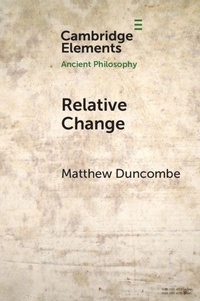
Relative Change
Published on 8. October 2020
Book
Paperback/Softback
72 pages
978-1-108-71342-9 (ISBN)
Description
A relative change occurs when some item changes a relation. This Element examines how Plato, Aristotle, Stoics and Sextus Empiricus approached relative change. Relative change is puzzling because the following three propositions each seem true but cannot be true together: (1) No relative changes are intrinsic changes; (2) Only intrinsic changes are proper changes; (3) Some relative changes are proper changes. Plato's Theaetetus and Phaedo property relative change. I argue that these dialogues assume relative changes to be intrinsic changes, so denying (1). Aristotle responds differently, by denying (3) that relative change is proper change. The Stoics claimed that some non-intrinsic changes are changes (denying (2)). Finally, I discuss Sextus' argument that relative change shows that there are no relatives at all.
More details
Series
Language
English
Place of publication
Cambridge
United Kingdom
Target group
Professional and scholarly
Product notice
Paperback (trade)
Illustrations
Worked examples or Exercises
Dimensions
Height: 229 mm
Width: 152 mm
Thickness: 4 mm
Weight
109 gr
ISBN-13
978-1-108-71342-9 (9781108713429)
Copyright in bibliographic data and cover images is held by Nielsen Book Services Limited or by the publishers or by their respective licensors: all rights reserved.
Schweitzer Classification
Other editions
Additional editions
Matthew Duncombe
Relative Change
E-Book
10/2020
Cambridge University Press
€14.49
Available for download
Matthew Duncombe
Relative Change
E-Book
09/2020
Cambridge University Press
€15.49
Available for download
Person
Matthew Duncombe is an Assistant Professor in the Department of Philosophy at the University of Nottingham. He held a British Academy Postdoctoral Fellowship at Durham University and was a post-doctoral research fellow at the University of Groningen. He studied philosophy and Classics at the University of Cambridge.
Content
Introduction; 1. Plato; 2. Aristotle; 3. Stoics and Sceptics; Conclusion.