

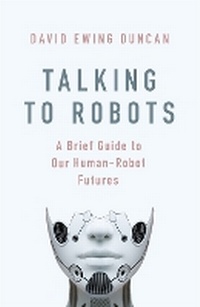
Talking to Robots
A Brief Guide to Our Human-Robot Futures
Published on 13. June 2019
Book
Paperback/Softback
320 pages
978-1-4721-4291-7 (ISBN)
Description
What robot and AI systems are being built and imagined right now? What do they say about us, their creators? Will they usher in a fantastic new future, or destroy us? What do some of our greatest thinkers, from physicist Brian Greene and futurist Kevin Kelly to inventor Dean Kamen, geneticist George Church, and filmmaker Tiffany Shlain, anticipate for our human-robot future? For even as robots and AI intrigue us and make us anxious about the future, our fascination with robots has always been about more than the potential of the technology - it's also about what robots tell us about being human.
From present-day Facebook and Amazon bots to near-future 'intimacy' bots and 'the robot that stole my job' bots, bestselling American popular science writer David Ewing Duncan's TALKING TO ROBOTS is a wonderfully entertaining and insightful guide to possible future scenarios about robots, both real and imagined.
These scenarios are informed by interviews with actual engineers, scientists, artists, philosophers, futurists and others, who share with us their ideas, hopes and fears about robots.
In the future, we will all remember when the robots truly arrived. Perhaps a robot surgeon saved your child's life, or maybe your inaugural robot moment will be more banal, when you realised with relief that the machines had taken over all the tasks you used to hate - taking out the rubbish, changing nappies, paying bills . . .
Perhaps your recollection will be less benign, a memory of when a robot turned against you: the robot that threatened to seize your assets over a tax dispute.
You might also remember when the robots began campaigning for equal rights with humans, and for an end to robot slavery, abuse and exploitation.
Or when robots became so smart that they became our benign overlords, treating us like cute and not very bright pets.
Or when the robots grew tired of us and decided to destroy us, turning our own robo-powered weapons of mass destruction against us.
Further into the future we will remember when robots became organic, created in a lab from living tissue to look and be just like us, only better and more resilient. Even further in the future, we will recall when we first had the option of becoming robots ourselves, by downloading our minds into organic-engineered beings that could theoretically live forever. And yet . . . will we feel that something is missing as the millennia pass? Will we grow weary of being robots, invulnerable and immortal?
Mostly we love our technology as it whisks us across and over continents and oceans at 35,000 feet, or summons us rides in someone else's Prius or connects us online to long-lost friends. Yet deep down, many of us fe
From present-day Facebook and Amazon bots to near-future 'intimacy' bots and 'the robot that stole my job' bots, bestselling American popular science writer David Ewing Duncan's TALKING TO ROBOTS is a wonderfully entertaining and insightful guide to possible future scenarios about robots, both real and imagined.
These scenarios are informed by interviews with actual engineers, scientists, artists, philosophers, futurists and others, who share with us their ideas, hopes and fears about robots.
In the future, we will all remember when the robots truly arrived. Perhaps a robot surgeon saved your child's life, or maybe your inaugural robot moment will be more banal, when you realised with relief that the machines had taken over all the tasks you used to hate - taking out the rubbish, changing nappies, paying bills . . .
Perhaps your recollection will be less benign, a memory of when a robot turned against you: the robot that threatened to seize your assets over a tax dispute.
You might also remember when the robots began campaigning for equal rights with humans, and for an end to robot slavery, abuse and exploitation.
Or when robots became so smart that they became our benign overlords, treating us like cute and not very bright pets.
Or when the robots grew tired of us and decided to destroy us, turning our own robo-powered weapons of mass destruction against us.
Further into the future we will remember when robots became organic, created in a lab from living tissue to look and be just like us, only better and more resilient. Even further in the future, we will recall when we first had the option of becoming robots ourselves, by downloading our minds into organic-engineered beings that could theoretically live forever. And yet . . . will we feel that something is missing as the millennia pass? Will we grow weary of being robots, invulnerable and immortal?
Mostly we love our technology as it whisks us across and over continents and oceans at 35,000 feet, or summons us rides in someone else's Prius or connects us online to long-lost friends. Yet deep down, many of us fe
Reviews / Votes
Praise for Calendar:Calendar sparkles. Gripping, expansive and scholarly, it will be indispensable reading for years to come. Duncan has achieved a rare feat in turning something ordinary into an extraordinary metaphor of life. - Observer
Praise for Calendar:
As the new millennium approaches, this fine book will prove to all readers that the establishment of a consistent and useful calendar is no dull work of drones and bean counters, but one of humanity's greatest achievements and the embodiment of our culture, history and progress.
Praise for Calendar:
Duncan writes the way good teachers teach, conversational, yet informed he is a popularizer and storyteller. - USA Today Editor s Pick
More details
Language
English
Place of publication
London
United Kingdom
Publishing group
Little, Brown Book Group
Target group
College/higher education
Professional and scholarly
Product notice
Paperback (UK-trade)
Dimensions
Height: 235 mm
Width: 154 mm
Thickness: 25 mm
Weight
400 gr
ISBN-13
978-1-4721-4291-7 (9781472142917)
Copyright in bibliographic data and cover images is held by Nielsen Book Services Limited or by the publishers or by their respective licensors: all rights reserved.
Schweitzer Classification
Person
David Ewing Duncan is an award-winning science journalist. A contributor to Wired, Vanity Fair, the New York Times, National Public Radio, ABC News, The Atlantic, and National Geographic and the bestselling author of eleven books published in twenty-one languages, he was founding director of the Center for Life Science Policy at the University of California, Berkeley.