

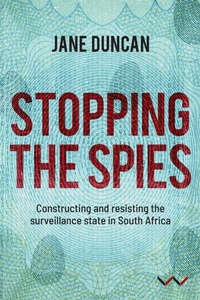
Stopping the Spies
Constructing and Resisting the Surveillance State in South Africa
Published on 1. May 2018
Book
Paperback/Softback
312 pages
978-1-77614-215-6 (ISBN)
Description
Is South Africa on its way to becoming a surveillance state, and will it need a whistleblower?
In 2013, former National Security Agency (NSA) contractor Edward Snowden leaked secret documents revealing that state agencies like the NSA had spied on the communications of millions of innocent citizens. International outrage resulted, but the Snowden documents revealed only the tip of the surveillance iceberg. Apart from insisting on their rights to tap into communications, more and more states are placing citizens under surveillance, tracking their movements and transactions with public and private institutions. The state is becoming like a one-way mirror, where it can see more of what its citizens do and say, while citizens see less and less of what the state does, owing to high levels of secrecy around surveillance.
In this book, Jane Duncan assesses the relevance of Snowden's revelations for South Africa. In doing so she questions the extent to which South Africa is becoming a surveillance society governed by a surveillance state. Duncan challenges members of civil society to be concerned about and to act on the ever-expanding surveillance capacities of the South African state. Is surveillance used for the democratic purpose of making people safer, or is it being used for the repressive purpose of social control, especially of those considered to be politically threatening to ruling interests? She explores the forms of collective action needed to ensure that unaccountable surveillance does not take place and examines what does and does not work when it comes to developing organised responses.
In 2013, former National Security Agency (NSA) contractor Edward Snowden leaked secret documents revealing that state agencies like the NSA had spied on the communications of millions of innocent citizens. International outrage resulted, but the Snowden documents revealed only the tip of the surveillance iceberg. Apart from insisting on their rights to tap into communications, more and more states are placing citizens under surveillance, tracking their movements and transactions with public and private institutions. The state is becoming like a one-way mirror, where it can see more of what its citizens do and say, while citizens see less and less of what the state does, owing to high levels of secrecy around surveillance.
In this book, Jane Duncan assesses the relevance of Snowden's revelations for South Africa. In doing so she questions the extent to which South Africa is becoming a surveillance society governed by a surveillance state. Duncan challenges members of civil society to be concerned about and to act on the ever-expanding surveillance capacities of the South African state. Is surveillance used for the democratic purpose of making people safer, or is it being used for the repressive purpose of social control, especially of those considered to be politically threatening to ruling interests? She explores the forms of collective action needed to ensure that unaccountable surveillance does not take place and examines what does and does not work when it comes to developing organised responses.
Reviews / Votes
"This book makes a timely contribution to the study of surveillance in the South African context. It is important reading not only because of the detailed information it provides about threats to citizen freedoms in post-apartheid South Africa, but also for its constructive suggestions for public agency and resistance." - Herman Wasserman, Professor of Media Studies and Director: Centre for Film and Media Studies, University of Cape TownMore details
Language
English
Place of publication
Johannesburg
South Africa
Target group
Professional and scholarly
Product notice
Paperback (trade)
Illustrations
3 black and white illustrations
Dimensions
Height: 234 mm
Width: 156 mm
Thickness: 18 mm
Weight
485 gr
ISBN-13
978-1-77614-215-6 (9781776142156)
Copyright in bibliographic data and cover images is held by Nielsen Book Services Limited or by the publishers or by their respective licensors: all rights reserved.
Schweitzer Classification
Other editions
Additional editions
E-Book
06/2018
Abingdon Press
€29.49
Available for download
Person
Jane Duncan is a professor in the Department of Journalism, Film and Television at the University of Johannesburg.
Content
PREFACE
ACKNOWLEDGEMENTS
LIST OF FIGURES AND TABLES
LIST OF ACRONYMS
INTRODUCTION
CHAPTER 1 Theorising the surveillance state
CHAPTER 2 Is privacy dead? Resistance to surveillance after the Snowden disclosures
CHAPTER 3 The context of surveillance and social control in South Africa
CHAPTER 4 Lawful interception in South Africa
CHAPTER 5 State mass surveillance, tactical surveillance and hacking in South Africa
CHAPTER 6 Privacy, surveillance and public spaces in South Africa
CHAPTER 7 Privacy, surveillance and population management: the turn to biometrics
CHAPTER 8 Stopping the spies: resisting unaccountable surveillance in South Africa
CHAPTER 9 Conclusion
NOTES
SELECT BIBLIOGRAPHY
INDEX
ACKNOWLEDGEMENTS
LIST OF FIGURES AND TABLES
LIST OF ACRONYMS
INTRODUCTION
CHAPTER 1 Theorising the surveillance state
CHAPTER 2 Is privacy dead? Resistance to surveillance after the Snowden disclosures
CHAPTER 3 The context of surveillance and social control in South Africa
CHAPTER 4 Lawful interception in South Africa
CHAPTER 5 State mass surveillance, tactical surveillance and hacking in South Africa
CHAPTER 6 Privacy, surveillance and public spaces in South Africa
CHAPTER 7 Privacy, surveillance and population management: the turn to biometrics
CHAPTER 8 Stopping the spies: resisting unaccountable surveillance in South Africa
CHAPTER 9 Conclusion
NOTES
SELECT BIBLIOGRAPHY
INDEX