

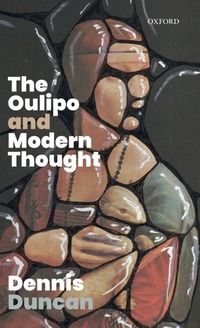
The Oulipo and Modern Thought
Published on 10. July 2019
Book
Hardback
186 pages
978-0-19-883163-1 (ISBN)
Description
The impact of the Oulipo (Ouvroir de Litterature Potentielle), one of the most important groups of experimental writers of the late twentieth century, is still being felt in contemporary literature, criticism, and theory, both in Europe and the US. Founded in 1960 and still active today, this Parisian literary workshop has featured among its members such notable writers as Italo Calvino, Georges Perec, and Raymond Queneau, all sharing in its light-hearted, slightly boozy bonhomie, the convivial antithesis of the fractious, volatile coteries of the early twentieth-century avant-garde. For the last fifty years the Oulipo has undertaken the same simple goal: to investigate the potential of 'constraints' in the production of literature--that is, formal procedures such as anagrams, acrostics, lipograms (texts which exclude a certain letter), and other strange and complex devices.
Yet, far from being mere parlour games, these methods have been frequently used as part of a passionate--though sometimes satirical--involvement with the major intellectual currents of the mid-twentieth century. Structuralism, psychoanalysis, Surrealism, analytic philosophy: all come under discussion in the group's meetings, and all find their way in the group's exercises in ways that, while often ironic, are also highly informed.
Using meeting minutes, correspondence, and other material from the Oulipo archive at the Bibliotheque nationale de France, The Oulipo and Modern Thought shows how the group have used constrained writing as means of puckish engagement with the debates of their peers, and how, as the broader intellectual landscape altered, so too would the group's conception of what constrained writing can achieve.
Yet, far from being mere parlour games, these methods have been frequently used as part of a passionate--though sometimes satirical--involvement with the major intellectual currents of the mid-twentieth century. Structuralism, psychoanalysis, Surrealism, analytic philosophy: all come under discussion in the group's meetings, and all find their way in the group's exercises in ways that, while often ironic, are also highly informed.
Using meeting minutes, correspondence, and other material from the Oulipo archive at the Bibliotheque nationale de France, The Oulipo and Modern Thought shows how the group have used constrained writing as means of puckish engagement with the debates of their peers, and how, as the broader intellectual landscape altered, so too would the group's conception of what constrained writing can achieve.
Reviews / Votes
...a study combining rigour with an Oulipian lightness. * Anna Aslanyan, Times Literary Supplement * Recommended. With the above caveat. Graduate students, researchers, faculty. * A. M. Rea, CHOICE * Dennis Duncan's short and lively book seeks to rescue Oulipo from the margins of French intellectual life * David Bellos, French Studies *More details
Language
English
Place of publication
Oxford
United Kingdom
Target group
Professional and scholarly
Illustrations
10 Illustrations
Dimensions
Height: 222 mm
Width: 145 mm
Thickness: 14 mm
Weight
373 gr
ISBN-13
978-0-19-883163-1 (9780198831631)
Copyright in bibliographic data and cover images is held by Nielsen Book Services Limited or by the publishers or by their respective licensors: all rights reserved.
Schweitzer Classification
Other editions
Additional editions
Dennis Duncan
The Oulipo and Modern Thought
E-Book
07/2019
1st Edition
OUP eBook
€50.49
Available for download
Dennis Duncan
The Oulipo and Modern Thought
E-Book
07/2019
1st Edition
OUP eBook
€50.49
Available for download
Person
Dennis Duncan is a writer and translator based in London. He is currently writing a history of the book index, from the medieval period to the age of the Kindle, to be published by Penguin in 2020 and is co-editor of Book Parts (with Adam Smyth, Oxford University Press, 2019). His recent articles have considered Mallarme and jugs, James Joyce and pornography, and the history of the Times New Roman typeface. Dr Duncan writes on bibliography and French literature for the Times Literary Supplement, and has published translations of Michel Foucault, Boris Vian, and Alfred Jarry.
Content
Introduction: The Secret of Lightness
1: Literature Machines: StructurElism versus StructurAlism
2: The Punning Muse: Psychoanalysis and Homophonic Translation
3: Surrealism's Subject: Two Cohorts of the Oulipo
4: Calvino at a Crossroads: Combinatorics and Anticombinatorics
5: Perec and Mathews: Translation and Analytic Philosophy in the South Seas
Conclusion
1: Literature Machines: StructurElism versus StructurAlism
2: The Punning Muse: Psychoanalysis and Homophonic Translation
3: Surrealism's Subject: Two Cohorts of the Oulipo
4: Calvino at a Crossroads: Combinatorics and Anticombinatorics
5: Perec and Mathews: Translation and Analytic Philosophy in the South Seas
Conclusion