

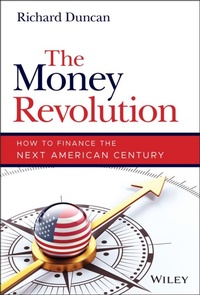
The Money Revolution
How to Finance the Next American Century
1st Edition
Published on 23. December 2021
Book
Hardback
352 pages
978-1-119-85626-9 (ISBN)
Description
Learn how the United States can stop and reverse its relative economic decline in this fascinating analysis of American Money, Credit and Capital
In The Money Revolution: How to Finance the Next American Century, economist and bestselling author Richard Duncan lays out a farsighted strategy to maximize the United States unmatched financial and technological potential.
In compelling fashion, the author shows that the United States can and should invest in the industries and technologies of the future on an unprecedented scale in order to ignite a new technological revolution that would cement the country's geopolitical preeminence, greatly enhance human wellbeing, and create unimaginable wealth. In this book, you will find:
* An important new history of the Federal Reserve that details the transformation of the country's central bank from the passive lender of last resort created by its founders in 1913 into the world's most powerful economic institution today.
* A fascinating discussion of the evolution of money and monetary policy in the United States over the past century.
* An examination of the role that credit has played in generating economic growth, especially since Dollars ceased to be backed by Gold five decades ago.
* A detailed description of the country's capital structure and its dangerous deficiencies.
* An urgent call-to-action for the United States to begin a multi-trillion-dollar investment program targeting industries of the future.
The Money Revolution: How to Finance the Next American Century is a page-turning read ideal for anyone interested in the future of the United States. Its gripping thesis offers anyone with a personal or professional interest in America's economy, financial system, or geopolitical position in the world an engrossing intellectual journey.
In The Money Revolution: How to Finance the Next American Century, economist and bestselling author Richard Duncan lays out a farsighted strategy to maximize the United States unmatched financial and technological potential.
In compelling fashion, the author shows that the United States can and should invest in the industries and technologies of the future on an unprecedented scale in order to ignite a new technological revolution that would cement the country's geopolitical preeminence, greatly enhance human wellbeing, and create unimaginable wealth. In this book, you will find:
* An important new history of the Federal Reserve that details the transformation of the country's central bank from the passive lender of last resort created by its founders in 1913 into the world's most powerful economic institution today.
* A fascinating discussion of the evolution of money and monetary policy in the United States over the past century.
* An examination of the role that credit has played in generating economic growth, especially since Dollars ceased to be backed by Gold five decades ago.
* A detailed description of the country's capital structure and its dangerous deficiencies.
* An urgent call-to-action for the United States to begin a multi-trillion-dollar investment program targeting industries of the future.
The Money Revolution: How to Finance the Next American Century is a page-turning read ideal for anyone interested in the future of the United States. Its gripping thesis offers anyone with a personal or professional interest in America's economy, financial system, or geopolitical position in the world an engrossing intellectual journey.
More details
Language
English
Place of publication
New York
United States
Target group
Professional and scholarly
Dimensions
Height: 163 mm
Width: 237 mm
Thickness: 39 mm
Weight
890 gr
ISBN-13
978-1-119-85626-9 (9781119856269)
Copyright in bibliographic data and cover images is held by Nielsen Book Services Limited or by the publishers or by their respective licensors: all rights reserved.
Schweitzer Classification
Other editions
Additional editions
E-Book
01/2022
1st Edition
Wiley
€17.99
Available for download
E-Book
01/2022
1st Edition
Wiley
€17.99
Available for download
Content
Introduction 3
Part One: Money 6
Chapter 1: The Power of The Fed 8
Chapter 2: 1914 to 1920: World War I 33
Chapter 3: 1920 to 1930: After The War 46
Chapter 4: 1930 to 1941: The Great Depression 56
Chapter 5: 1941 to 1945: World War II 74
Chapter 6: 1945 to 1971: The Bretton Woods Era 94
Chapter 7: 1971 to 2007: After Gold 111
Part Two: Credit 124
Chapter 8: Credit Creation By The Banking System 126
Chapter 9: Credit Creation By The Financial Sector 156
Chapter 10: Credit Creation By Foreign Central Banks 184
Chapter 11: Creditism 210
Chapter 12: 2007 to 2016: Crisis and Response 240
Chapter 13: Creditism Between The Crises 279
Chapter 14: Pandemic 300
Chapter 15: Inflation 320
Part Three: The Future 348
Chapter 16: America Must Invest 350
Chapter 17: Inadequate Investment 357
Chapter 18: R&D - The Future Depends On It 380
Chapter 19: The United States Can Afford To Invest 408
Chapter 20: Monetize The Debt 430
Chapter 21: An Investment Revolution 458
Conclusion 474
Part One: Money 6
Chapter 1: The Power of The Fed 8
Chapter 2: 1914 to 1920: World War I 33
Chapter 3: 1920 to 1930: After The War 46
Chapter 4: 1930 to 1941: The Great Depression 56
Chapter 5: 1941 to 1945: World War II 74
Chapter 6: 1945 to 1971: The Bretton Woods Era 94
Chapter 7: 1971 to 2007: After Gold 111
Part Two: Credit 124
Chapter 8: Credit Creation By The Banking System 126
Chapter 9: Credit Creation By The Financial Sector 156
Chapter 10: Credit Creation By Foreign Central Banks 184
Chapter 11: Creditism 210
Chapter 12: 2007 to 2016: Crisis and Response 240
Chapter 13: Creditism Between The Crises 279
Chapter 14: Pandemic 300
Chapter 15: Inflation 320
Part Three: The Future 348
Chapter 16: America Must Invest 350
Chapter 17: Inadequate Investment 357
Chapter 18: R&D - The Future Depends On It 380
Chapter 19: The United States Can Afford To Invest 408
Chapter 20: Monetize The Debt 430
Chapter 21: An Investment Revolution 458
Conclusion 474