

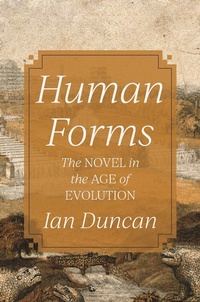
Human Forms
The Novel in the Age of Evolution
Published on 17. December 2024
Book
Paperback/Softback
312 pages
978-0-691-26478-3 (ISBN)
Description
A major rethinking of the European novel and its relationship to early evolutionary science
The 120 years between Henry Fielding's Tom Jones (1749) and George Eliot's Middlemarch (1871) marked both the rise of the novel and the shift from the presumption of a stable, universal human nature to one that changes over time. In Human Forms, Ian Duncan reorients our understanding of the novel's formation during its cultural ascendancy, arguing that fiction produced new knowledge in a period characterized by the interplay between literary and scientific discourses-even as the two were separating into distinct domains.
Duncan focuses on several crisis points: the contentious formation of a natural history of the human species in the late Enlightenment; the emergence of new genres such as the Romantic bildungsroman; historical novels by Walter Scott and Victor Hugo that confronted the dissolution of the idea of a fixed human nature; Charles Dickens's transformist aesthetic and its challenge to Victorian realism; and George Eliot's reckoning with the nineteenth-century revolutions in the human and natural sciences. Modeling the modern scientific conception of a developmental human nature, the novel became a major experimental instrument for managing the new set of divisions-between nature and history, individual and species, human and biological life-that replaced the ancient schism between animal body and immortal soul.
The first book to explore the interaction of European fiction with "the natural history of man" from the late Enlightenment through the mid-Victorian era, Human Forms sets a new standard for work on natural history and the novel.
The 120 years between Henry Fielding's Tom Jones (1749) and George Eliot's Middlemarch (1871) marked both the rise of the novel and the shift from the presumption of a stable, universal human nature to one that changes over time. In Human Forms, Ian Duncan reorients our understanding of the novel's formation during its cultural ascendancy, arguing that fiction produced new knowledge in a period characterized by the interplay between literary and scientific discourses-even as the two were separating into distinct domains.
Duncan focuses on several crisis points: the contentious formation of a natural history of the human species in the late Enlightenment; the emergence of new genres such as the Romantic bildungsroman; historical novels by Walter Scott and Victor Hugo that confronted the dissolution of the idea of a fixed human nature; Charles Dickens's transformist aesthetic and its challenge to Victorian realism; and George Eliot's reckoning with the nineteenth-century revolutions in the human and natural sciences. Modeling the modern scientific conception of a developmental human nature, the novel became a major experimental instrument for managing the new set of divisions-between nature and history, individual and species, human and biological life-that replaced the ancient schism between animal body and immortal soul.
The first book to explore the interaction of European fiction with "the natural history of man" from the late Enlightenment through the mid-Victorian era, Human Forms sets a new standard for work on natural history and the novel.
Reviews / Votes
"Duncan's study is a wide ranging, superbly researched and brilliantly written account of the ways in which the history of the novel is interwoven with the emergence of the new discourse of 'natural'history, and its logic of an organic transformation of forms and kinds.' . . . . Human Forms is a rich and brilliant examination of the complex dynamics between the history of scientific ideas and the development of the novel and, as such, will be invaluable to all those interested in Victorian fiction."---Iain Crawford, Dickens Quarterly "[An] exhilarating study which follows in the footsteps of Gillian Beer, Sally Shuttleworth, and George Levine in exploring the resonances between nineteenth-century literature and science."---David Womersley, Studies in English Literature, 1500-1900 "Duncan teases out, in intimate detail, the deep engagement between putatively Romantic and Victorian modes of thought and writing. This insight should give present studies of the novel renewed urgency. . . . Human Forms casts a bright light on the nineteenth-century novel not simply as an accessory to scientific thought, but as a powerful instrument for formulating questions about the status of the human as a social and biological problem"---Devin Griffiths, Modern PhilologyMore details
Language
English
Place of publication
New Jersey
United States
Target group
College/higher education
Professional and scholarly
Product notice
Paperback (trade)
Dimensions
Height: 234 mm
Width: 156 mm
Thickness: 18 mm
Weight
481 gr
ISBN-13
978-0-691-26478-3 (9780691264783)
Copyright in bibliographic data and cover images is held by Nielsen Book Services Limited or by the publishers or by their respective licensors: all rights reserved.
Schweitzer Classification
Other editions
Additional editions
E-Book
10/2019
1st Edition
Princeton University Press
€26.49
Available for download
Person
Ian Duncan is professor and Florence Green Bixby Chair in English at the University of California, Berkeley. His books include Scott's Shadow: The Novel in Romantic Edinburgh (Princeton).