

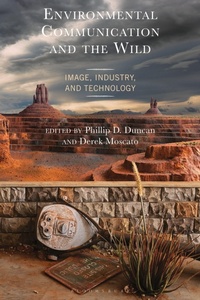
Environmental Communication and the Wild
Image, Industry, and Technology
Published on 10. July 2025
Book
Hardback
360 pages
978-1-6669-5464-7 (ISBN)
Description
This edited volume brings together scholars, teachers, journalists, activists, and filmmakers engaged in environmental communication and media studies to explore the constructions of primitive and wild spaces in our cultural creations of film, television, advertising, social media, infrastructure, and new technologies, among other media. Contributors present close analyses of a number of examples - including Indigenous social media activism, National Geographic, #VanLife content, Japanese haikyo, and more - to examine the representation, commodification, exploitation, and politicization of primitive and wild natural areas in contemporary media and technology. Ultimately, this collection demonstrates that, while the media of wild representations have significantly changed since the days of our ancestors, the same themes of reverence, fear, beauty, power, and awe are still reflected and coopted. Scholars of environmental studies, communication, popular culture, technology studies, and media studies will find this book of particular interest.
Reviews / Votes
From the metaphorical resonance between "wilderness" and cyberspace to utopian and dystopian ecological imaginaries in film, television, and branding, Derek Moscato and Phillip D. Duncan have brought together an exceptional collection of diverse scholarly work that frames ways to think about how "the wild" is constructed through contemporary mediascapes and virtual technologies. Readers will come away with not only an understanding of how the mediation of "wilderness" is tied to deeply embedded colonial epistemologies, but also ways to critically engage damaging tropes and narratives in environmental messaging. * Patrick D. Murphy, Professor of Media and Communication, Temple University, USA, and Author of The Media Commons: Globalization and Environmental Discourses (2017) * What might wild forms of agency look like or mean for environmental communication? Tracing shifting relationships of human, technology, and nature across an array of subjects, including lost cats, the authors pose pressing questions about the proliferating forms of wild animating our communication environment. * Chris Russill, Professor of Communication, Carleton University, Canada *More details
Language
English
Place of publication
United States
Publishing group
Bloomsbury Publishing Plc
Target group
Professional and scholarly
Illustrations
15 bw illus and 1 table
Dimensions
Height: 235 mm
Width: 157 mm
Thickness: 24 mm
Weight
664 gr
ISBN-13
978-1-6669-5464-7 (9781666954647)
Copyright in bibliographic data and cover images is held by Nielsen Book Services Limited or by the publishers or by their respective licensors: all rights reserved.
Schweitzer Classification
Other editions
Additional editions
Environmental Communication and the Wild
Image, Industry, and Technology
E-Book
07/2025
1st Edition
Bloomsbury Academic
€107.99
Available for download
Environmental Communication and the Wild
Image, Industry, and Technology
E-Book
07/2025
1st Edition
Bloomsbury Academic
€107.99
Available for download
Persons
Philip D. Duncan is Assistant Professor of Communication and Media Studies at Eureka College.
Derek Moscato is Professor of Journalism at Western Washington University.
Derek Moscato is Professor of Journalism at Western Washington University.
Content
Acknowledgments
Introduction
Part I: Techno Wilds
Chapter 1: On Conserving Cyberspace: The Metaphorical Wild and Digital Networks
Christopher Lee Adamczyk
Chapter 2: Visualizing the Future of AR Environmental Communication
Kailan Sindelar
Chapter 3: Nature as Vanishing Wilderness: Mobile Communication Technologies and Colonial Epistemologies
Stephen B. Crofts Wiley
Part II: Performative Wilds
Chapter 4: Environment as its Own Movie Director: Anti-Representationalism as More-Than-Human Cinema
Hugo Picado de Almeida and Adalberto Fernandes
Chapter 5: "We Shall Remain Men": Masculinity, Nature, and Environmentalism in YETI Presents Films
Brandon Robert Green
Chapter 6: Born in China and the International Political Economy of Disneynature
Phillip D. Duncan, Janet Wasko, and Zak Roman
Part III: Mediated Wilds
Chapter 7: Wilderness, Constructed: The Dystopian Imaginaries of Lori Nix and Kathleen Gerber
Kathleen M. Ryan and David Staton
Chapter 8: From Sacred Lands to Social Media: Indigenous Sovereignty Digitized
Nii Mahliaire
Chapter 9: Transition in Translation: Haikyo, The Wild, and the Mediation of Material Decay on Instagram
Evan R. Jones
Chapter 10: Framing Wildlife through National Geographic: Animal Logic in the Anthropocene
Minos-Athanasios Karyotakis
Part IV: Experiential Wilds
Chapter 11: Driving Discourses of Ecotopia: The Wild and the Winding Road of #VanLife
Derek Moscato
Chapter 12: The Pennsylvania Wilds and the Rhetorical Construction of Wilderness
Casey R. Schmitt
Chapter 13: Traces of Extraction: Finding and Forgetting Environmental Destruction in "Wild and Wonderful" West Virginia
Ryan McCullough
Chapter 14: Losing Raymond: Digital Rescue Technologies, Social Media, and The Wild
JV Fuqua
About the Contributors
Introduction
Part I: Techno Wilds
Chapter 1: On Conserving Cyberspace: The Metaphorical Wild and Digital Networks
Christopher Lee Adamczyk
Chapter 2: Visualizing the Future of AR Environmental Communication
Kailan Sindelar
Chapter 3: Nature as Vanishing Wilderness: Mobile Communication Technologies and Colonial Epistemologies
Stephen B. Crofts Wiley
Part II: Performative Wilds
Chapter 4: Environment as its Own Movie Director: Anti-Representationalism as More-Than-Human Cinema
Hugo Picado de Almeida and Adalberto Fernandes
Chapter 5: "We Shall Remain Men": Masculinity, Nature, and Environmentalism in YETI Presents Films
Brandon Robert Green
Chapter 6: Born in China and the International Political Economy of Disneynature
Phillip D. Duncan, Janet Wasko, and Zak Roman
Part III: Mediated Wilds
Chapter 7: Wilderness, Constructed: The Dystopian Imaginaries of Lori Nix and Kathleen Gerber
Kathleen M. Ryan and David Staton
Chapter 8: From Sacred Lands to Social Media: Indigenous Sovereignty Digitized
Nii Mahliaire
Chapter 9: Transition in Translation: Haikyo, The Wild, and the Mediation of Material Decay on Instagram
Evan R. Jones
Chapter 10: Framing Wildlife through National Geographic: Animal Logic in the Anthropocene
Minos-Athanasios Karyotakis
Part IV: Experiential Wilds
Chapter 11: Driving Discourses of Ecotopia: The Wild and the Winding Road of #VanLife
Derek Moscato
Chapter 12: The Pennsylvania Wilds and the Rhetorical Construction of Wilderness
Casey R. Schmitt
Chapter 13: Traces of Extraction: Finding and Forgetting Environmental Destruction in "Wild and Wonderful" West Virginia
Ryan McCullough
Chapter 14: Losing Raymond: Digital Rescue Technologies, Social Media, and The Wild
JV Fuqua
About the Contributors