

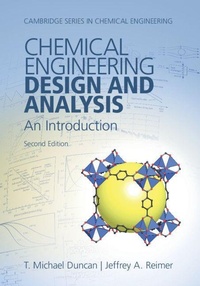
Chemical Engineering Design and Analysis
An Introduction
2nd Edition
Published on 24. January 2019
Book
Hardback
588 pages
978-1-108-42147-8 (ISBN)
Description
This textbook puts design at the center of introducing students to the course in mass and energy balances in chemical engineering. Employers and accreditations increasingly stress the importance of design in the engineering curriculum, and design-driven analysis will motivate students to dig deeply into the key concepts of the field. The second edition has been completely revised and updated. It introduces the central steps in design and three methods of analysis: mathematical modeling, graphical methods, and dimensional analysis. Students learn how to apply engineering skills, such as how to simplify calculations through assumptions and approximations; how to verify calculations, significant figures, spreadsheets, graphing (standard, semi-log and log-log); and how to use data maps, in the contexts of contemporary chemical processes such as the hydrogen economy, petrochemical and biochemical processes, polymers, semiconductors, and pharmaceuticals.
More details
Series
Edition
2nd Revised edition
Language
English
Place of publication
Cambridge
United Kingdom
Target group
College/higher education
Edition type
Revised edition
Illustrations
Worked examples or Exercises; 132 Tables, black and white; 749 Line drawings, black and white
Dimensions
Height: 250 mm
Width: 175 mm
Thickness: 36 mm
Weight
1190 gr
ISBN-13
978-1-108-42147-8 (9781108421478)
Copyright in bibliographic data and cover images is held by Nielsen Book Services Limited or by the publishers or by their respective licensors: all rights reserved.
Schweitzer Classification
Other editions
Additional editions
E-Book
01/2019
2nd Edition
Cambridge University Press
€80.49
Available for download
Previous edition
Book
09/1998
Cambridge University Press
€105.23
Article exhausted; check for reprint
Persons
T. Michael Duncan joined the School of Chemical Engineering at Cornell University in 1990, where he holds the Thorpe Chair in Chemical Engineering and has served as Associate Director for the undergraduate program since 1993. Duncan has received many teaching awards: he has been selected four times for the Tau Beta Pi / Cornell Engineering Alumni Association Excellence in Teaching Award and was named Professor of the Year for New York State by the Carnegie Foundation in 2007. He is also a Weiss Scholar at Cornell, a distinction bestowed on three faculty members each year at Cornell, from the entire campus of over 1600 instructors. Jeffrey A. Reimer is the C. Judson King Endowed Professor and Warren and Katharine Schlinger Distinguished Professor and Chair of the Chemical and Biomolecular Engineering Department at University of California, Berkeley. Reimer has received many teaching awards, culminating in the University of California, Berkeley Distinguished Teaching Award, the highest award bestowed on faculty for their teaching. He is a Fellow of the American Association for the Advancement of Science, a Fellow of the American Physical Society, and a Fellow of the International Society for Magnetic Resonance, and was the recipient of a Humboldt Research Award in 2014.
Content
Preface; Acknowledgements; 1. An overview of chemical engineering; 2. Process design; 3. Models derived from laws and mathematical analysis; 4. Models derived from graphical analysis; 5. Dimensional analysis and dynamic scaling; 6. Transient-state processes; Appendix A. List of symbols; Appendix B. Units, conversion factors, and physical constants; Appendix C. Significant figures; Appendix D. Log-log graph paper; Appendix E. Mathematics, mechanics, and thermodynamics; Appendix F. Glossary of chemical engineering; Index.