

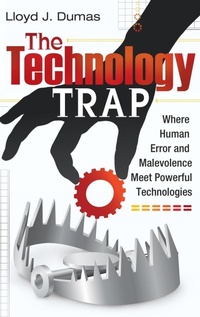
The Technology Trap
Where Human Error and Malevolence Meet Powerful Technologies
Published on 2. September 2010
Book
Hardback
408 pages
978-0-313-37888-1 (ISBN)
Description
In this eye-opening book, author Lloyd J. Dumas argues that our capacity for developing ever more powerful technologies and the unavoidable fallibility of both machine and man will lead us towards a disaster of an unprecedented scale.
Most of us assume that those in charge can always find a way to control any technology mankind creates, no matter how powerful. But in a world of imperfect human beings who are prone to error, emotion, and sometimes to malevolent behavior, this could be an arrogant-and disastrous-assumption.
This book is filled with compelling, factual stories that illustrate how easy it is for situations to go terribly wrong, despite our best efforts to prevent any issue. The author is not advocating an anti-technology "return to nature," nor intending to highlight the marvels of our high-tech world. Instead, the objective is to reveal the potential for disaster that surrounds us in our modern world, elucidate how we arrived at this predicament, explain the nature and ubiquity of human fallibility, expose why proposed "solutions" to these Achilles heels cannot work, and suggest alternatives that could thwart human-induced technological disasters.
Most of us assume that those in charge can always find a way to control any technology mankind creates, no matter how powerful. But in a world of imperfect human beings who are prone to error, emotion, and sometimes to malevolent behavior, this could be an arrogant-and disastrous-assumption.
This book is filled with compelling, factual stories that illustrate how easy it is for situations to go terribly wrong, despite our best efforts to prevent any issue. The author is not advocating an anti-technology "return to nature," nor intending to highlight the marvels of our high-tech world. Instead, the objective is to reveal the potential for disaster that surrounds us in our modern world, elucidate how we arrived at this predicament, explain the nature and ubiquity of human fallibility, expose why proposed "solutions" to these Achilles heels cannot work, and suggest alternatives that could thwart human-induced technological disasters.
Reviews / Votes
Recommended. Public and academic undergraduate library collections. * Choice *More details
Language
English
Place of publication
United States
Publishing group
Bloomsbury Publishing Plc
Target group
Interest Age: From 7 to 17 years
Dimensions
Height: 240 mm
Width: 161 mm
Thickness: 26 mm
Weight
775 gr
ISBN-13
978-0-313-37888-1 (9780313378881)
Copyright in bibliographic data and cover images is held by Nielsen Book Services Limited or by the publishers or by their respective licensors: all rights reserved.
Schweitzer Classification
Other editions
Additional editions
E-Book
09/2010
1st Edition
Praeger Publishers Inc
€38.49
Available for download
Person
Lloyd J. Dumas is a social scientist and engineer.
Content
List of Tables
Acknowledgments
Part I: Threatening Ourselves
1 Human Fallibility and the Proliferation of Dangerous Technologies
2 Dangerous Technologies and the Terrorist Threat
Part II: What Could Go Wrong?
3 Losing Control (of Dangerous Materials)
4 Accidents Do Happen
Appendix Tables: Major Accidents Related to Weapons of Mass Destruction
5 Accidental War with Weapons of Mass Destruction
Part III: Why It Can Happen Here: Understanding the Human Factor
6 Substance Abuse and Mental Illness
7 The Character of Work; the Conditions of Life
Part IV: "Solutions" That Do Not Work
8 Seeking Safety in Numbers: The Reliability of Groups
9 Making Technology Foolproof
10 Computers Instead of People
Part V: Finding Solutions That Do Work
11 Judging Risk
12 Escaping the Trap: Four Steps for Preventing Disaster
Index
Acknowledgments
Part I: Threatening Ourselves
1 Human Fallibility and the Proliferation of Dangerous Technologies
2 Dangerous Technologies and the Terrorist Threat
Part II: What Could Go Wrong?
3 Losing Control (of Dangerous Materials)
4 Accidents Do Happen
Appendix Tables: Major Accidents Related to Weapons of Mass Destruction
5 Accidental War with Weapons of Mass Destruction
Part III: Why It Can Happen Here: Understanding the Human Factor
6 Substance Abuse and Mental Illness
7 The Character of Work; the Conditions of Life
Part IV: "Solutions" That Do Not Work
8 Seeking Safety in Numbers: The Reliability of Groups
9 Making Technology Foolproof
10 Computers Instead of People
Part V: Finding Solutions That Do Work
11 Judging Risk
12 Escaping the Trap: Four Steps for Preventing Disaster
Index