

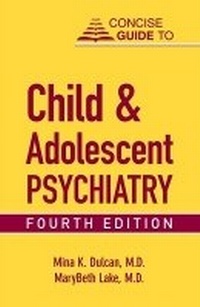
Concise Guide to Child and Adolescent Psychiatry
4th Edition
Published on 30. June 2011
Book
Paperback/Softback
405 pages
978-1-58562-416-4 (ISBN)
Description
Since the 2003 release of the third edition of Concise Guide to Child and Adolescent Psychiatry, research on mental illness in children and the practical applications of this research have been evolving at a rapid pace. With these changes have come enhanced methods of assessment and treatment.
Topics covered in this text include: The use of DSM-IV-TR for diagnosing psychiatric disorders in children and ways in which adult criteria can be adapted for use in young patients. An outline of the Axis I conditions especially relevant to children and adolescents that may be a focus of clinical attention. A review of how childhood psychological disorders often occur in combinations and require broad-spectrum rating scales to supplement the diagnostic process and help avoid overly narrow focus on the presenting problem. New trends in treatment that include a consideration of biological factors, multimodal treatment approaches, multidisciplinary teams, and use of evidence-based interventions. Ways to help both the patient and the parent or caregiver through the treatment process for better outcomes. Identification of the strengths and vulnerabilities that are critical to treatment plans, such as the family's financial resources and the child's social environment, which includes school, neighborhood, and social support networks, all of which influence the choice of treatment strategy.
Concise Guide to Child and Adolescent Psychiatry provides professionals in psychiatric settings, pediatric offices and hospitals, schools, and juvenile justice settings with an efficient and easily portable reference to pediatric mental health topics of concern to practicing clinicians and students alike. Designed to fit into a lab coat or jacket pocket, this manual offers the information that most experts agree is relevant to helping children and adolescents overcome mental disorders.
Topics covered in this text include: The use of DSM-IV-TR for diagnosing psychiatric disorders in children and ways in which adult criteria can be adapted for use in young patients. An outline of the Axis I conditions especially relevant to children and adolescents that may be a focus of clinical attention. A review of how childhood psychological disorders often occur in combinations and require broad-spectrum rating scales to supplement the diagnostic process and help avoid overly narrow focus on the presenting problem. New trends in treatment that include a consideration of biological factors, multimodal treatment approaches, multidisciplinary teams, and use of evidence-based interventions. Ways to help both the patient and the parent or caregiver through the treatment process for better outcomes. Identification of the strengths and vulnerabilities that are critical to treatment plans, such as the family's financial resources and the child's social environment, which includes school, neighborhood, and social support networks, all of which influence the choice of treatment strategy.
Concise Guide to Child and Adolescent Psychiatry provides professionals in psychiatric settings, pediatric offices and hospitals, schools, and juvenile justice settings with an efficient and easily portable reference to pediatric mental health topics of concern to practicing clinicians and students alike. Designed to fit into a lab coat or jacket pocket, this manual offers the information that most experts agree is relevant to helping children and adolescents overcome mental disorders.
Reviews / Votes
I recently went on an away rotation and this was the only book I took with me, and it was the only one I ended up using. Although the hospital provided me four larger books geared toward specific disorders, to be honest, I didn't really need to have anything else. I would highly recommend this as a pocket guide. * Karen Hadley, M.D., DOODY'S PUBLISHERS *More details
Edition
Fourth Edition
Language
English
Place of publication
VA
United States
Target group
College/higher education
Professional and scholarly
US School Grade: College Graduate Student and over
Edition type
New edition
Illustrations
44 tables
Dimensions
Height: 162 mm
Width: 109 mm
Thickness: 25 mm
Weight
336 gr
ISBN-13
978-1-58562-416-4 (9781585624164)
Copyright in bibliographic data and cover images is held by Nielsen Book Services Limited or by the publishers or by their respective licensors: all rights reserved.
Schweitzer Classification
Persons
Mina K. Dulcan, M.D., is Margaret C. Osterman Professor of Child Psychiatry, Head of the Department of Child and Adolescent Psychiatry at Children's Memorial Hospital, Director of the Warren Wright Adolescent Program at Northwestern Memorial Hospital, and Professor of Psychiatry and Behavioral Sciences and Pediatrics and Chief of Child and Adolescent Psychiatry at the Northwestern University Feinberg School of Medicine in Chicago, Illinois.
MaryBeth Lake, M.D., is Director of Education in Child and Adolescent Psychiatry in the Department of Child and Adolescent Psychiatry at Children's Memorial Hospital and Associate Professor of Psychiatry and Behavioral Sciences at Northwestern University Feinberg School of Medicine in Chicago, Illinois.
MaryBeth Lake, M.D., is Director of Education in Child and Adolescent Psychiatry in the Department of Child and Adolescent Psychiatry at Children's Memorial Hospital and Associate Professor of Psychiatry and Behavioral Sciences at Northwestern University Feinberg School of Medicine in Chicago, Illinois.
Content
About the AuthorsIntroduction to the Concise Guides SeriesPreface to the Fourth EditionChapter 1. IntroductionChapter 2. Evaluation and Treatment PlanningChapter 3. Axis I Disorders Usually First Diagnosed in Infancy, Childhood, or Adolescence: Attention-Deficit and Disruptive Behavior DisordersChapter 4. Other Axis I Disorders Usually First Diagnosed in infancy, Childhood, or AdolescenceChapter 5. Adult Disorders That May Begin in Childhood or AdolescenceChapter 6. Developmental DisordersChapter 7. Special Clinical CircumstancesChapter 8. PsychopharmacologyChapter 9. Psychosocial TreatmentsAppendix: Resources for ParentsIndex