

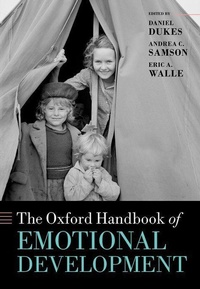
The Oxford Handbook of Emotional Development
Published on 12. January 2022
Book
Hardback
640 pages
978-0-19-885590-3 (ISBN)
Description
Emotional Development is a topic that embraces a range of disciplines, including, psychology, neuroscience, sociology, primatology, philosophy, history, cognitive science, computer science, and education.
The Oxford Handbook of Emotional Development is the first volume of its kind to include such a multidisciplinary group of experts to consider this topic, and as such, provides perhaps the most complete examination yet of how emotions develop and manifest themselves neuronally, intra- and interpersonally, across different cultures and species, and over time.
The volume is separated into five themes: macro and micro underpinnings; communication and understanding; interactive contexts; socialization and learning; and morality and prosocial behaviour. Each section includes contributions from researchers in at least three disciplines, resulting in a volume that is destined to provoke the interested reader into either purposively or accidentally discovering emotional development from novel and stimulating perspectives. The chapters are written to be concise in their overview and accessible to the researcher or intellectually curious person alike. The reader can enjoy state of the art critical analysis of emotional development from different viewpoints, which, whether dipped into casually or read as a whole, will provide the best view of not only what we know today about emotional development, but also where the future study of emotional development lies.
The Oxford Handbook of Emotional Development is an original and important contribution to the literature in psychology and the affective sciences.
The Oxford Handbook of Emotional Development is the first volume of its kind to include such a multidisciplinary group of experts to consider this topic, and as such, provides perhaps the most complete examination yet of how emotions develop and manifest themselves neuronally, intra- and interpersonally, across different cultures and species, and over time.
The volume is separated into five themes: macro and micro underpinnings; communication and understanding; interactive contexts; socialization and learning; and morality and prosocial behaviour. Each section includes contributions from researchers in at least three disciplines, resulting in a volume that is destined to provoke the interested reader into either purposively or accidentally discovering emotional development from novel and stimulating perspectives. The chapters are written to be concise in their overview and accessible to the researcher or intellectually curious person alike. The reader can enjoy state of the art critical analysis of emotional development from different viewpoints, which, whether dipped into casually or read as a whole, will provide the best view of not only what we know today about emotional development, but also where the future study of emotional development lies.
The Oxford Handbook of Emotional Development is an original and important contribution to the literature in psychology and the affective sciences.
Reviews / Votes
This is a truly exceptional Handbook. It is less a compendium of past contributions and more one of projections into needed future work. Its content is guided not solely by psychological theories, but also by sociology, primatology, history, philosophy, computer science, cognitive science, neuroscience, and education -- each of which impresses its own color in to the picture one gets of human development. The chapters are cogent, generally well written, and often create seamless blends of theory and findings into deeper understanding of the areas covered in the book. The volume is truly a MUST for understanding not only previous contributions to human development, but also forecasting cross-disciplinary forays into important new fields. * Joseph J. Campos, Professor of Psychology, University of California, Berkeley; Co-Founder International Society for Research on Emotions * So much is being written about emotional development in contemporary neuroscience, sociology, moral psychology, education, and moral philosophy - in addition to developmental psychology - but so little of it aims at building bridges between disciplines. This new interdisciplinary Handbook ameliorates a lacuna in the available literature and sets high standards for any subsequent work. I strongly recommend it for all researchers and students working on the development and cultivation of emotional capacities. * Kristjan Kristjansson, University of Birmingham (Author of Virtuous Emotions, OUP, 2018) * This unique volume will prove invaluable to scholars wishing to broaden their perspective on emotional development. In addition to contributions by developmental psychologists, it includes chapters by scholars from a variety of disciplines including philosophy, history, primatology, and sociology. Venturing outside the laboratory, many contributing authors focus on how emotions function in the context of social interactions and relationships. Reading this important book inspired me to think about emotional developmental in new and different ways * Linda Camras, Professor Emerita, College of Science and Health, DePaul University * For emotion researchers that grasp the importance of interdisciplinary research, the Oxford Handbook of Emotional Development is sure to be an indispensable resource. Drawing on leading thinkers across affective science, computational science and the humanities, the Handbook brings about a welcome and overdue integration of developmental research, spanning timescales from the firing of neurons to the evolution of civilizations. It is sure to stimulate the field for years to come. * Jonathan Gratch, Research Professor of Computer Science, USC Affective Computing Group, USC * This handbook offers an excellent insight into the complexity of research on emotional development. The editors have succeeded in bringing together renowned scholars from a wide range of disciplines, whose contributions reflect the diversity of aspects that interact in emotional development processes. The handbook captivates through the underlying understanding of emotions as multifaceted and highly dynamic processes over time and the importance given to different temporal dimensions in this context. * Prof. Dr. Birgitt Roettger-Roessler, Department of Social and Cultural Anthropology, Freie Universitaet Berlin *More details
Series
Language
English
Place of publication
Oxford
United Kingdom
Target group
Professional and scholarly
Product notice
sewn/stitched
Cloth over boards
Dimensions
Height: 236 mm
Width: 163 mm
Thickness: 41 mm
Weight
1225 gr
ISBN-13
978-0-19-885590-3 (9780198855903)
Copyright in bibliographic data and cover images is held by Nielsen Book Services Limited or by the publishers or by their respective licensors: all rights reserved.
Schweitzer Classification
Other editions
Additional editions
Daniel Dukes | Andrea Samson | Eric Walle
The Oxford Handbook of Emotional Development
E-Book
01/2022
1st Edition
OUP eBook
€92.49
Available for download
Daniel Dukes | Andrea Samson | Eric Walle
The Oxford Handbook of Emotional Development
E-Book
01/2022
1st Edition
OUP eBook
€92.49
Available for download
Persons
Daniel Dukes worked in special education before returning to academia. He is currently a postdoctoral researcher at the University of Fribourg and is Co-General Editor of the Studies of Emotion and Social Interaction series at Cambridge University Press. His research mainly focuses on socio-emotional development and processes, including affective social learning.
Andrea C. Samson is Associate Professor in psychology at Unidistance, Switzerland and holds a Swiss National Science Foundation-funded professorship at the Institute of Special Education, University of Fribourg. She is the director of the chEERS Lab, a team of researchers interested in socio-emotional processes in developmental disorders and intellectual disabilities.
Eric A. Walle is an Associate Professor of Psychological Sciences at the University of California, Merced. He is the Director of the Interpersonal Development Lab and conducts research examining emotion, socio-emotional development, and developmental transitions. He also serves on the Executive Board of the International Society for Research on Emotion.
Andrea C. Samson is Associate Professor in psychology at Unidistance, Switzerland and holds a Swiss National Science Foundation-funded professorship at the Institute of Special Education, University of Fribourg. She is the director of the chEERS Lab, a team of researchers interested in socio-emotional processes in developmental disorders and intellectual disabilities.
Eric A. Walle is an Associate Professor of Psychological Sciences at the University of California, Merced. He is the Director of the Interpersonal Development Lab and conducts research examining emotion, socio-emotional development, and developmental transitions. He also serves on the Executive Board of the International Society for Research on Emotion.
Editor
Postdoctoral researcherPostdoctoral researcher, chEERS Laboratory, University of Fribourg, Switzerland
Associate Professor of PsychologyAssociate Professor of Psychology, University of California, Merced
Associate Professor of PsychologyAssociate Professor, chEERS Laboratory, University of Fribourg
Content
Section One: Theory
1: Colin Holbrook and Jennifer Hahn-Holbrook: Evolved to learn: Emotions as calibrational adaptations
2: Peter Stearns: Changing standards in emotional development: The history factor
3: Jonathan Turner: Why Are Humans So Emotional? An Explanation from Evolutionary Sociology
4: David Rudrauf, Andrea Samson, and Martin Debbane: Current challenges and advances in computational and artificial agent modelling for the simulation of social affective learning and regulation of motivated behaviours
5: Eric Walle: The Development of Appraisals and Discrete Emotions
6: Rista C. Plate, Kristina Woodard, and Seth D. Pollak: Statistical Learning in an Emotional World
7: Michaela Riediger and Jennifer Bellingtier: Emotion Regulation Across the Lifespan
8: Kalee De France and Tom Hollenstein: The development of cognitive reappraisal to regulate emotions from infancy to adolescence
Section Two: Communication & Understanding
9: Yena Kim and Kret Mariska: The function of emotional expressions: An ontogenic and phylogenic comparison
10: Karen Vallgarda and Stephanie Olsen: Historicizing Emotion Development
11: Kristin Lagattuta and Hannah Kramer: Developmental Changes in Emotion Understanding During Middle Childhood
12: Sherri Widen and Nicole Nelson: Differentiation and language acquisition in children's understanding of emotion
13: Gina Mireault: The social and affective power of humor in infancy
14: Jennifer Silvers and Adriana Mendez Leal: Neuroscientific approaches to the study of self- and social emotion regulation during development
15: Caitlin Conner, Andrea Trubanova Wieckowski, Taylor Day, and Carla Mazefsky: Emotion Development in Autism
16: Lizet Ketelaar, John Lambie, Boya Li, Adva Eichengreen, Anat Zaidman-Zait, and Carolien Rieffe: Impact of hearing loss on children's emotional development and mental health
Section Three: Interactive Contexts
17: Vasudeva Reddy and Vanello Daniel: Emotional Engagement and Social Understanding
18: Michael Mascolo: Emotions as Felt Patterns of Engagement: A Relational-Developmental Approach
19: Zanna Clay, Christine Webb, Teresa Romero, and Frans BM de Waal: Comparative perspectives of socio-emotional development: Insights from chimpanzees and bonobos
20: Jessica Lougheed: Developmental Methods for Emotion Dynamics
21: Daniel S. Messinger, Jacquelyn Moffitt, Samantha G. Mitsven, Yeojin Amy Ahn, Stephanie Custode, Evgeniy Chervonenko, Saad Sadiq, Mei-Ling Shyu, and Lynn K. Perry: Early interaction: New approaches
22: Claudia Haase, Emily Hittner, and Jacquelyn Stephens: Emotion Regulation in Couples Across the Life Span
23: Guida Veiga, Brenda MS da Silva, Jenny Louise Gibson, and Carolien Rieffe: Play and emotions; the effect of physical play on children's social well-being
24: Andrea Samson, Linda Dell'Angela, David Sander, and Alexandra Zaharia: The potential of board games to promote emotional competences
Section Four: Socialization and Learning
25: Rebecca J. Erickson and Marci Cottingham: Emotion Development in Context
26: Fabrice Clement and Daniel Dukes: Affective Social Learning: a lens for developing a fuller picture of socialization processes
27: Tanya Broesch & Jeremy Carpendale: Emotional development across cultures
28: Amy Halberstadt: Emotions as Fixatives for Children's Understandings about the World
29: Jeffrey Liew and Qing Zhou: Parenting, Emotion Regulation, and Psychosocial Adjustment in Chinese and Chinese Immigrant Children and Adolescents
30: Stephanie Olsen and Karen Vallgarda: Emotional Frontiers
31: Rheinard Pekrun: Development of achievement emotions
32: Bruce Maxwell and Joanna Peplak: Educational Applications of Social and Emotional Learning: A Review of Normative and Conceptual Critiques
Section Five: Morality and Prosocial Behavior
33: Elliot Turiel: The development of moral judgments, emotions, and sentiments
34: Steve Hitlin and Sarah Harkness: Inequality and Moral Emotions
35: Mario De Caro, Maria Silvia Vaccarezza, and Ariele Niccoli: Emotional skilfulness and virtue acquisition
36: Amrisha Vaish: The prosocial functions of guilt in early childhood
37: Gustavo Carlo, Paul D. Hastings, J. Logan Dicus, and Elisa Ugarte: Development, Culture, and Neurobiology of Moral Emotions in Ethnic/Racial Minority Children: A Case Study of U.S. Latino/a Children
38: Aleksandra Petkova and Celia Brownell: I feel, you feel, we feel: The role of emotion in early prosocial beahvior
39: Ross A. Thompson: Emotional development and the growth of moral self-awareness
40: 1. Karine M.P. Viana, Juliana Lucena, Imac Maria Zambrana, Paul L. Harris & Francisco Pons: Emotion understanding and cooperative problem-solving in children
1: Colin Holbrook and Jennifer Hahn-Holbrook: Evolved to learn: Emotions as calibrational adaptations
2: Peter Stearns: Changing standards in emotional development: The history factor
3: Jonathan Turner: Why Are Humans So Emotional? An Explanation from Evolutionary Sociology
4: David Rudrauf, Andrea Samson, and Martin Debbane: Current challenges and advances in computational and artificial agent modelling for the simulation of social affective learning and regulation of motivated behaviours
5: Eric Walle: The Development of Appraisals and Discrete Emotions
6: Rista C. Plate, Kristina Woodard, and Seth D. Pollak: Statistical Learning in an Emotional World
7: Michaela Riediger and Jennifer Bellingtier: Emotion Regulation Across the Lifespan
8: Kalee De France and Tom Hollenstein: The development of cognitive reappraisal to regulate emotions from infancy to adolescence
Section Two: Communication & Understanding
9: Yena Kim and Kret Mariska: The function of emotional expressions: An ontogenic and phylogenic comparison
10: Karen Vallgarda and Stephanie Olsen: Historicizing Emotion Development
11: Kristin Lagattuta and Hannah Kramer: Developmental Changes in Emotion Understanding During Middle Childhood
12: Sherri Widen and Nicole Nelson: Differentiation and language acquisition in children's understanding of emotion
13: Gina Mireault: The social and affective power of humor in infancy
14: Jennifer Silvers and Adriana Mendez Leal: Neuroscientific approaches to the study of self- and social emotion regulation during development
15: Caitlin Conner, Andrea Trubanova Wieckowski, Taylor Day, and Carla Mazefsky: Emotion Development in Autism
16: Lizet Ketelaar, John Lambie, Boya Li, Adva Eichengreen, Anat Zaidman-Zait, and Carolien Rieffe: Impact of hearing loss on children's emotional development and mental health
Section Three: Interactive Contexts
17: Vasudeva Reddy and Vanello Daniel: Emotional Engagement and Social Understanding
18: Michael Mascolo: Emotions as Felt Patterns of Engagement: A Relational-Developmental Approach
19: Zanna Clay, Christine Webb, Teresa Romero, and Frans BM de Waal: Comparative perspectives of socio-emotional development: Insights from chimpanzees and bonobos
20: Jessica Lougheed: Developmental Methods for Emotion Dynamics
21: Daniel S. Messinger, Jacquelyn Moffitt, Samantha G. Mitsven, Yeojin Amy Ahn, Stephanie Custode, Evgeniy Chervonenko, Saad Sadiq, Mei-Ling Shyu, and Lynn K. Perry: Early interaction: New approaches
22: Claudia Haase, Emily Hittner, and Jacquelyn Stephens: Emotion Regulation in Couples Across the Life Span
23: Guida Veiga, Brenda MS da Silva, Jenny Louise Gibson, and Carolien Rieffe: Play and emotions; the effect of physical play on children's social well-being
24: Andrea Samson, Linda Dell'Angela, David Sander, and Alexandra Zaharia: The potential of board games to promote emotional competences
Section Four: Socialization and Learning
25: Rebecca J. Erickson and Marci Cottingham: Emotion Development in Context
26: Fabrice Clement and Daniel Dukes: Affective Social Learning: a lens for developing a fuller picture of socialization processes
27: Tanya Broesch & Jeremy Carpendale: Emotional development across cultures
28: Amy Halberstadt: Emotions as Fixatives for Children's Understandings about the World
29: Jeffrey Liew and Qing Zhou: Parenting, Emotion Regulation, and Psychosocial Adjustment in Chinese and Chinese Immigrant Children and Adolescents
30: Stephanie Olsen and Karen Vallgarda: Emotional Frontiers
31: Rheinard Pekrun: Development of achievement emotions
32: Bruce Maxwell and Joanna Peplak: Educational Applications of Social and Emotional Learning: A Review of Normative and Conceptual Critiques
Section Five: Morality and Prosocial Behavior
33: Elliot Turiel: The development of moral judgments, emotions, and sentiments
34: Steve Hitlin and Sarah Harkness: Inequality and Moral Emotions
35: Mario De Caro, Maria Silvia Vaccarezza, and Ariele Niccoli: Emotional skilfulness and virtue acquisition
36: Amrisha Vaish: The prosocial functions of guilt in early childhood
37: Gustavo Carlo, Paul D. Hastings, J. Logan Dicus, and Elisa Ugarte: Development, Culture, and Neurobiology of Moral Emotions in Ethnic/Racial Minority Children: A Case Study of U.S. Latino/a Children
38: Aleksandra Petkova and Celia Brownell: I feel, you feel, we feel: The role of emotion in early prosocial beahvior
39: Ross A. Thompson: Emotional development and the growth of moral self-awareness
40: 1. Karine M.P. Viana, Juliana Lucena, Imac Maria Zambrana, Paul L. Harris & Francisco Pons: Emotion understanding and cooperative problem-solving in children