

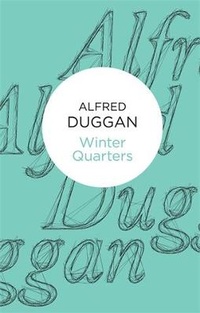
Winter Quarters
Published on 18. October 2012
Book
Paperback/Softback
226 pages
978-1-4472-3206-3 (ISBN)
Description
Camul and Acco are young noble Gauls of the Pyrenees, content to accept Roman occupation for the benefits it brings, but fiercely proud of their superior civilisation. Until Acco brings on himself the curse of the Goddess, and the two are forced to escape her by joining the Roman army.
From Julius Caesar's campaigns on the Rhine to Rome, Greece, and finally the Empire's eastern rim in the steppes of Russia, Camul recounts their adventures and mishaps, their impressions of the different customs, cults and cultures they meet, with an idealistic but also pragmatic tone. But the Goddess dogs them in every land except Judaea, and when Acco finally succumbs to her vengeance, Camul has to make his own pact with the gods - and goddesses - to survive . . .
`Covers a remarkable amount of ground, and covers it convincingly' Sunday Times
`Few novelists can touch Alfred Duggan when it comes to re-creating remote corners of historical time and place' Guardian
From Julius Caesar's campaigns on the Rhine to Rome, Greece, and finally the Empire's eastern rim in the steppes of Russia, Camul recounts their adventures and mishaps, their impressions of the different customs, cults and cultures they meet, with an idealistic but also pragmatic tone. But the Goddess dogs them in every land except Judaea, and when Acco finally succumbs to her vengeance, Camul has to make his own pact with the gods - and goddesses - to survive . . .
`Covers a remarkable amount of ground, and covers it convincingly' Sunday Times
`Few novelists can touch Alfred Duggan when it comes to re-creating remote corners of historical time and place' Guardian
More details
Language
English
Place of publication
London
United Kingdom
Publishing group
Pan Macmillan
Target group
Interest Age: From 18 years
Product notice
Paperback (UK-trade)
Dimensions
Height: 234 mm
Width: 156 mm
Thickness: 13 mm
Weight
354 gr
ISBN-13
978-1-4472-3206-3 (9781447232063)
Copyright in bibliographic data and cover images is held by Nielsen Book Services Limited or by the publishers or by their respective licensors: all rights reserved.
Schweitzer Classification
Person
Historian, archaeologist and novelist Alfred Duggan wrote historical fiction and non-fiction about a wide range of subjects, in places and times as diverse as Julius Caesar's Rome and the Medieval Europe of Thomas Becket.
Although he was born in Argentina, Duggan grew up in England, and was educated at Eton and Balliol College, Oxford. After Oxford, he travelled extensively through Greece and Turkey, visiting almost all the sites later mentioned in his books. In 1935 helped excavate Constantine's palace in Istanbul.
Duggan came to writing fiction quite late in his life: his first novel about the First Crusade, Knight in Armour, was published in 1950, after which he published at least a book every year until his death in 1964. His fictional works were bestselling page-turners, but thoroughly grounded in meticulous research informed by Duggan's experience as an archaeologist and historian.
Duggan has been favourably compared to Bernard Cornwell as well as being praised in his own right as 'an extremely gifted writer who can move into an unknown period and give it life and immediacy.' (New York Times).
Although he was born in Argentina, Duggan grew up in England, and was educated at Eton and Balliol College, Oxford. After Oxford, he travelled extensively through Greece and Turkey, visiting almost all the sites later mentioned in his books. In 1935 helped excavate Constantine's palace in Istanbul.
Duggan came to writing fiction quite late in his life: his first novel about the First Crusade, Knight in Armour, was published in 1950, after which he published at least a book every year until his death in 1964. His fictional works were bestselling page-turners, but thoroughly grounded in meticulous research informed by Duggan's experience as an archaeologist and historian.
Duggan has been favourably compared to Bernard Cornwell as well as being praised in his own right as 'an extremely gifted writer who can move into an unknown period and give it life and immediacy.' (New York Times).