

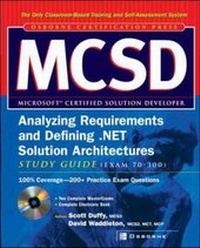
MCSD Analyzing Requirements and Defining .NET Solutions Architectures Study Guide (Exam 70-300
2nd Edition
Published on 27. June 2003
Book
Mixed media product
528 pages
978-0-07-212586-3 (ISBN)
Description
This is the only classroom-based training and self-assessment system! Osborne's "MCSD Visual Basic .NET Web Applications Study Guide" provides 100 per cent complete coverage of all objectives for exam 70-305. Based on 300,000+ hours of IT training experience, the book contains hundreds of practice exam questions and hands-on exercises. The CD-ROM features full practice exam software with interactive tutorials and lab simulations, plus an adaptive test engine.
Reviews / Votes
"...learning.NET will provide you with solid tools for developing applications for at least the next couple of releases of Windows." ---Mike Gunderloy, MCP MagazineMore details
Series
Edition
2nd Revised edition
Language
English
Place of publication
New York
United States
Publishing group
McGraw-Hill Education - Europe
Target group
Professional and scholarly
Edition type
Revised edition
Illustrations
150 Illustrations
Dimensions
Height: 226 mm
Width: 183 mm
Thickness: 36 mm
Weight
899 gr
ISBN-13
978-0-07-212586-3 (9780072125863)
Copyright in bibliographic data and cover images is held by Nielsen Book Services Limited or by the publishers or by their respective licensors: all rights reserved.
Schweitzer Classification
Persons
Larry Chambers (Winnipeg, Ontario) is a Senior Infrastructure Specialist for EDS Bluesphere - Canada, E.solutions, EDS. He has contributed to several certification books including: McGraw-Hill/Osborne's MCAD/MCSD Visual Basic[registered].NET[trademark] Windows[registered] Applications Study Guide (Exam 70-306), MCSE Training Guide (70-216): Installing and Administering Windows 2000 Network Infrastructure from NRP, and a forthcoming title focused on the 70-218 exams, also from NRP.
Content
Part I: Determining a Solution 1: Understanding the .NET Framework 2: Visualizing the Solution 3: Gathering and Analyzing Business and User Requirements 4: Formalizing Business Requirements into Functional Specifications Part II: Designing the Solution 5: An Overview of Object Role Modeling 6: Conceptual Design 7: Logical Design 8: Physical Design 9: Developing Standards for Your Solution Part III: Appendixes A: About the CD-ROM B: Exam 70-300 Objective Mapping Document