

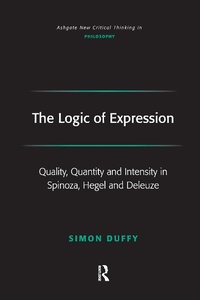
The Logic of Expression
Quality, Quantity and Intensity in Spinoza, Hegel and Deleuze
1st Edition
Published on 30. November 2016
Book
Paperback/Softback
296 pages
978-1-138-27777-9 (ISBN)
Description
Engaging with the challenging and controversial reading of Spinoza presented by Gilles Deleuze in Expressionism in Philosophy (1968), this book focuses on Deleuze's redeployment of Spinozist concepts within the context of his own philosophical project of constructing a philosophy of difference as an alternative to the Hegelian dialectical philosophy. Duffy demonstrates that a thorough understanding of Deleuze's Spinozism is necessary in order to fully engage with Deleuze's philosophy of difference.
Reviews / Votes
'Simon Duffy's book is an outstanding study of Gilles Deleuze's interpretation of Spinoza. Its guiding thread is the "logic of expression" that Deleuze extracts from Spinoza, and which plays an important role in Deleuze's own philosophy of difference. Along the way, however, Duffy examines an impressively wide array of critical topics, including Hegel's (mis)reading of Spinoza, the problem of the infinite and the metaphysics of the differential calculus, the theory of distinctions, Deleuze's "intensive" conception of modal existence, Duns Scotus' doctrine of univocity, and Deleuze's relation to other French commentators such as Pierre Macherey and Martial Gueroult. This is a rich and erudite work that will repay many re-readings. Highly recommended.' Daniel W. Smith, Department of Philosophy, Purdue University, USA 'This is a remarkable book, written with clarity and elegance on a difficult subject. It demonstrates the centrality of Spinoza in the construction of Deleuze's philosophy and, conversely, the necessity of a Deleuzian concept of "difference" in order to understand the originality of Spinoza's ontology. In the end we realize that, through these symmetric readings, Simon Duffy has himself contributed to the formulation of a "speculative logic" of quantities and intensities, that bridges the gap between a mathematics of variations and an ethics of individual powers. With this interpretation Duffy will establish his reputation as a major participant in contemporary philosophical debates.' Etienne Balibar, Emeritus Professor of Philosophy, University of Nanterre 'This book is an important contribution to the understanding of the philosophies of Deleuze and Spinoza. Simon Duffy displays an impressive mastery of material drawn from the history of mathematics and the history of philosophy in providing a rigorous and informative account of the nature and sources of Deleuze's differential logic. He shows how this logic informs Deleuze's reconstruction of Spinoza's metaphysics in Expressionism in Philosophy: Spinoza and how it differs from that of Hegel. This is essential reading for anyone interested in the metaphysics of difference.' Professor Paul Patton, University of New South Wales, Sydney, AustraliaMore details
Series
Language
English
Place of publication
London
United Kingdom
Publishing group
Taylor & Francis Ltd
Target group
College/higher education
Product notice
Paperback (trade)
Unsewn / adhesive bound
Dimensions
Height: 232 mm
Width: 155 mm
Thickness: 17 mm
Weight
440 gr
ISBN-13
978-1-138-27777-9 (9781138277779)
Copyright in bibliographic data and cover images is held by Nielsen Book Services Limited or by the publishers or by their respective licensors: all rights reserved.
Schweitzer Classification
Other editions
Additional editions
E-Book
12/2016
Routledge
€68.49
Available for download
E-Book
12/2016
Routledge
€68.49
Available for download
Book
10/2006
1st Edition
Routledge
€222.84
Shipment within 10-20 days
Person
Simon Duffy is Lecturer in Philosophy, Department of Philosophy, University of Sydney, Australia.
Content
Contents: Introduction: Spinoza and the problem of expression; Spinoza from the point of view of an idealist or a materialist dialectic; The differential point of view of the infinitesimal calculus; The metaphysics of the calculus: extensive quantity; From Scotist univocity to Spinozist immanence: intensive quantity; The distinction between intensive and extensive parts; Spinoza's theory of relations; The transformation of the characteristic relations of modal existence; The mechanics of joyful passive affections; The distinction between the duration of a finite existing mode and its eternity; The logic of expression and the construction of a philosophy of difference; Conclusion: expressionism in philosophy; Bibliography; Index.