

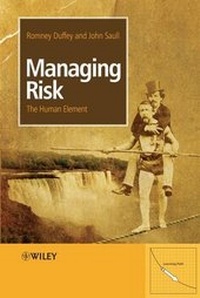
Managing Risk
The Human Element
Published on 17. October 2008
Book
Hardback
568 pages
978-0-470-69976-8 (ISBN)
Description
The human element is the principle cause of incidents and accidents in all technology industries; hence it is evident that an understanding of the interaction between humans and technology is crucial to the effective management of risk. Despite this, no tested model that explicitly and quantitatively includes the human element in risk prediction is currently available.
Managing Risk: the Human Element combines descriptive and explanatory text with theoretical and mathematical analysis, offering important new concepts that can be used to improve the management of risk, trend analysis and prediction, and hence affect the accident rate in technological industries. It uses examples of major accidents to identify common causal factors, or "echoes", and argues that the use of specific experience parameters for each particular industry is vital to achieving a minimum error rate as defined by mathematical prediction. New ideas for the perception, calculation and prediction of risk are introduced, and safety management is covered in depth, including for rare events and "unknown" outcomes
* Discusses applications to multiple industries including nuclear, aviation, medical, shipping, chemical, industrial, railway, offshore oil and gas;
* Shows consistency between learning for large systems and technologies with the psychological models of learning from error correction at the personal level;
* Offers the expertise of key leading industry figures involved in safety work in the civil aviation and nuclear engineering industries;
* Incorporates numerous fascinating case studies of key technological accidents.
Managing Risk: the Human Element is an essential read for professional safety experts, human reliability experts and engineers in all technological industries, as well as risk analysts, corporate managers and statistical analysts. It is also of interest to professors, researchers and postgraduate students of reliability and safety engineering, and to experts in human performance.
".congratulations on what appears to be, at a high level of review, a significant contribution to the literature.I have found much to be admired in (your) research"
Mr. Joseph Fragola - Vice President of Valador Inc.
"The book is not only technically informative, but also attractive to all concerned readers and easy to be comprehended at various level of educational background. It is truly an excellent book ever written for the safety risk managers and analysis professionals in the engineering community, especially in the high reliability organizations."
Dr Feng Hsu, Head of Risk Assessment and Management, NASA Goddard Space Flight Center
"I admire your courage in confronting your theoretical ideas with such diverse, ecologically valid data, and your success in capturing a major trend in them.I should add that I find all this quite inspiring.The idea that you need to find the right measure of accumulated experience and not just routinely used calendar time makes so much sense that it comes as a shock to realize that this is a new idea",
Professor Stellan Ohlsson, Professor of Psychology, University of Illinois at Chicago
Reviews / Votes
"An excellently produced book with over 500 pages of detailed information on the management of risk and the avoidance of accidents." (AMEC, November 2008)More details
Product info
gebunden
Edition
1. Auflage
Language
English
Place of publication
New York
United States
Target group
Professional and scholarly
Product notice
sewn/stitched
Cloth over boards
Dimensions
Height: 250 mm
Width: 175 mm
Thickness: 35 mm
Weight
1162 gr
ISBN-13
978-0-470-69976-8 (9780470699768)
Schweitzer Classification
Other editions
Additional editions
E-Book
09/2008
Wiley
€147.99
Available for download
Persons
Romney B. Duffey, Principal Scientist, Research and Product Development, Chalk River, Atomic Energy of Canada Ltd.
Romney B. Duffey is a leading expert in commercial nuclear reactors and is active in global environmental and energy studies and in advanced system design. He is currently Principal Scientist for AECL (Canada), having previously held a number of leadership roles within the US utility industry and in government laboratories and programs. He is a past chair of the American Society of Engineers' Nuclear Engineering Division, and the American Nuclear Society's Thermal Hydraulics Division. He has authored over 200 papers and articles.
John W. Saull, Executive Director, International Federation of Airworthiness, UK.
John W. Saull is an internationally renowned aeronautical engineer with over 45 years' experience in commercial aircraft certification, manufacturing, maintenance, personnel licensing and flight operations, and is a leading expert in safety management and human error. He is currently Executive Director of the International Federation of Airworthiness, having retired from his position as Chief Surveyor and Head of Operating Standards at the Civil Aviation Authority in 1996. He is currently a member of a number of international safety committees dealing with maintenance and human factors, and continues to be involved in organizing air safety conferences and chairing technical sessions.
Romney B. Duffey is a leading expert in commercial nuclear reactors and is active in global environmental and energy studies and in advanced system design. He is currently Principal Scientist for AECL (Canada), having previously held a number of leadership roles within the US utility industry and in government laboratories and programs. He is a past chair of the American Society of Engineers' Nuclear Engineering Division, and the American Nuclear Society's Thermal Hydraulics Division. He has authored over 200 papers and articles.
John W. Saull, Executive Director, International Federation of Airworthiness, UK.
John W. Saull is an internationally renowned aeronautical engineer with over 45 years' experience in commercial aircraft certification, manufacturing, maintenance, personnel licensing and flight operations, and is a leading expert in safety management and human error. He is currently Executive Director of the International Federation of Airworthiness, having retired from his position as Chief Surveyor and Head of Operating Standards at the Civil Aviation Authority in 1996. He is currently a member of a number of international safety committees dealing with maintenance and human factors, and continues to be involved in organizing air safety conferences and chairing technical sessions.
Content
Contents
About the Authors
Preface
Acknowledgements
Defi nitions of Risk and Risk Management
Introduction
1 The Universal Learning Curve
2 The Four Echoes
3 Predicting Rocket Risks and Refi nery Explosions: Near Misses, Shuttles, Safety and Anti-Missile Defence Systems Effectiveness
4 The Probability of Human Error: Learning in Technological Systems
5 Eliminating Mistakes: The Concept of Error States
6 Risk Assessment: Dynamic Events and Financial Risks
7 Safety and Risk Management Systems: the Fifth Echoes
8 Risk Perception: Searching for the Truth Among all the Numbers
9 I Must Be Learning
Appendices:
Appendix A: The 'Human Bathtub': Predicting the Future Risk
Appendix B: The Most Risk, or Maximum Likelihood, for the Outcome (Failure or Error) Rate while Learning
Appendix C: Transcripts of the Four Echoes
Appendix D: The Four Phases: Fuel Leak Leading to Gliding a Jet in to Land without any Engine Power
Appendix E: The Four Phases of a Midair Collision
Appendix F: Risk From the Number of Outcomes We Observe: How Many Are There?
Appendix G: Mixing in a Tank: The D.D. Williamson Vessel Explosion
Appendix H: Never Happening Again
Appendix I: A Heuristic Organisational Risk Stability Criterion
Appendix J: New Laws of Practice for Learning and Error Correction
Appendix K: Predicting Rocket Launch Reliability - Case Study
Index