

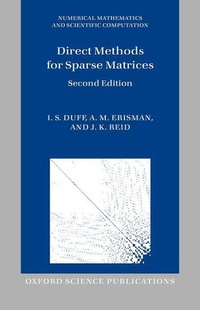
Direct Methods for Sparse Matrices
2nd Edition
Published on 26. January 2017
Book
Hardback
450 pages
978-0-19-850838-0 (ISBN)
Description
The subject of sparse matrices has its root in such diverse fields as management science, power systems analysis, surveying, circuit theory, and structural analysis. Efficient use of sparsity is a key to solving large problems in many fields.
This second edition is a complete rewrite of the first edition published 30 years ago. Much has changed since that time. Problems have grown greatly in size and complexity; nearly all examples in the first edition were of order less than 5,000 in the first edition, and are often more than a million in the second edition. Computer architectures are now much more complex, requiring new ways of adapting algorithms to parallel environments with memory hierarchies. Because the area is such an important one to all of computational science and engineering, a huge amount of research has been done in the last 30 years, some of it by the authors themselves. This new research is integrated into the text with a clear explanation of the underlying mathematics and algorithms.
New research that is described includes new techniques for scaling and error control, new orderings, new combinatorial techniques for partitioning both symmetric and unsymmetric problems, and a detailed description of the multifrontal approach to solving systems that was pioneered by the research of the authors and colleagues. This includes a discussion of techniques for exploiting parallel architectures and new work for indefinite and unsymmetric systems.
This second edition is a complete rewrite of the first edition published 30 years ago. Much has changed since that time. Problems have grown greatly in size and complexity; nearly all examples in the first edition were of order less than 5,000 in the first edition, and are often more than a million in the second edition. Computer architectures are now much more complex, requiring new ways of adapting algorithms to parallel environments with memory hierarchies. Because the area is such an important one to all of computational science and engineering, a huge amount of research has been done in the last 30 years, some of it by the authors themselves. This new research is integrated into the text with a clear explanation of the underlying mathematics and algorithms.
New research that is described includes new techniques for scaling and error control, new orderings, new combinatorial techniques for partitioning both symmetric and unsymmetric problems, and a detailed description of the multifrontal approach to solving systems that was pioneered by the research of the authors and colleagues. This includes a discussion of techniques for exploiting parallel architectures and new work for indefinite and unsymmetric systems.
Reviews / Votes
This is a thorough and thoughtful revision of a classic text, bringing it up to date with respect to subsequent developments in the field whilst retaining the qualities of the first edition. * James Andrew J. Hall, Mathematical Reviews * [T]his book is a well written and authoritative reference that should be of interest to anyone involved in the implementation of sparse LU factorization software * Brian Borchers, MAA Reviews *More details
Series
Edition
2nd Revised edition
Language
English
Place of publication
Oxford
United Kingdom
Target group
College/higher education
Edition type
Revised edition
Dimensions
Height: 240 mm
Width: 161 mm
Thickness: 29 mm
Weight
837 gr
ISBN-13
978-0-19-850838-0 (9780198508380)
Copyright in bibliographic data and cover images is held by Nielsen Book Services Limited or by the publishers or by their respective licensors: all rights reserved.
Schweitzer Classification
Other editions
Additional editions
I. S. Duff | A. M. Erisman | J. K. Reid
Direct Methods for Sparse Matrices
E-Book
03/2017
2nd Edition
OUP eBook
€100.99
Available for download
I. S. Duff | A. M. Erisman | J. K. Reid
Direct Methods for Sparse Matrices
E-Book
02/2017
2nd Edition
OUP eBook
€100.99
Available for download
Persons
I. S. (Iain) Duff is an STFC Senior Fellow in the Scientific Computing Department at the STFC Rutherford Appleton Laboratory in Oxfordshire, England. He is also the Scientific Advisor for the Parallel Algorithms Group at CERFACS in Toulouse and is a Visiting Professor of Mathematics at the University of Strathclyde.
J. K. (John) Reid is an Honorary Scientist at the STFC Rutherford Appleton Laboratory in Oxfordshire, England. He is also a Visiting Professor at the Shrivenham Campus of Cranfield University and is Convener of the ISO/IEC Fortran Committee.
A. M. (Al) Erisman is the Executive in Residence in the School of Business, Government, and Economics at Seattle Pacific University and is executive editor of Ethix magazine (), which he co-founded with a colleague in 1998. Over the past 15 years he has lectured on five continents in areas of business, technology, mathematics, ethics, faith, and economic development.
J. K. (John) Reid is an Honorary Scientist at the STFC Rutherford Appleton Laboratory in Oxfordshire, England. He is also a Visiting Professor at the Shrivenham Campus of Cranfield University and is Convener of the ISO/IEC Fortran Committee.
A. M. (Al) Erisman is the Executive in Residence in the School of Business, Government, and Economics at Seattle Pacific University and is executive editor of Ethix magazine (), which he co-founded with a colleague in 1998. Over the past 15 years he has lectured on five continents in areas of business, technology, mathematics, ethics, faith, and economic development.
Content
1: Introduction
2: Sparse matrices: storage schemes and simple operations
3: Gaussian elimination for dense matrices: the algebraic problem
4: Gaussian elimination for dense matrices: numerical considerations
5: Gaussian elimination for sparse matrices: an introduction
6: Reduction to block triangular form
7: Local pivotal strategies for sparse matrices
8: Ordering sparse matrices for band solution
9: Orderings based on dissection
10: Implementing Gaussian elimination without symbolic factorize
11: Implementing Gaussian elimination with symbolic factorize
12: Gaussian elimination using trees
13: Graphs for symmetric and unsymmetric matrices
14: The SOLVE phase
15: Other sparsity-oriented issues
A: Matrix and vector norms
B: Pictures of sparse matrices
C: Solutions to selected exercises
2: Sparse matrices: storage schemes and simple operations
3: Gaussian elimination for dense matrices: the algebraic problem
4: Gaussian elimination for dense matrices: numerical considerations
5: Gaussian elimination for sparse matrices: an introduction
6: Reduction to block triangular form
7: Local pivotal strategies for sparse matrices
8: Ordering sparse matrices for band solution
9: Orderings based on dissection
10: Implementing Gaussian elimination without symbolic factorize
11: Implementing Gaussian elimination with symbolic factorize
12: Gaussian elimination using trees
13: Graphs for symmetric and unsymmetric matrices
14: The SOLVE phase
15: Other sparsity-oriented issues
A: Matrix and vector norms
B: Pictures of sparse matrices
C: Solutions to selected exercises