

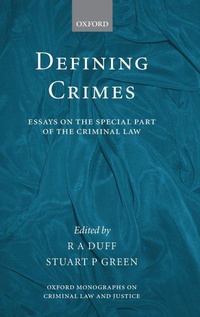
Defining Crimes
Essays on The Special Part of the Criminal Law
Published on 25. August 2005
Book
Hardback
272 pages
978-0-19-926922-8 (ISBN)
Description
This collection of original essays, by some of the best known contemporary criminal law theorists, tackles a range of issues about the criminal law's 'special part' - the part of the criminal law that defines specific offences. One of its aims is to show the importance, for theory as well as for practice, of focusing on the special part as well as on the general part which usually receives much more theoretical attention.
Some of the issues covered concern the proper scope of the criminal law, for example how far should it include offences of possession, or endangerment? If it should punish only wrongful conduct, how can it justly include so-called 'mala prohibita', which are often said to involve conduct that is not wrongful prior to its legal prohibition? Other issues concern the ways in which crimes should be classified. Can we make plausible sense, for instance, of the orthodox distinction between crimes of basic and general intent? Should domestic violence be defined as a distinct offence, distinguished from other kinds of personal violence?
Also examined are the ways in which specific offences should be defined, to what extent those definitions should identify distinctive types of wrongs, and the light that such definitional questions throw on the grounds and structures of criminal liability. Such issues are discussed in relation not only to such crimes as murder, rape, theft and other property offences, but also in relation to offences such as bribery, endangerment and possession that have not traditionally been subjects for in depth theoretical analysis.
Some of the issues covered concern the proper scope of the criminal law, for example how far should it include offences of possession, or endangerment? If it should punish only wrongful conduct, how can it justly include so-called 'mala prohibita', which are often said to involve conduct that is not wrongful prior to its legal prohibition? Other issues concern the ways in which crimes should be classified. Can we make plausible sense, for instance, of the orthodox distinction between crimes of basic and general intent? Should domestic violence be defined as a distinct offence, distinguished from other kinds of personal violence?
Also examined are the ways in which specific offences should be defined, to what extent those definitions should identify distinctive types of wrongs, and the light that such definitional questions throw on the grounds and structures of criminal liability. Such issues are discussed in relation not only to such crimes as murder, rape, theft and other property offences, but also in relation to offences such as bribery, endangerment and possession that have not traditionally been subjects for in depth theoretical analysis.
Reviews / Votes
This book..constitutes a welcome and timely contribution to what is undoubtedly a growing interest in this field * The British Journal of Criminology *More details
Series
Language
English
Place of publication
Oxford
United Kingdom
Target group
Professional and scholarly
Primary readership: academics, postgraduate and higher level undergraduate students, in criminal law and legal philosophy. Secondary readership: academics in criminology, judges, practitioners.
Dimensions
Height: 240 mm
Width: 161 mm
Thickness: 19 mm
Weight
570 gr
ISBN-13
978-0-19-926922-8 (9780199269228)
Copyright in bibliographic data and cover images is held by Nielsen Book Services Limited or by the publishers or by their respective licensors: all rights reserved.
Schweitzer Classification
Persons
Professor R.A. Duff, Department of Philosophy, University of Stirling
Educated at Oxford; after a year at University of Washington, Seattle, has taught at Stirling since 1970.
British Academy Research Readership 1989-91; Leverhulme Senior Research Fellowship 2002-05; FRSE 1996, FBA 2004
Professor Stuart P. Green, Louis B Porterie Professor of Law, Louisiana State University
Graduate of Yale Law School; has taught at Louisiana State University since 1995. Fulbright Distinguished Scholar in U.K. 2002-03.
Educated at Oxford; after a year at University of Washington, Seattle, has taught at Stirling since 1970.
British Academy Research Readership 1989-91; Leverhulme Senior Research Fellowship 2002-05; FRSE 1996, FBA 2004
Professor Stuart P. Green, Louis B Porterie Professor of Law, Louisiana State University
Graduate of Yale Law School; has taught at Louisiana State University since 1995. Fulbright Distinguished Scholar in U.K. 2002-03.
Content
1. Introduction: Defining Crimes ; 2. The Classification of Crimes and the Special Part of the Criminal Law ; 3. Criminalizing Endangerment ; 4. Malum Prohibitum and Retributivism ; 5. The Possession Paradigm: The Special Part and the Police Power Model of the Criminal Process ; 6. The Distinctiveness of Domestic Violence: a Freedom Based Account ; 7. What's Wrong with Bribery ; 8. On the Nature and Rationale of Property Offences ; 9. Is Strict Liability Rape Defensible? ; 10. Merger and Felony Murder