

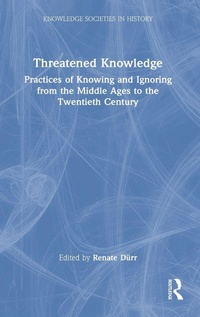
Threatened Knowledge
Practices of Knowing and Ignoring from the Middle Ages to the Twentieth Century
1st Edition
Published on 24. September 2021
Book
Hardback
250 pages
978-0-367-52323-7 (ISBN)
Description
Threatened Knowledge discusses the practices of knowing, not-knowing, and not wanting to know from the Middle Ages to the twentieth century.
In times of "fake news", processes of forgetting and practices of non-knowledge have sparked the interest of historical and sociological research. The common ground between all the contributions in this volume is the assumption that knowledge does not simply increase over time and thus supplant phases of not-knowing. Moreover, the contributions show that knowing and not-knowing function in very similar ways, which means they can be analysed along similar methodological lines. Given the implied juxtaposition between emotions and rational thinking, the role of emotions in the process of knowledge production has often been trivialized in more traditional approaches to the subject. Through a broad geographical and chronological approach, spanning from prognostic texts in the Carolingian period to stock market speculation in early-twentieth-century United States, this volume demonstrates the important role of emotions in the history of science.
By bringing together cultural historians of knowledge, emotions, finance, and global intellectual history, Threatened Knowledge is a useful tool for all students and scholars of the history of knowledge and science on a global scale.
In times of "fake news", processes of forgetting and practices of non-knowledge have sparked the interest of historical and sociological research. The common ground between all the contributions in this volume is the assumption that knowledge does not simply increase over time and thus supplant phases of not-knowing. Moreover, the contributions show that knowing and not-knowing function in very similar ways, which means they can be analysed along similar methodological lines. Given the implied juxtaposition between emotions and rational thinking, the role of emotions in the process of knowledge production has often been trivialized in more traditional approaches to the subject. Through a broad geographical and chronological approach, spanning from prognostic texts in the Carolingian period to stock market speculation in early-twentieth-century United States, this volume demonstrates the important role of emotions in the history of science.
By bringing together cultural historians of knowledge, emotions, finance, and global intellectual history, Threatened Knowledge is a useful tool for all students and scholars of the history of knowledge and science on a global scale.
More details
Series
Language
English
Place of publication
London
United Kingdom
Publishing group
Taylor & Francis Ltd
Target group
College/higher education
Illustrations
20 s/w Abbildungen, 19 s/w Photographien bzw. Rasterbilder, 1 s/w Zeichnung, 1 s/w Tabelle
1 Tables, black and white; 1 Line drawings, black and white; 19 Halftones, black and white; 20 Illustrations, black and white
Dimensions
Height: 240 mm
Width: 161 mm
Thickness: 19 mm
Weight
570 gr
ISBN-13
978-0-367-52323-7 (9780367523237)
Copyright in bibliographic data and cover images is held by Nielsen Book Services Limited or by the publishers or by their respective licensors: all rights reserved.
Schweitzer Classification
Other editions
Additional editions
Renate Duerr
Threatened Knowledge
Practices of Knowing and Ignoring from the Middle Ages to the Twentieth Century
Book
09/2021
1st Edition
Routledge
€61.40
Shipment within 15-20 days
Renate Duerr
Threatened Knowledge
Practices of Knowing and Ignoring from the Middle Ages to the Twentieth Century
E-Book
09/2021
1st Edition
Routledge
€53.99
Available for download
Renate Duerr
Threatened Knowledge
Practices of Knowing and Ignoring from the Middle Ages to the Twentieth Century
E-Book
09/2021
1st Edition
Routledge
€53.99
Available for download
Person
Renate Duerr is Professor of Early Modern History at the University of Tuebingen. Her research focuses on Jesuit missions within the context of global history and the history of knowledge. Together with Ulrike Strasser (San Diego) she is currently writing a monograph De-centering the Enlightenment: Global Knowledge, Emotions, and Jesuit Practices in a German Cultural Encyclopedia.
Content
1. Introduction: Practices of Knowing and Ignoring from the Middle Ages to the Twentieth Century Part 1: Negotiating Uncertainties and the Reliability of Knowledge 2. What (not) to Read in Times of Crises. Responses to the First Index of Banned Books (c.500 to c.1100) 3. Precarious knowledge and the Problem of Reliability: the case of prognostic texts in the Carolingian period 4. "Doubt all before you believe anything": Stock Market Speculation in the Early Twentieth Century United States Part 2: Creating and Misunderstanding References 5. Knowledge and Violence in a Society Under Stress: Death Penalty Under Charles the Bald (843-877) 6. Global Encounters - Precarious Knowledge: Traces of Alchemical Practice in Indonesian Batavia 7. Biculturalism, Multiculturalism and Indigeneity as a Strategy of Memoria. Canada and Australia Defining Themselves in Times of Threat Part 3: Knowing and Ignoring as Reciprocal Answers 8. Rhetoric and Divination in Erasmus's Edition of Jerome: Ancient and Modern Ways to Save Dangerous, Vulnerable Texts 9. "Ignorance is power, as well as joy": Trying to Manage Information in turn-of-the century America 10. Corresponding Knowledge: Arguments about Emotions and Entertainment in Berlin and Cairo around 1900