

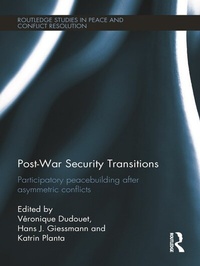
Post-War Security Transitions
Participatory Peacebuilding after Asymmetric Conflicts
1st Edition
Published on 27. January 2012
Book
Hardback
304 pages
978-0-415-68080-6 (ISBN)
Description
This book explores the conditions under which non-state armed groups (NSAGs) participate in post-war security and political governance.
The text offers a comprehensive approach to post-war security transition processes based on five years of participatory research with local experts and representatives of former non-state armed groups. It analyses the successes and limits of peace negotiations, demobilisation, arms management, political or security sector integration, socio-economic reintegration and state reform from the direct point of view of conflict stakeholders who have been central participants in ongoing and past peacebuilding processes.
Challenging common perceptions of ex-combatants as "spoilers" or "passive recipients of aid", the various contributors examine the post-war transitions of these individuals from state challengers to peacebuilding agents. The book concludes on a cross-country comparative analysis of the main research findings and the ways in which they may facilitate a participatory, inclusive and gender-sensitive peacebuilding strategy.
Post-War Security Transitions will be of much interest to students of peacebuilding, security governance, war and conflict studies, political violence and IR in general.
The text offers a comprehensive approach to post-war security transition processes based on five years of participatory research with local experts and representatives of former non-state armed groups. It analyses the successes and limits of peace negotiations, demobilisation, arms management, political or security sector integration, socio-economic reintegration and state reform from the direct point of view of conflict stakeholders who have been central participants in ongoing and past peacebuilding processes.
Challenging common perceptions of ex-combatants as "spoilers" or "passive recipients of aid", the various contributors examine the post-war transitions of these individuals from state challengers to peacebuilding agents. The book concludes on a cross-country comparative analysis of the main research findings and the ways in which they may facilitate a participatory, inclusive and gender-sensitive peacebuilding strategy.
Post-War Security Transitions will be of much interest to students of peacebuilding, security governance, war and conflict studies, political violence and IR in general.
More details
Series
Language
English
Place of publication
London
United Kingdom
Publishing group
Taylor & Francis Ltd
Target group
College/higher education
Illustrations
6 s/w Tabellen
6 Tables, black and white
Dimensions
Height: 234 mm
Width: 156 mm
Weight
720 gr
ISBN-13
978-0-415-68080-6 (9780415680806)
Copyright in bibliographic data and cover images is held by Nielsen Book Services Limited or by the publishers or by their respective licensors: all rights reserved.
Schweitzer Classification
Other editions
Additional editions
Uma Narula | W. Barnett Pearce
Post-War Security Transitions
Participatory Peacebuilding after Asymmetric Conflicts
E-Book
01/2012
1st Edition
Routledge
€60.49
Available for download
Uma Narula | W. Barnett Pearce
Post-War Security Transitions
Participatory Peacebuilding after Asymmetric Conflicts
E-Book
01/2012
1st Edition
Routledge
€60.49
Available for download
Persons
Veronique Dudouet is senior researcher at Berghof Conflict Research in Berlin. She obtained a PhD in conflict resolution at the University of Bradford, UK.
Hans J. Giessmann is the Director of Berghof Conflict Research in Berlin, and is the author of over 300 articles, books and essays.
Katrin Planta is research assistant at Berghof Conflict Research, and is currently preparing her PhD dissertation.
Hans J. Giessmann is the Director of Berghof Conflict Research in Berlin, and is the author of over 300 articles, books and essays.
Katrin Planta is research assistant at Berghof Conflict Research, and is currently preparing her PhD dissertation.
Content
General Introduction Part I: Security Transition Processes in Post-War Societies 1. DDR and SSR: Conventional Approaches to International Peacebuilding Assistance 2. Defecits and Blindspots in Existing Approaches to Post-War Security Promotion Part II: Colombia Introduction 3. The M19's Reinsertion Process: Challenges and Lessons Learnt Part III: South Africa Introduction 4. Political and Security Negogiations and Security Sector Transformation in South Africa 5. South Africa's Experience of Military Integration through Interactive Negogiation and Planning Part IV: El Salvador Introduction 6. The Guarantees of Security: The FMLN and the Salvadoran Peace Process Part V: Northern Ireland Introduction 7. Agents of Change- Ex-Prisoners, Ex-Combatants and Conflict Transformation in Northern Ireland Part VI: Kosovo Introduction 8. Demobilising and Integrating a Liberation Army in the Context of State Formation: Kosovo's Perspective on Security Transition Part VII: Burundi Introduction 9. The Process of Security Transition in Burundi: Challenges in Security Sector Reform and Combatant Integration Part VIII: Sudan Introduction 10. Linking DDR, Security Sector Development and Transitional Justice in Southern Sudan Part IX: Aceh Introduction 11. Guns, Soldiers and Votes: Lessons from the DDR Process in Aceh 12. The Reintegration of Ex-Combatants in Post-War Aceh: Remaining Challenges to a Gender-Blind Planning and Implementation Process Part X: Nepal Introduction 13. The Challenges of Security Sector Restructuring in Nepal 14. Challenges of Combatants' Rehabilititaion and Army Integration: Perspectives from Maoist Cantonments in Nepal Part XI: Comparative Analysis and Lessons Learnt 15. Security Transitions in Perspective Conclusion