

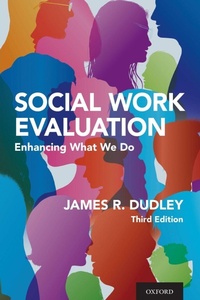
Social Work Evaluation
Enhancing What We Do
3rd Edition
Published on 5. June 2020
Book
Paperback/Softback
368 pages
978-0-19-091665-7 (ISBN)
Description
Social workers are increasingly faced with the demands of evaluating their own programs and practice to maintain accountability to funding agencies, secure funding, and remedy a number of social problems facing our society. One of the nine basic competencies required by the social work accreditation agency is to be able to conduct evaluations. Evaluation is a critical area of practice for demonstrating accountability to clients, communities, numerous other stakeholders, and funding and regulatory agencies.
Social Work Evaluation, Third Edition, offers a straightforward guide to a broad range of social work evaluations at both the program and practice levels. Author James R. Dudley's seven-step approach to evaluation makes use of qualitative, quantitative, and mixed research methods to provide oversight and address important issues at the planning, implementation, and outcome stages of a program or practice intervention. His unique focus on involving clients in the evaluation process ensures that social workers consistently improve their capacity to impact their clients' well-being and remain accountable to them and others they serve. Case examples from the extensive evaluation experience of the author and others illustrate a wide range of logic-based methods discussed throughout the text for real-world application. This comprehensive text effectively aims to enhance student and practitioner skill sets to meet these demands of a changing field.
Social Work Evaluation, Third Edition, offers a straightforward guide to a broad range of social work evaluations at both the program and practice levels. Author James R. Dudley's seven-step approach to evaluation makes use of qualitative, quantitative, and mixed research methods to provide oversight and address important issues at the planning, implementation, and outcome stages of a program or practice intervention. His unique focus on involving clients in the evaluation process ensures that social workers consistently improve their capacity to impact their clients' well-being and remain accountable to them and others they serve. Case examples from the extensive evaluation experience of the author and others illustrate a wide range of logic-based methods discussed throughout the text for real-world application. This comprehensive text effectively aims to enhance student and practitioner skill sets to meet these demands of a changing field.
Reviews / Votes
Dr. James Dudley offers a succinct and focused approach to helping students understand evaluation practice in social work. I can see in each chapter the author's obvious deep commitment to social work evaluation and social work education.-David P. Moxley, University of Alaska Anchorage The book is chock full of interesting and relevant case examples which bring life to the learning process. A good resource for both agency administrators and practitioners.
-Michael Cronin, Monmouth University
More details
Edition
3rd Revised edition
Language
English
Place of publication
New York
United States
Target group
Professional and scholarly
Edition type
Revised edition
Dimensions
Height: 234 mm
Width: 156 mm
Thickness: 20 mm
Weight
553 gr
ISBN-13
978-0-19-091665-7 (9780190916657)
Copyright in bibliographic data and cover images is held by Nielsen Book Services Limited or by the publishers or by their respective licensors: all rights reserved.
Schweitzer Classification
Person
James R. Dudley, Ph.D., MSW, LCSW, Professor Emeritus, School of Social Work, College of Health and Human Services, University of North Carolina at Charlotte
Content
Preface Acknowledgements Part I: Introduction
1 Evaluation and Social Work: Making the Connection Part II: Orientation to the Bigger Picture of Evaluations
2 The Influence of History and Varying Theoretical Views
3 The Role of Ethics in Evaluations
4 Common Types of Evaluations
5 Focusing an Evaluation Part III: The Planning or Input Stage
6 Needs Assessments 7 Crafting Goals and Objectives Part IV: The Implementation Stage
8 Improving How Programs and Practice Work Part V: The Outcome Stage
9 Is the Intervention Effective? Part VI: Final Steps in Completing an Evaluation
10 Analyzing Evaluation Data
11 Preparing and Disseminating a Report of Findings Part VII: Consuming Evaluation Reports
12 Becoming Critical Consumers of Evaluations Appendixes Index
1 Evaluation and Social Work: Making the Connection Part II: Orientation to the Bigger Picture of Evaluations
2 The Influence of History and Varying Theoretical Views
3 The Role of Ethics in Evaluations
4 Common Types of Evaluations
5 Focusing an Evaluation Part III: The Planning or Input Stage
6 Needs Assessments 7 Crafting Goals and Objectives Part IV: The Implementation Stage
8 Improving How Programs and Practice Work Part V: The Outcome Stage
9 Is the Intervention Effective? Part VI: Final Steps in Completing an Evaluation
10 Analyzing Evaluation Data
11 Preparing and Disseminating a Report of Findings Part VII: Consuming Evaluation Reports
12 Becoming Critical Consumers of Evaluations Appendixes Index