

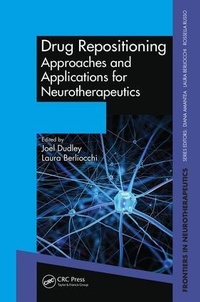
Drug Repositioning
Approaches and Applications for Neurotherapeutics
1st Edition
Published on 30. June 2017
Book
Hardback
313 pages
978-1-4822-2083-4 (ISBN)
Description
Nervous system diseases represent a major health concern worldwide. Although important financial and professional investment, their etiology and pathophysiology still remain mostly elusive. Moreover, the clinical need of disease-modifying therapies is still unmet.
In the last decades, traditional R&D has failed in identifying new effective therapies in many medical areas and drug repositioning has recently emerged as a promising alternative strategy to de novo drug discovery to improve and accelerate therapeutic development.
For the first time, Drug Repositioning: Approaches and Applications for Neurotherapeutics reviews history and advances in drug repositioning, with a special focus on therapeutics for nervous system diseases. International experts from Academia, Industry and Non-profit organisations will provide different views on drug repositioning advantages, challenges and specific applications, which will be covered for nervous system diseases including Alzheimer's, Parkinson's, Huntington's diseases, Amyotrophic Lateral Sclerosis, Spinal Muscular Atrophy, ischemic stroke, and psychiatric disorders.
This book provides a balanced overview and synthesis of drug repositioning concept, methods and applications for neurotherapeutics. It represents a valuable resource for students, scientists and clinicians working in academic settings, industry and government agencies within the fields of neuroscience, pharmacology, neurology, pharmaceutical sciences, drug discovery and development.
In the last decades, traditional R&D has failed in identifying new effective therapies in many medical areas and drug repositioning has recently emerged as a promising alternative strategy to de novo drug discovery to improve and accelerate therapeutic development.
For the first time, Drug Repositioning: Approaches and Applications for Neurotherapeutics reviews history and advances in drug repositioning, with a special focus on therapeutics for nervous system diseases. International experts from Academia, Industry and Non-profit organisations will provide different views on drug repositioning advantages, challenges and specific applications, which will be covered for nervous system diseases including Alzheimer's, Parkinson's, Huntington's diseases, Amyotrophic Lateral Sclerosis, Spinal Muscular Atrophy, ischemic stroke, and psychiatric disorders.
This book provides a balanced overview and synthesis of drug repositioning concept, methods and applications for neurotherapeutics. It represents a valuable resource for students, scientists and clinicians working in academic settings, industry and government agencies within the fields of neuroscience, pharmacology, neurology, pharmaceutical sciences, drug discovery and development.
Reviews / Votes
This excellent book is a must read for those interested in drug-repositioning and those involved in the hunt for new effective neurotherapeutics. The introductory sections of the book provide not only a clear explanation of the merits of repositioning but also an honest consideration of the difficulties of the approach. This is well illustrated by examples from the fields of Alzheimer's and Parkinson's describing successes and failures. Also introduced is the value of drug-repositioning to not-for profit organisations. Which adds to those who are involved in medical charity research to list of those who should read this publication. For the reader whose interest is piqued by the possibilities of drug repositioning and want to know more of the mechanics following chapters explore a variety of techniques that can be adopted for the identification of candidate repositioned therapies. Again, these an honest consideration with both pro and cons described. This makes the publication useful reading for any interested in repositioning irrespective of their field of interest.The latter sections focus on repositioning for a very diverse range of CNS conditions. These include Parkinson's, Alzheimer's, Huntingdon's, ALS, Spinal muscular atrophy and Ischaemic injury. For those with specific interests in any of the above this is a useful work. But in addition, I would recommend to those with a specific CNS disease interest reading the other chapters as they provide a potentially useful insight into methods and approaches than could be adopted within a specific interest.
Taken together this is valuable read and reference work for a diverse readership.
- Dr Alan Rothaul, Re-Pharm
Drug repositioning, also known as repurposing, seems an easy and straight forward route for the successful development of drugs. However, aspects of value creation and sound business cases are still essential, even if a drug has been fully or partly developed before.
Complexity is added to this situation by applying repurposing to the area of neurodegenerative diseases: pathogenesis of Parkinson's, Alzheimer's and other neurologic diseases of the higher ages are still poorly understood. Nevertheless, there is hope in repurposing even for this very difficult indication area, increasingly neglected by pharma companies due to extremely high development costs and numerous failures to successfully develop drugs.
Joel Dudley and Laura Berliocchi's book is disentangling the complexity and shows with many positive examples, that repurposing is possible, needs courage and attention to detail and sometimes also happens just by serendipity. Systematic approaches to drug repositioning, as well as funding mechanisms for repurposing projects and options to gain IP protection for existing drugs are comprehensively explained. Reading is highly recommended to newcomers in the field of therapy development for neurodegenerative indications as well as established scientists and medical doctors wishing to gain broad insight into the drug repositioning topic illustrated with plenty of case studies.
- Dr Bernadett Simon, PhD, RTTP, Head of Technology Transfer at DZNE, Bonn, Germany
More details
Series
Language
English
Place of publication
Bosa Roca
United States
Publishing group
Taylor & Francis Inc
Target group
College/higher education
Professional and scholarly
Academic and Professional Practice & Development
Product notice
sewn/stitched
Cloth over boards
Illustrations
30 s/w Abbildungen, 22 s/w Photographien bzw. Rasterbilder, 8 s/w Zeichnungen, 12 s/w Tabellen
12 Tables, black and white; 8 Line drawings, black and white; 22 Halftones, black and white; 30 Illustrations, black and white
Dimensions
Height: 229 mm
Width: 155 mm
Thickness: 23 mm
Weight
590 gr
ISBN-13
978-1-4822-2083-4 (9781482220834)
Copyright in bibliographic data and cover images is held by Nielsen Book Services Limited or by the publishers or by their respective licensors: all rights reserved.
Schweitzer Classification
Other editions
Additional editions
Book
12/2019
1st Edition
CRC Press
€111.50
Shipment within 15-20 days
E-Book
07/2017
1st Edition
CRC Press
€104.99
Available for download
E-Book
07/2017
CRC Press
€104.99
Available for download
Persons
Dr. Joel Dudley is associate professor of genetics and genomic sciences and director of biomedical informatics at Mount Sinai School of Medicine, New York (NY, USA).
Dr. Laura Berliocchi is associate professor of pharmacology at the Department of Health Sciences, Magna Graecia University (Catanzaro, Italy).
Dr. Laura Berliocchi is associate professor of pharmacology at the Department of Health Sciences, Magna Graecia University (Catanzaro, Italy).
Content
Section I The Rationale and Economics
of Drug Repositioning
Chapter 1 Scientific and Commercial Value of Drug Repurposing
David Cavalla
Chapter 2 Repurposing for Alzheimer's and Parkinson's Diseases: The
Ideas, the Pipeline, the Successes, and the Disappointments
Hermann Mucke
Chapter 3 Contribution of Not-for-Profit Organizations to Drug Repurposing
Bruce Bloom
Section II Repositioning Approaches and
Technologies: From Serendipity to
Systematic and Rational Strategies
Chapter 4 Systematic Drug Repositioning
Spyros N. Deftereos, Aris Persidis, Andreas Persidis,
Eftychia Lekka, Christos Andronis, and Vassilis Virvillis
Chapter 5 Technical Tools for Computational Drug Repositioning
Francesco Napolitano
Chapter 6 RNAi Screening toward Therapeutic Drug Repurposing
Nichole Orr-Burks, Byoung-Shik Shim, Olivia Perwitasari,
and Ralph A. Tripp
Chapter 7 Phenotypic Screening
Christine M. Macolino-Kane, John R. Ciallella,
Christopher A. Lipinski, and Andrew G. Reaume
Section III Drug Repositioning for
Nervous System Diseases
Chapter 8 A Case Study: Chlorpromazine
Francisco Lopez-Munoz, Cecilio Alamo,
and Silvia E. Garcia-Ramos
Chapter 9 Drug Repurposing for Central Nervous System Disorders: A
Pillar of New Drug Discovery
Mondher Toumi, Aleksandra Caban, Anna Kapusniak,
Szymon Jaroslawski, and Cecile Remuzat
Chapter 10 Repurposing Opportunities for Parkinson's Disease Therapies
Giulia Ambrosi, Silvia Cerri, and Fabio Blandini
Chapter 11 Drug Candidates for Repositioning in Alzheimer's Disease
Maria P. del Castillo-Frias and Andrew J. Doig
Chapter 12 Promising Candidates for Drug Repurposing in Huntington's
Disease
Francesca Romana Fusco and Emanuela Paldino
Chapter 13 Drug Repositioning Opportunities in Psychiatry
Alexander W. Charney, Joseph R. Scarpa, Douglas M. Ruderfer,
and Dennis S. Charney
Chapter 14 Pharmacology of Amyotrophic Lateral Sclerosis: Old Strategies
and New Perspectives
Tiziana Petrozziello, Valentina Tedeschi, Alba Esposito,
and Agnese Secondo
Chapter 15 Repositioning Clinic-Ready Compounds for the Treatment
of Spinal Muscular Atrophy
Faraz Farooq
Chapter 16 Rescuing Ischemic Brain Injury by Targeting the Immune
Response through Repositioned Drugs
Diana Amantea and Giacinto Bagetta
of Drug Repositioning
Chapter 1 Scientific and Commercial Value of Drug Repurposing
David Cavalla
Chapter 2 Repurposing for Alzheimer's and Parkinson's Diseases: The
Ideas, the Pipeline, the Successes, and the Disappointments
Hermann Mucke
Chapter 3 Contribution of Not-for-Profit Organizations to Drug Repurposing
Bruce Bloom
Section II Repositioning Approaches and
Technologies: From Serendipity to
Systematic and Rational Strategies
Chapter 4 Systematic Drug Repositioning
Spyros N. Deftereos, Aris Persidis, Andreas Persidis,
Eftychia Lekka, Christos Andronis, and Vassilis Virvillis
Chapter 5 Technical Tools for Computational Drug Repositioning
Francesco Napolitano
Chapter 6 RNAi Screening toward Therapeutic Drug Repurposing
Nichole Orr-Burks, Byoung-Shik Shim, Olivia Perwitasari,
and Ralph A. Tripp
Chapter 7 Phenotypic Screening
Christine M. Macolino-Kane, John R. Ciallella,
Christopher A. Lipinski, and Andrew G. Reaume
Section III Drug Repositioning for
Nervous System Diseases
Chapter 8 A Case Study: Chlorpromazine
Francisco Lopez-Munoz, Cecilio Alamo,
and Silvia E. Garcia-Ramos
Chapter 9 Drug Repurposing for Central Nervous System Disorders: A
Pillar of New Drug Discovery
Mondher Toumi, Aleksandra Caban, Anna Kapusniak,
Szymon Jaroslawski, and Cecile Remuzat
Chapter 10 Repurposing Opportunities for Parkinson's Disease Therapies
Giulia Ambrosi, Silvia Cerri, and Fabio Blandini
Chapter 11 Drug Candidates for Repositioning in Alzheimer's Disease
Maria P. del Castillo-Frias and Andrew J. Doig
Chapter 12 Promising Candidates for Drug Repurposing in Huntington's
Disease
Francesca Romana Fusco and Emanuela Paldino
Chapter 13 Drug Repositioning Opportunities in Psychiatry
Alexander W. Charney, Joseph R. Scarpa, Douglas M. Ruderfer,
and Dennis S. Charney
Chapter 14 Pharmacology of Amyotrophic Lateral Sclerosis: Old Strategies
and New Perspectives
Tiziana Petrozziello, Valentina Tedeschi, Alba Esposito,
and Agnese Secondo
Chapter 15 Repositioning Clinic-Ready Compounds for the Treatment
of Spinal Muscular Atrophy
Faraz Farooq
Chapter 16 Rescuing Ischemic Brain Injury by Targeting the Immune
Response through Repositioned Drugs
Diana Amantea and Giacinto Bagetta