

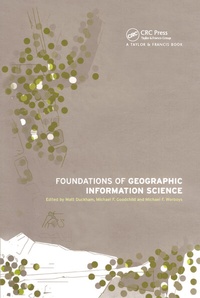
Foundations of Geographic Information Science
1st Edition
Published on 30. January 2003
Book
Hardback
268 pages
978-0-415-30726-0 (ISBN)
Description
As the use of geographical information systems develops apace, a significant strand of research activity is being directed to the fundamental nature of geographic information. This volume contains a collection of essays and discussions on this theme.
What is geographic information? What fundamental principles are associated with it? How can it be represented? How does it represent the world? How can geographic information be quantified? How can it be communicated and related to the other information sciences? How does HCI tie in with it? A number of other more specific but relevant issues are considered, such as Spatio-temporal relationships, boundaries, granularity and taxonomy.
This book is a revised and updated version of a collection of presentations given by a group of distinguished researchers in the field of Geographic Information Science who gathered in Manchester in July 2001. It should be useful for graduate students as well as researchers and high-level professionals.
What is geographic information? What fundamental principles are associated with it? How can it be represented? How does it represent the world? How can geographic information be quantified? How can it be communicated and related to the other information sciences? How does HCI tie in with it? A number of other more specific but relevant issues are considered, such as Spatio-temporal relationships, boundaries, granularity and taxonomy.
This book is a revised and updated version of a collection of presentations given by a group of distinguished researchers in the field of Geographic Information Science who gathered in Manchester in July 2001. It should be useful for graduate students as well as researchers and high-level professionals.
Reviews / Votes
'A well-crafted, authoritative volume with a coherent structure ... This volume is a useful review of GI science ten years from Goodchild's (1992) seminal paper ... The authors have posed challenging questions.' - Environment and Planning B, 2005 'A well-crafted, authoritative volume with a coherent structure ... This volume is a useful review of GI science ten years from Goodchild's (1992) seminal paper ... The authors have posed challenging questions.'- Environment and Planning B, 2005More details
Language
English
Place of publication
London
United Kingdom
Publishing group
Taylor & Francis Ltd
Target group
Professional and scholarly
Academic, Professional, and Professional Practice & Development
Dimensions
Height: 229 mm
Width: 152 mm
Weight
660 gr
ISBN-13
978-0-415-30726-0 (9780415307260)
Copyright in bibliographic data and cover images is held by Nielsen Book Services Limited or by the publishers or by their respective licensors: all rights reserved.
Schweitzer Classification
Other editions
Additional editions
Matt Duckham | Michael F. Goodchild | Michael Worboys
Foundations of Geographic Information Science
Book
12/2020
1st Edition
CRC Press
€95.90
Shipment within 15-20 days
Matt Duckham | Michael F. Goodchild | Michael Worboys
Foundations of Geographic Information Science
E-Book
01/2003
CRC Press
€88.49
Available for download
Matt Duckham | Michael F. Goodchild | Michael Worboys
Foundations of Geographic Information Science
E-Book
01/2003
1st Edition
CRC Press
€88.49
Available for download
Persons
Matt Duckham is a visiting researcher at the National Center for Geographic Information and Analysis, University of Maine, USA. He completed his PhD in spatial data quality at the University of Glasgow, UK, at the end of 1999, and worked for two years as a postdoctoral researcher at the University of Keele, UK. He is currently co-authoring, with Michael Worboys, the second edition of the text book Geographic Information Systems: A Computing Perspective.
Content
Geographic Information Science. The Nature and Value of Geographic Information. Communicating Geographic Information in Context. Pragmatic Information Content. Representational Commitment in Maps. Granularity in Change over Time. A Theory of Granular Partitions. On the Ontological Status of Geographical Boundaries. Regions in Geography. Neighborhoods and Landmarks. Geographical Terminology Servers. Placing Cultural Events and Documents. Geographic Activity Models.